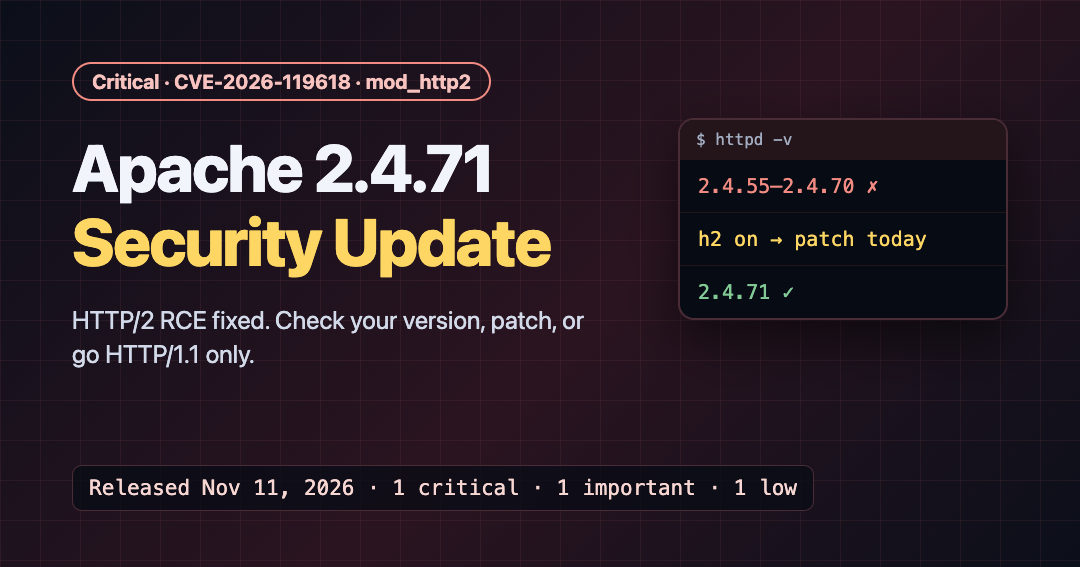
The Apache 2.4.71 security update, released on November 11, 2026, fixes a critical remote code execution bug in mod_http2 (CVE-2026-119618) plus two smaller flaws in mod_md and mod_vhost_alias. Every Apache HTTP Server from 2.4.55 through 2.4.70 that serves HTTP/2 is exposed. Upgrade to 2.4.71 or your distribution's patched package today; if you can't, switch the server to HTTP/1.1 only until you can.
Written November 12, 2026, 20:00 KST (11:00 UTC). Facts checked on November 12, 2026 against the Apache HTTP Server 2.4 vulnerabilities page, the 2.4.71 announcement and CHANGES file, the mod_http2 documentation, the Debian security tracker, Red Hat's CVE page and the Docker Hub tag list for the official httpd image. I have not reproduced the bug or run these upgrades on a specific server for this post. The commands below are standard Apache, apt, dnf and Docker commands.
What the Apache 2.4.71 security update fixes
Apache lists three CVEs for 2.4.71. Only one is critical, but it is the kind that matters: a remote, unauthenticated attacker may be able to run code on the server.
| CVE | Severity | Module | Affected versions |
|---|---|---|---|
| CVE-2026-119618 | Critical | mod_http2 | 2.4.55 – 2.4.70 (mod_h2 2.0.8 – 2.0.42) |
| CVE-2026-106023 | Important | mod_md | 2.4.30 – 2.4.70 |
| CVE-2026-109163 | Low | mod_vhost_alias | 2.4.69 – 2.4.70 |
Source: httpd.apache.org "Apache HTTP Server 2.4 vulnerabilities", checked Nov 12, 2026.
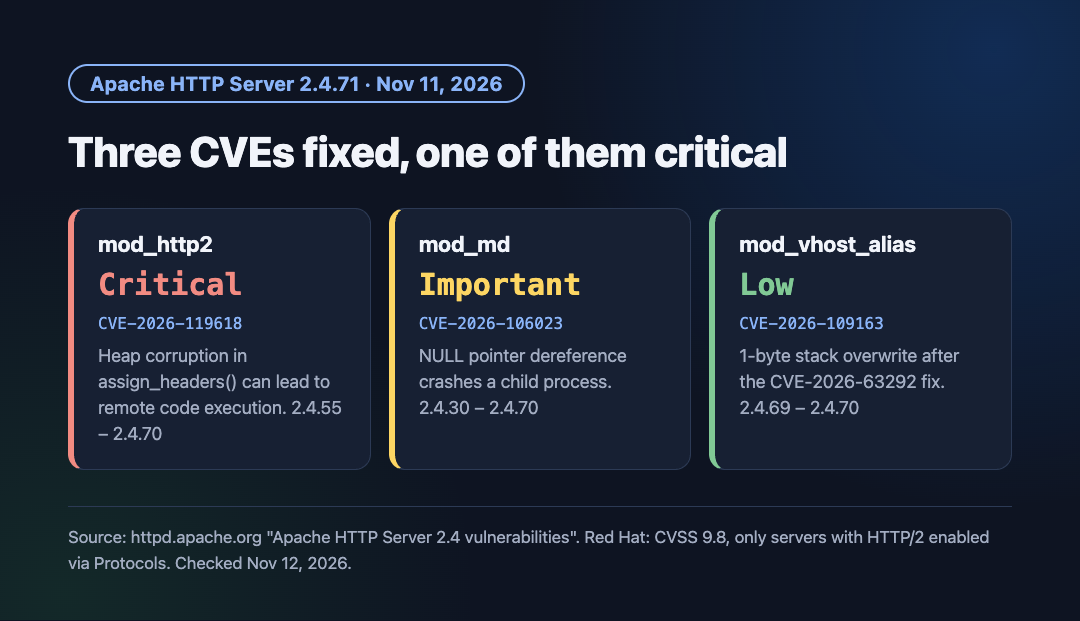
- CVE-2026-119618 (mod_http2): a synchronization bug in
assign_headers(). Two threads touch shared memory without proper locking, which can corrupt the heap and lead to RCE. Apache credits Anthropic's OSS Scanner (reported October 26) and Anthony Weems and Simon Scannell of Google Cloud Vulnerability Research (reported November 3). - CVE-2026-106023 (mod_md): a NULL pointer dereference during request handling crashes a child process. This is a denial-of-service risk for sites that use mod_md for ACME (Let's Encrypt) certificates.
- CVE-2026-109163 (mod_vhost_alias): a one-byte stack overwrite left over after the CVE-2026-63292 fix in 2.4.69. Only 2.4.69 and 2.4.70 are affected.
Red Hat rates CVE-2026-119618 at CVSS 9.8 and states that only servers with HTTP/2 enabled through the Protocols directive are affected. It rates RHEL 9 and RHEL 10 as Important rather than Critical because each HTTP/2 stream uses its own allocator there, which makes exploitation harder. RHEL 8 and older are not affected. NVD had not published a score when I checked.
The release also has non-security changes that can show up after the upgrade. Two mod_remoteip changes and a mod_dav lock-timeout change are covered in the troubleshooting section below.
Am I affected? Check your Apache version and HTTP/2
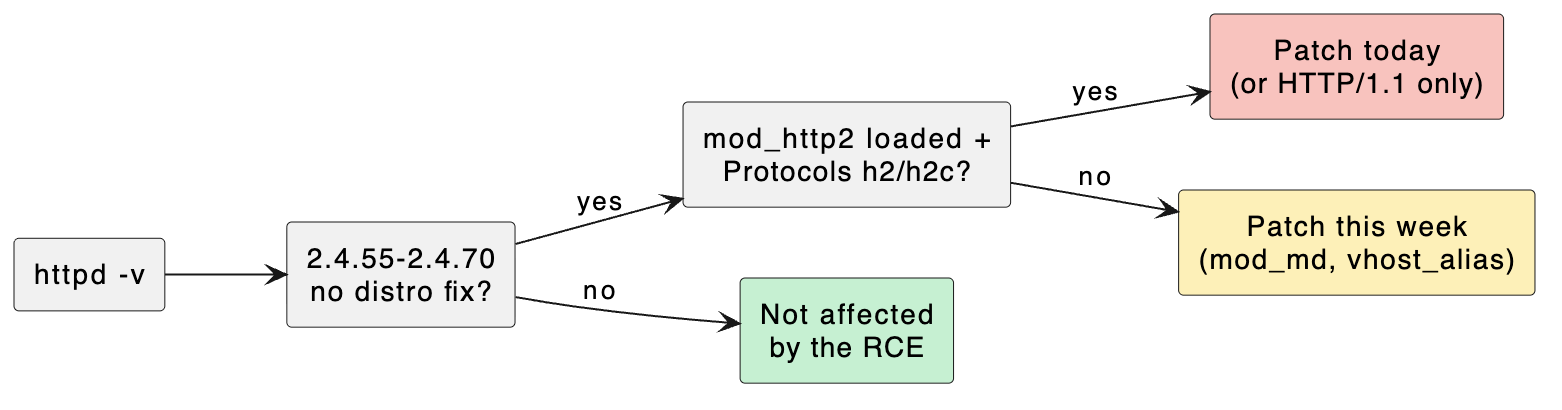
You are exposed to the critical bug only if both are true:
- Your httpd is 2.4.55–2.4.70 (or a distro package without the backported fix), and
- mod_http2 is loaded and
Protocolsincludesh2orh2csomewhere.
View PlantUML source
@startuml
left to right direction
skinparam defaultTextAlignment center
rectangle "httpd -v" as V
rectangle "2.4.55–2.4.70\nno distro fix?" as Q1
rectangle "mod_http2 loaded +\nProtocols h2/h2c?" as Q2
rectangle "Patch today\n(or HTTP/1.1 only)" as P #F8C3BE
rectangle "Not affected\nby the RCE" as N #C6F0D2
rectangle "Patch this week\n(mod_md, vhost_alias)" as W #FDF0B8
V --> Q1
Q1 --> Q2 : yes
Q1 --> N : no
Q2 --> P : yes
Q2 --> W : no
@enduml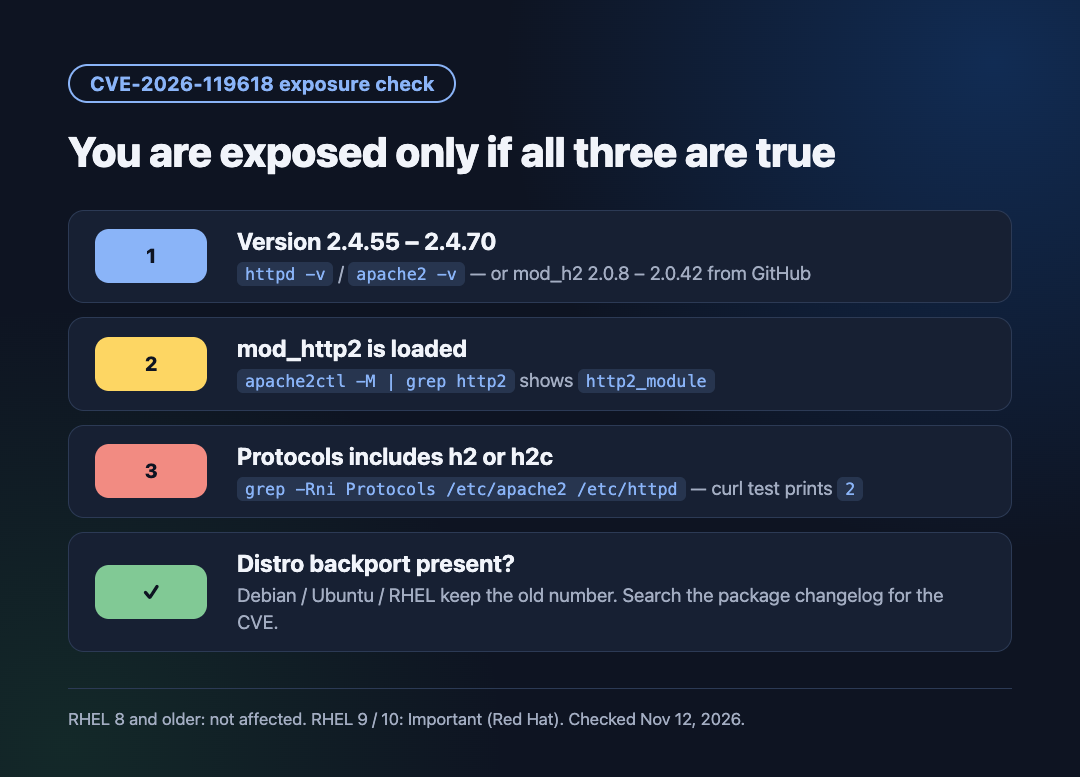
Debian and Ubuntu
## Upstream base version (distros backport fixes, so this alone is not enough)
apache2 -v
dpkg -l apache2 | tail -1

## Is mod_http2 loaded? Are mod_md and mod_vhost_alias loaded?
sudo apache2ctl -M 2>/dev/null | grep -E 'http2|md_module|vhost_alias'

## Where is HTTP/2 turned on?
sudo grep -RniE '^\s*Protocols' /etc/apache2/

## Does the installed package already include the fix?
zgrep -c CVE-2026-119618 /usr/share/doc/apache2/changelog.Debian.gz
Example output on an exposed server:
Server version: Apache/2.4.68 (Debian)
 http2_module (shared)
/etc/apache2/mods-enabled/http2.conf:  Protocols h2 h2c http/1.1
0
A 0 from zgrep means the changelog does not mention the CVE yet. Combined with a loaded http2_module and a Protocols h2 line, that is the "vulnerable" result.
RHEL, Rocky, AlmaLinux and Fedora
On Red Hat-family systems, mod_http2 and mod_md are separate packages, so check all three:
httpd -v
rpm -q httpd mod_http2 mod_md

sudo httpd -M 2>/dev/null | grep -E 'http2|md_module|vhost_alias'
sudo grep -RniE '^\s*Protocols' /etc/httpd/

## Is there an advisory or changelog entry for this CVE?
sudo dnf updateinfo list --cve CVE-2026-119618
rpm -q --changelog mod_http2 | grep -m1 CVE-2026-119618
If mod_http2 is installed and the changelog has no entry for the CVE, treat the host as affected (RHEL 9 and 10 per Red Hat's statement).
Docker and source builds
## Official httpd image or a source build under /usr/local/apache2
docker exec <CONTAINER_NAME> httpd -v
docker exec <CONTAINER_NAME> httpd -M | grep http2
docker exec <CONTAINER_NAME> grep -nE '^\s*(LoadModule http2|Protocols)' /usr/local/apache2/conf/httpd.conf
The official image builds upstream Apache, so its version number is exact: anything from 2.4.55 to 2.4.70 is affected if HTTP/2 is on.
Test from the outside
Config greps can miss an Include you forgot. Ask the server what it actually negotiates:
## Over TLS: prints 2 if h2 is negotiated, 1.1 if not
curl -s -o /dev/null --http2 -w '%{http_version}\n' https://<YOUR_DOMAIN>/

## Cleartext h2c with prior knowledge: prints 2 if h2c is accepted
curl -s -o /dev/null --http2-prior-knowledge -w '%{http_version}\n' http://<YOUR_DOMAIN>/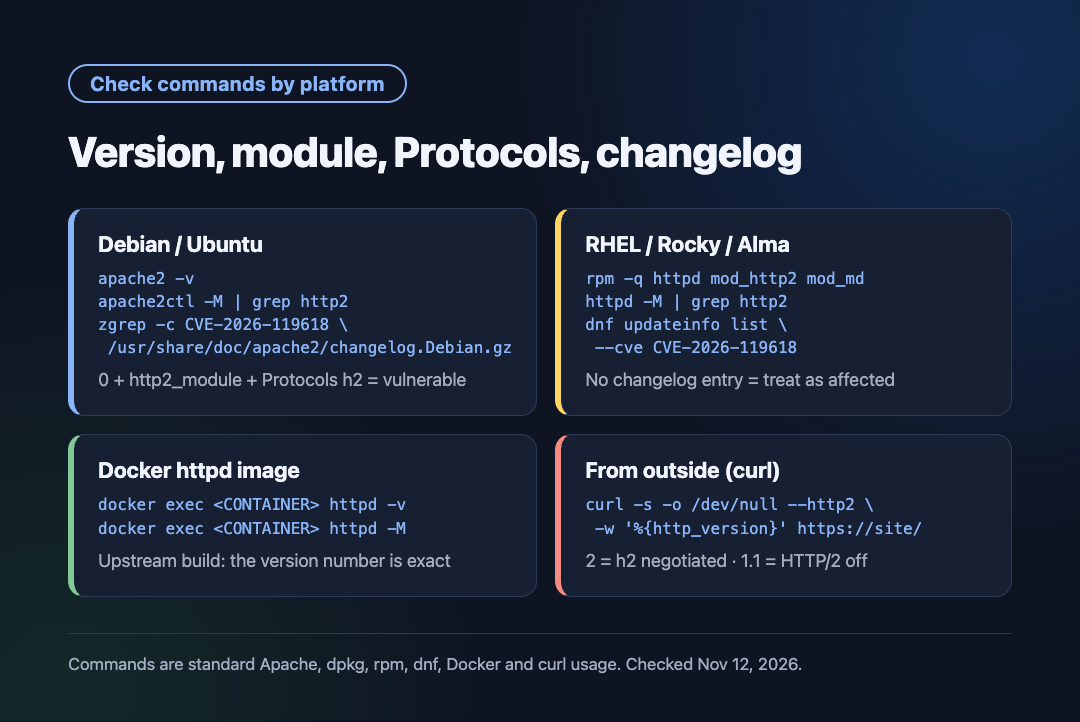
How to update to Apache 2.4.71 or the patched package
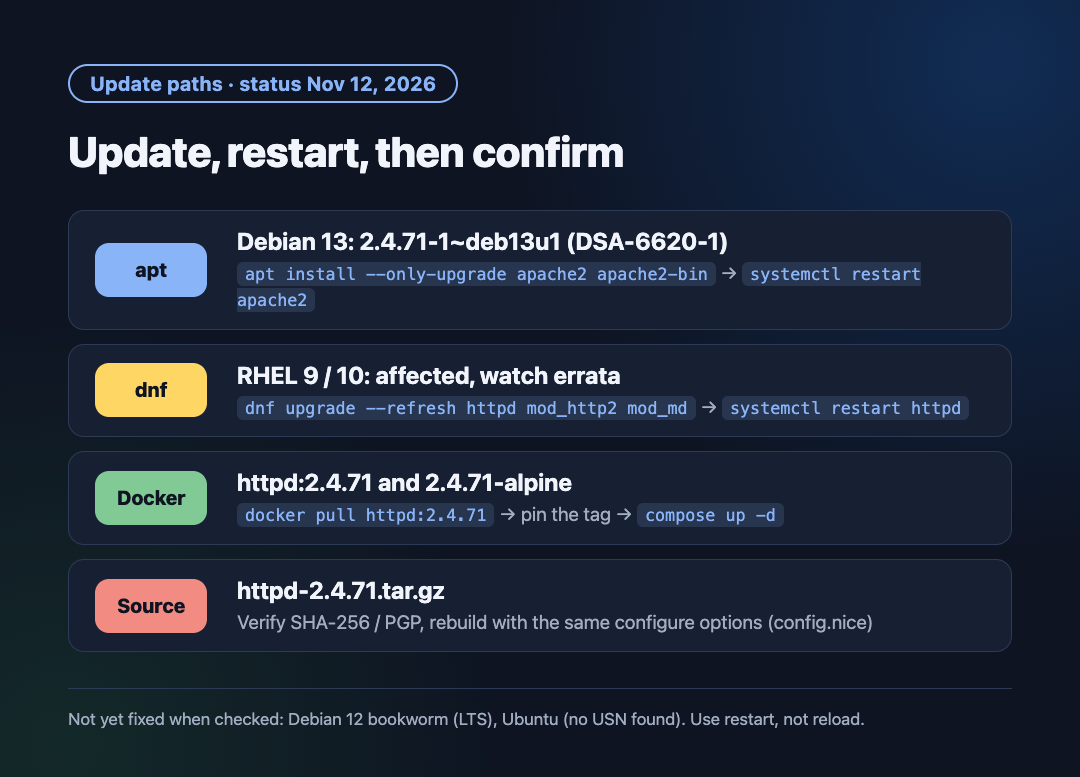
Distribution status changes quickly. As of November 12, 2026:
| Platform | Patched build | Status on Nov 12 |
|---|---|---|
| Upstream source | 2.4.71 | Released Nov 11 |
Docker httpd | 2.4.71, 2.4.71-alpine | Tags pushed Nov 12 (UTC) |
| Debian 13 trixie | 2.4.71-1~deb13u1 | Fixed, DSA-6620-1 |
| Debian 12 bookworm | — | Vulnerable, no fix listed (LTS) |
| Debian sid | 2.4.71-1 | Fixed |
| RHEL 9 / 10 | — | Affected (Important), check errata |
| Ubuntu | — | No USN found when checked |
Sources: Debian security tracker, Red Hat CVE page, Docker Hub tags. Check again before you plan around a "no fix" line.
Debian and Ubuntu (apt)
sudo apt update
apt list --upgradable 2>/dev/null | grep apache2
sudo apt install --only-upgrade apache2 apache2-bin apache2-data apache2-utils
sudo apache2ctl configtest && sudo systemctl restart apache2

## Confirm
zgrep -m1 CVE-2026-119618 /usr/share/doc/apache2/changelog.Debian.gz
Use restart, not reload, so every child process loads the new binary. If apt list --upgradable shows nothing for apache2, your release has no fix yet: go to the mitigation section. If you hit errors in apt itself, my APT CVE-2026-109518 patch guide covers the apt side.
RHEL family (dnf)
sudo dnf upgrade --refresh httpd mod_http2 mod_md
sudo httpd -t && sudo systemctl restart httpd
rpm -q --changelog mod_http2 | grep -m1 CVE-2026-119618
If dnf says nothing to do, the errata is not out for your release yet.
Docker
docker pull httpd:2.4.71          # or httpd:2.4.71-alpine
docker compose up -d --pull always
docker exec <CONTAINER_NAME> httpd -v   # Server version: Apache/2.4.71 (Unix)
Pin the exact tag (2.4.71) in your Compose file or Dockerfile instead of latest, so the next rebuild can't silently go back to an older cached image. If you build your own image FROM httpd:2.4, rebuild it with --pull.
Source builds
Download httpd-2.4.71.tar.gz from the Apache download page, verify the SHA-256 or PGP signature against the files on downloads.apache.org, then rebuild with the same ./configure options you used before (check config.nice in your old build directory). Stand-alone mod_h2 users from GitHub need a release newer than 2.0.42.
Can't update yet? Turn off HTTP/2 in Apache
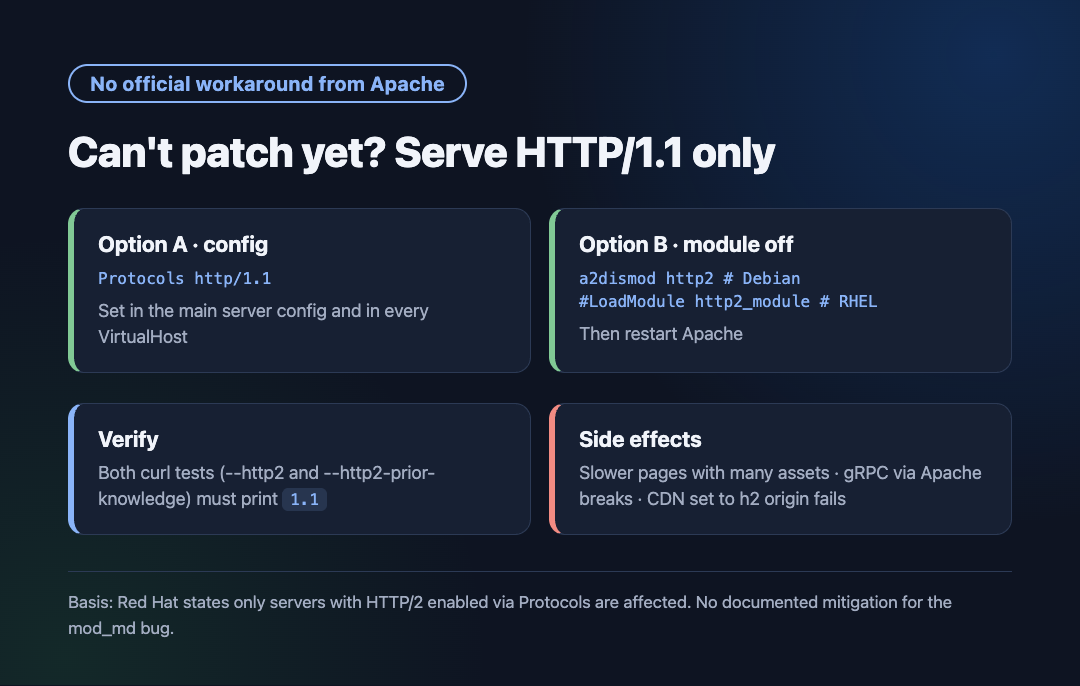
Apache's advisory lists no official workaround. Red Hat's statement that only servers with HTTP/2 enabled through Protocols are affected gives you one: serve HTTP/1.1 only until the patch lands.
## In every VirtualHost and in the main server config
Protocols http/1.1
Or disable the module completely:
## Debian/Ubuntu
sudo a2dismod http2 && sudo systemctl restart apache2

## RHEL family: comment out the LoadModule line, then restart
sudo sed -i 's/^LoadModule http2_module/#LoadModule http2_module/' /etc/httpd/conf.modules.d/10-h2.conf
sudo systemctl restart httpd
Run the two curl tests again. Both must print 1.1.
Side effects: browsers fall back to HTTP/1.1, so pages with many small assets can load a bit slower. Anything that needs HTTP/2 to the origin breaks, for example gRPC proxied through Apache or a CDN configured to talk h2 to your origin. Also check whether a CDN or load balancer terminates TLS in front of Apache: if it speaks HTTP/1.1 to Apache, your Apache is not reachable over h2 from outside, but an internal client still could be.
There is no documented mitigation for the mod_md bug. If you don't use MDomain, you can disable mod_md; if you do, patch and watch your error log for child crashes.
Troubleshooting after the Apache 2.4.71 upgrade
1. Apache won't start after the upgrade. Run apache2ctl configtest (or httpd -t). On Debian, apt may have asked about a changed config file; if you accepted the maintainer version, your custom edits are in *.dpkg-old next to it. Compare with diff and merge.
2. Real client IPs look wrong in the logs. In 2.4.71, RemoteIPTrustedProxyList and RemoteIPInternalProxyList now apply to the virtual host where you set them. Lists from the main server and the vhost are merged, and Apache logs a warning if both define one. If you only set the list inside one vhost and relied on it globally, move it to the main server config.
3. WebDAV clients see different lock timeouts. Invalid or overflowing Timeout: headers now get the RFC 4918 maximum instead of an already-expired lock. That's a fix, but clients that sent bad headers will now hold locks longer.
4. HTTP/2 is still on after the mitigation. Another file still has Protocols h2. Run grep -RniE '^\s*Protocols' /etc/apache2/ /etc/httpd/ again, include sites-enabled, and restart rather than reload.
Rolling back. Only roll back if the new build breaks production, and switch to Protocols http/1.1 first, because the old build is still vulnerable.
## Debian/Ubuntu: list versions, then pin the previous one
apt-cache policy apache2
sudo apt install apache2=<PREVIOUS_VERSION> apache2-bin=<PREVIOUS_VERSION> apache2-data=<PREVIOUS_VERSION> apache2-utils=<PREVIOUS_VERSION>

## RHEL family
sudo dnf downgrade httpd mod_http2 mod_md

## Docker: go back to your previous pinned tag
docker compose up -d   # after changing the image tag back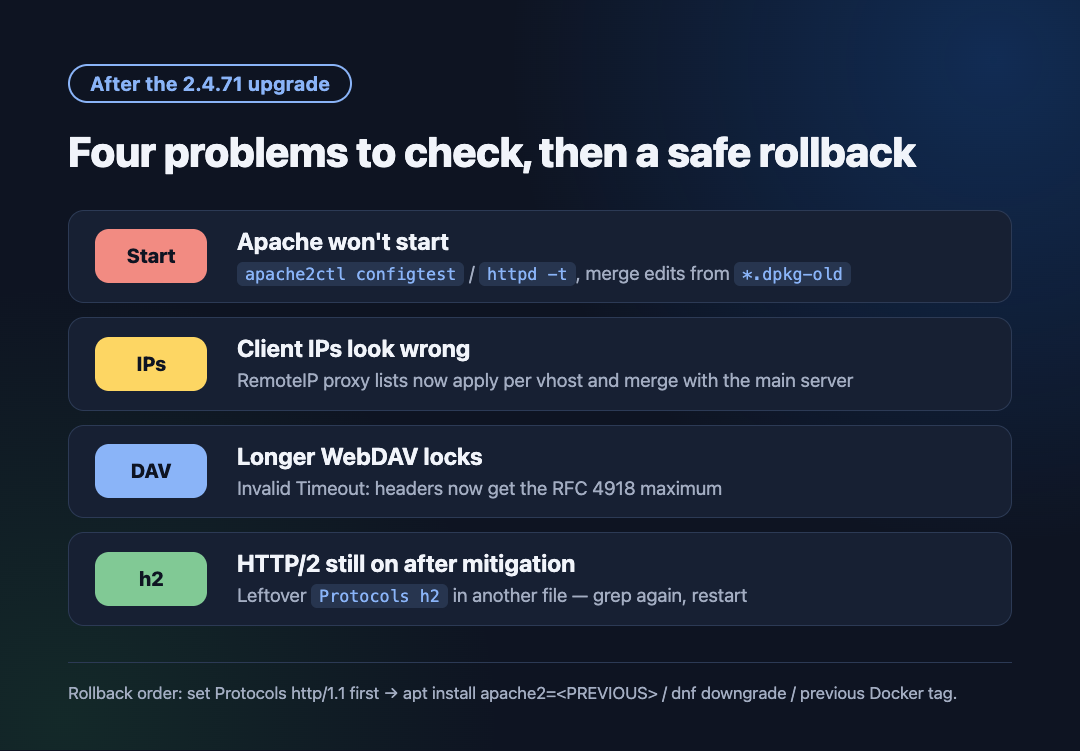
Apache 2.4.71 patch priority by environment
| Your setup | Action |
|---|---|
| 2.4.55–2.4.70, HTTP/2 on, internet-facing | Patch today, or HTTP/1.1-only now |
| 2.4.55–2.4.70, HTTP/2 on, internal only | Patch this week; mitigate if many users |
| 2.4.55–2.4.70, HTTP/2 off | Patch this week (mod_md, vhost_alias) |
| Uses mod_md, any 2.4.30–2.4.70 | Patch this week |
| RHEL 8 or older, 2.4.54 or older | Not affected by the RCE |
| Already on 2.4.71 or patched package | No action |
"Patch today" for public h2 servers is my recommendation based on the Critical rating and the remote, unauthenticated attack path. Apache did not report active exploitation when I checked.
If the same server also runs Node.js behind Apache, the Node.js 26.13.1 security update fixed several HTTP/2 bugs on November 11 too, so patch both in the same window. Running WordPress on this Apache? See the WordPress 7.1.4 patch guide.
FAQ
Is Apache vulnerable if I never enabled HTTP/2? Not to CVE-2026-119618. Red Hat states only servers with HTTP/2 enabled through Protocols are affected. You still get the mod_md and mod_vhost_alias fixes from 2.4.71, so update anyway.
Does Nginx or Caddy have this bug? No. CVE-2026-119618 is in Apache's mod_http2 code. Other servers have their own HTTP/2 code and their own advisories.
My distro still shows Apache 2.4.62 after updating. Am I safe? Maybe. Debian, Ubuntu and Red Hat backport fixes without changing the upstream number. Search the package changelog for CVE-2026-119618 as shown above; that is the reliable check.
Is there a public exploit? I did not find one, and Apache's advisory does not mention exploitation as of November 12, 2026. That can change quickly after a critical HTTP/2 fix, so don't wait for one.
Does a CDN in front of Apache protect me? Only if the CDN talks HTTP/1.1 to your origin and your origin is not reachable directly. Check your CDN's origin protocol setting and block direct access to the origin IP.
Next, check the other services on the same host: Apache usually sits in front of PHP, Node.js or a CMS that needs its own patches.
References
- Apache HTTP Server 2.4 vulnerabilities — Apache Software Foundation, checked Nov 12, 2026
- Apache HTTP Server 2.4.71 announcement — checked Nov 12, 2026
- CHANGES_2.4.71 — checked Nov 12, 2026
- mod_http2 documentation — checked Nov 12, 2026
- Debian security tracker: CVE-2026-119618 — checked Nov 12, 2026
- Red Hat: CVE-2026-119618 — checked Nov 12, 2026
- Docker Hub: official httpd image — tags checked Nov 12, 2026
- Cyber Security News: Apache patches critical HTTP/2 flaw — checked Nov 12, 2026