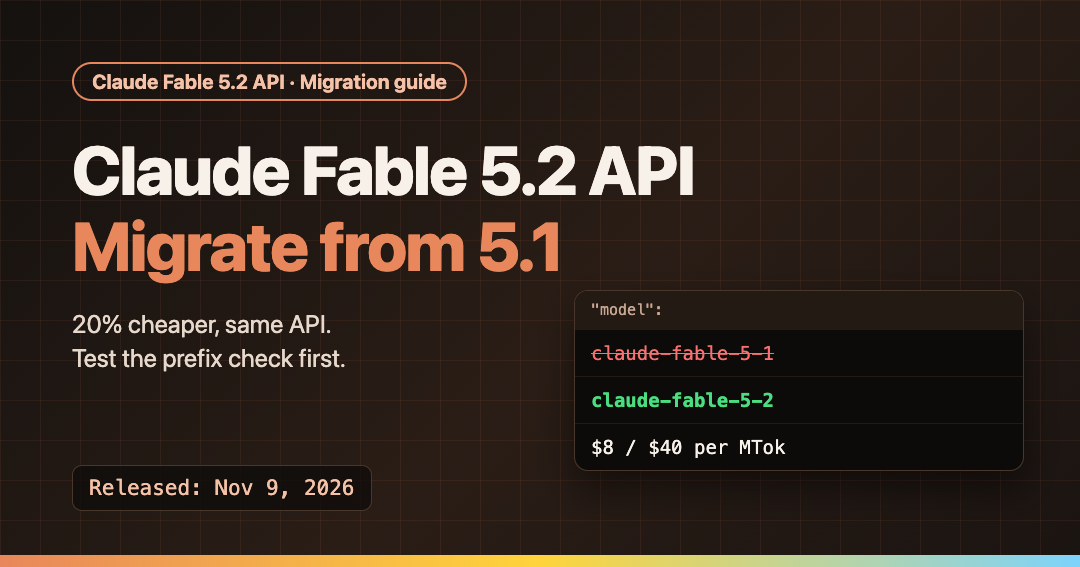
The Claude Fable 5.2 API went live on November 9, 2026 as claude-fable-5-2. It costs 20% less than Fable 5.1 ($8 / $40 per million input / output tokens instead of $10 / $50) and Anthropic says it generates output up to 30% faster. For most apps, migrating means changing one model string. But four changes can break code that worked on Fable 5.1, and the most likely one to hit you is the prefix check, which now applies to every account. Below: what changed, how to find the risky code, the exact requests to test with, and what to do when you get a 400.
Written November 11, 2026, 10:30 KST (November 11, 01:30 UTC). Facts checked on November 11, 2026 against Anthropic's Claude Fable 5.2 model page, the "What's new in Claude Fable 5.2" page, the Fable 5.2 migration guide, the preserved thinking, effort and model deprecation docs, and Anthropic's launch page. I did not run these requests against the API for this post. The code samples follow the official docs, with the model ID set to Fable 5.2. Test on a staging key before you switch production traffic.
What changed in the Claude Fable 5.2 API
Fable 5.2 keeps the same API surface as Fable 5.1. Adaptive thinking is still always on, forced tool choice still returns a 400, and the 30-day data retention requirement is the same. The specs did not change either: 1M token context window, 128K max output tokens, a June 2026 knowledge cutoff, and text and image input.
The part that changed is the price:
| Item (per million tokens) | Fable 5.1 | Fable 5.2 | Change |
|---|---|---|---|
| Input | $10 | $8 | -20% |
| Output | $50 | $40 | -20% |
| Cache read | $0.25 | $0.20 | -20% |
| Batch input / output | — | $4 / $20 | 50% off |
| Fast mode input / output | — | $16 / $80 | 2× price |
Source: Anthropic "What's new in Claude Fable 5.2" and the Fable 5.2 model page, checked Nov 11, 2026. 5m / 1h cache writes on Fable 5.2 are $10 / $16.
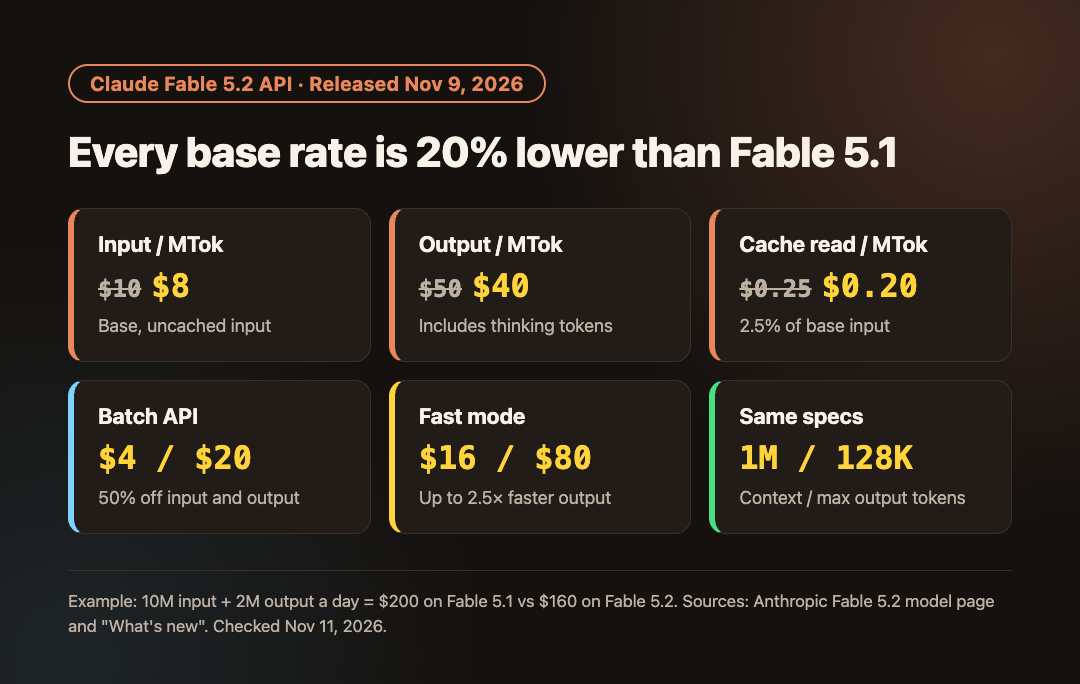
A quick cost check, using the same volume for both models: a workload that sends 10M input tokens and 2M output tokens a day costs 10 × $10 + 2 × $50 = $200 on Fable 5.1 and 10 × $8 + 2 × $40 = $160 on Fable 5.2. That is $40 a day, or 20%, at the same token count. Thinking tokens are billed as output, so your real number depends on effort level and how much the model thinks. Measure it on your own traffic.
Other facts worth knowing before you switch:
- Model IDs:
claude-fable-5-2on the Claude API, Claude Platform on AWS, both Google Cloud options and Microsoft Foundry. On Amazon Bedrock it isanthropic.claude-fable-5-2. - Rate limits: Fable 5.2 has its own rate limit, separate from the combined limit that Fable 5.1 and Fable 5 share. Check your tier in the Console before moving production traffic.
- Lifecycle: Fable 5.1 is still Active with retirement "not sooner than September 1, 2027". Nothing forces you to move today.
- Defaults: The API default effort is still
high. Anthropic's launch page says the Claude apps and Claude Code default tomedium.
The 4 breaking changes from Fable 5.1
Anthropic lists four changes that can break working Fable 5.1 code:
- The prefix check applies to every account. On Fable 5.1 it is enforced by default only for accounts created on or after August 31, 2026. On Fable 5.2 it is enforced for all accounts. If your code changes
system,toolsor an earlier message and sends old thinking blocks back, you now get a 400. - Fable 5.1 can't read Fable 5.2 thinking blocks. Moving a conversation onto 5.2 keeps the reasoning. Moving it back to 5.1 (or to Opus 5.5) silently drops 5.2's thinking blocks. The request succeeds, but the first turn after the switch can cost more.
computer_20251124returns a 400 on every platform except Amazon Bedrock. Use thecomputer_toolset_20260801toolset.- The advisor tool needs a 5.2 advisor. A Fable 5.2 executor accepts only
claude-fable-5-2orclaude-mythos-5-2as its advisor. A Fable 5.1 advisor returns a 400.
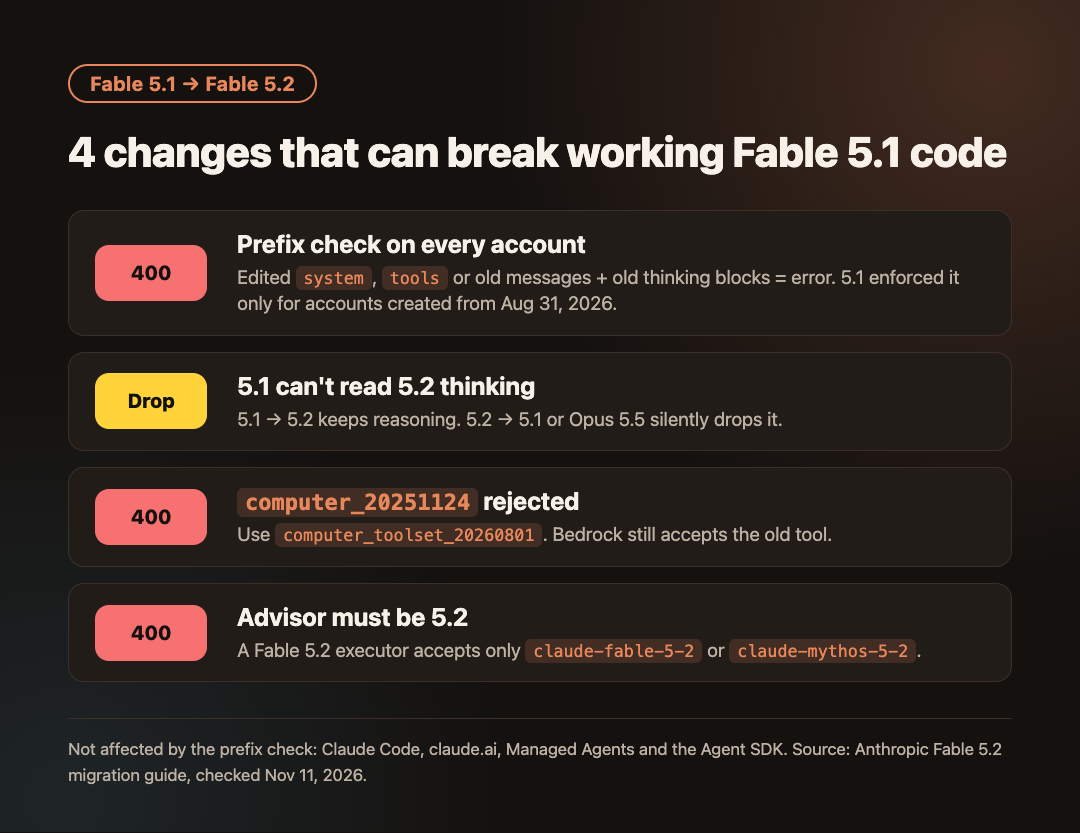
If Claude Code, claude.ai, Claude Managed Agents or the Claude Agent SDK builds your requests, the prefix check change does not affect you. It matters when your own code builds the messages array.
Step 1: Find Fable 5.1 code and risky features
Search your repo for the old model ID and the features that changed. In order: model IDs (also check env files, IaC and config stores), the old computer use tool and its beta header, advisor definitions that pin a 5.1 advisor, and code that may rewrite history between requests:
grep -rn --exclude-dir=node_modules --exclude-dir=.git \
  -e 'claude-fable-5-1' -e 'anthropic.claude-fable-5-1' .
grep -rn -e 'computer_20251124' -e 'computer-use-2025-11-24' .
grep -rn -e 'advisor' . | grep -i 'fable-5-1\|mythos-5-1'
grep -rn -e 'messages\[' -e 'messages.splice' -e 'messages.pop' -e 'system=' .
The last search is only a rough filter. The things that count as an edit are easy to miss:
| Your code does this between requests | Result on Fable 5.2 |
|---|---|
| Appends new messages at the end | OK |
Changes effort, max_tokens, output_config | OK |
Adds or moves cache_control markers | OK |
Rebuilds system (date, mode flag) | 400 |
Adds, removes or edits a tool in tools | 400 |
Shortens an old tool_result | 400 |
| Image URL returns different bytes | 400 |
Source: Anthropic preserved thinking docs, "What counts as an edit", checked Nov 11, 2026. "400" means the request fails when it sends back thinking blocks that came after the change and prefix_mismatch_behavior is unset.
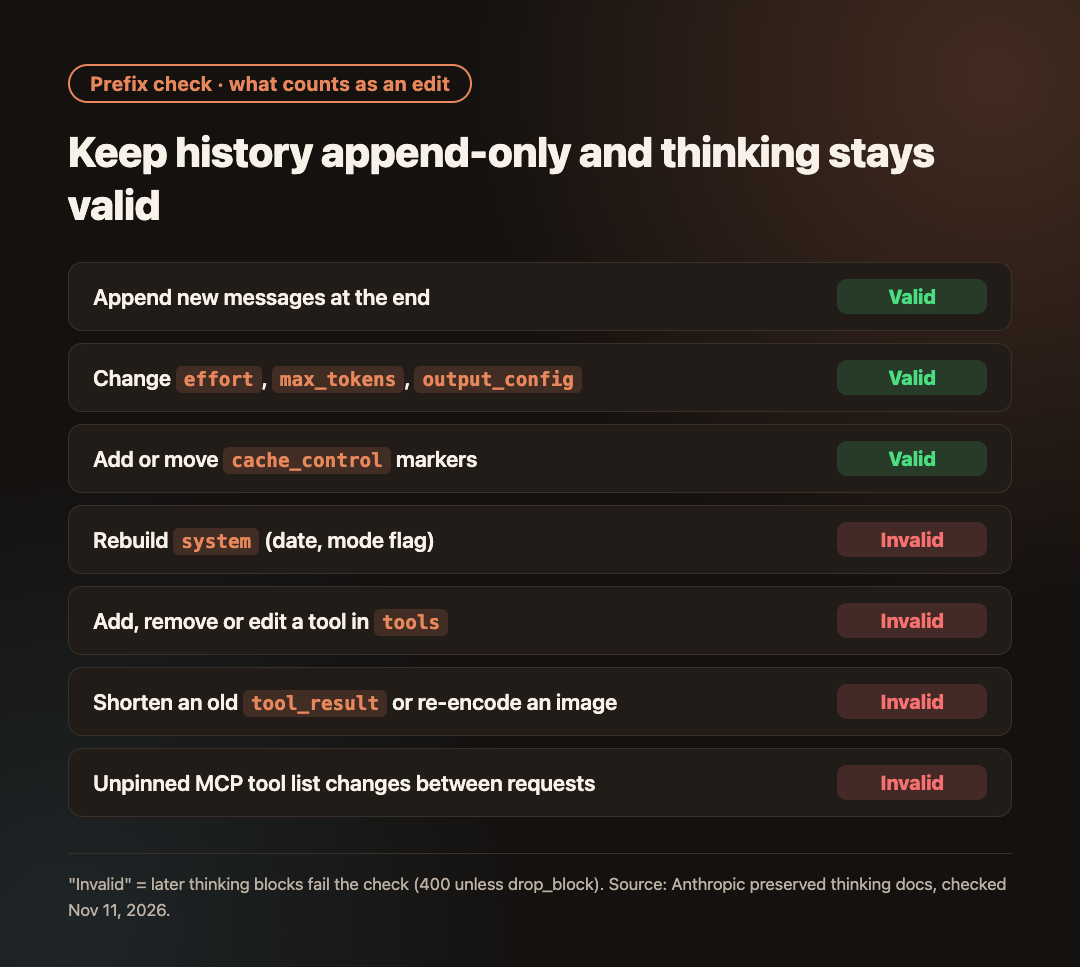
One more trap: if you use the MCP connector without pinning the server's tool list, a tool list that changes between requests counts as an edit for Fable 5.2 thinking blocks, but not for Fable 5.1 blocks.
Step 2: Run the prefix check test before you switch
The migration guide asks you to run a session with the thinking-binding-controls-2026-08-01 beta header and prefix_mismatch_behavior: "drop_block". With that setting, the API drops bad blocks instead of failing, and lists each one in a top-level input_transformations array. You can run it on claude-fable-5-1 today, from any account.
This Python script follows the official example. Replace the two sample turns with a real flow from your app, through your own history code:
import anthropic

client = anthropic.Anthropic()  # reads ANTHROPIC_API_KEY

user_turns = [
    "How many positive integers below 500 have exactly 6 positive divisors?",
    "How many of those are odd?",
]

messages = []
for user_turn in user_turns:
    messages.append({"role": "user", "content": user_turn})
    response = client.beta.messages.create(
        model="claude-fable-5-2",
        max_tokens=16000,
        thinking={
            "type": "adaptive",
            "block_binding": {"prefix_mismatch_behavior": "drop_block"},
        },
        messages=messages,
        betas=["thinking-binding-controls-2026-08-01"],
    )
    # Send the assistant turn back exactly as returned
    messages.append({"role": "assistant", "content": response.content})
    thinking = sum(b.type == "thinking" for b in response.content)
    dropped = response.input_transformations or []
    print(f"thinking blocks: {thinking}, dropped: {len(dropped)}")
    for t in dropped:
        print("  ", t.type, t.path, t.reason)
How to read the result:
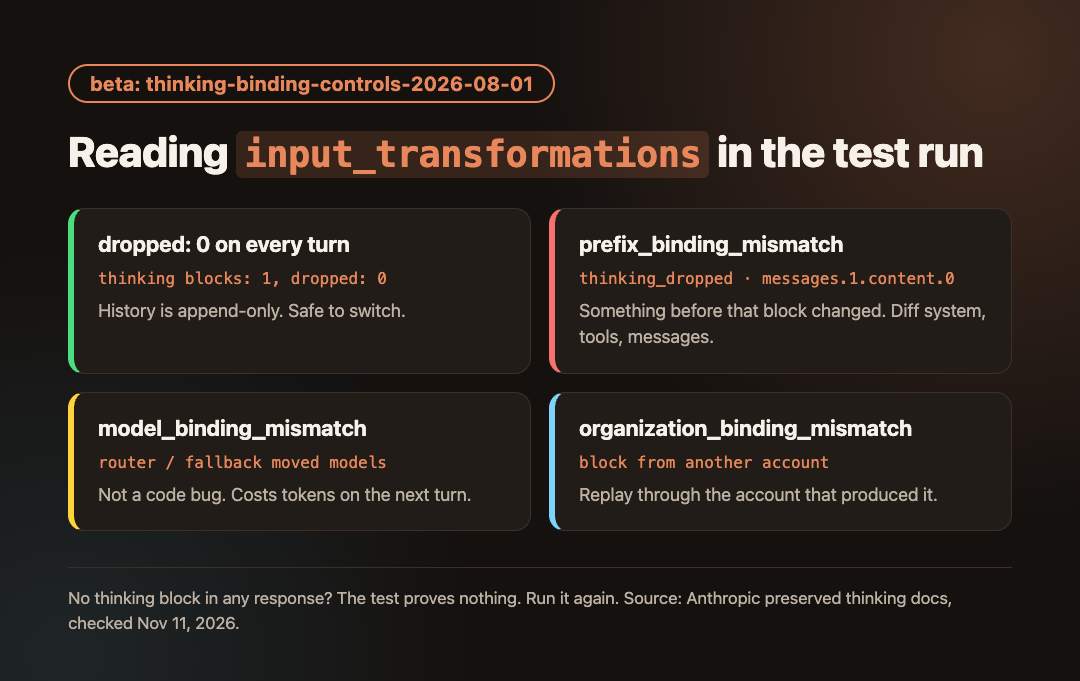
dropped: 0on every turn (and at least one response had a thinking block): your history code is append-only. You are fine.reason: prefix_binding_mismatch: something before the block atpathchanged. Diffsystem,toolsandmessagesbetween the two requests.reason: model_binding_mismatch: a router moved the conversation to a model that can't read the earlier blocks. Not a code bug, but it costs tokens.reason: organization_binding_mismatch: the block came from another account. Replay stored conversations through the account that produced them.
With adaptive thinking, some responses have no thinking block. If none of yours do, the test proves nothing. Run it again.
Step 3: Update the model ID and set effort
Once the test is clean, the change itself is small. Here is a plain Messages API request with explicit effort, using the API version from Anthropic's current examples:
curl https://api.anthropic.com/v1/messages \
  -H "x-api-key: <YOUR_API_KEY>" \
  -H "anthropic-version: 2026-10-21" \
  -H "content-type: application/json" \
  -d '{
    "model": "claude-fable-5-2",
    "max_tokens": 32000,
    "output_config": { "effort": "high" },
    "messages": [
      { "role": "user", "content": "Review this migration plan and list the risks." }
    ]
  }'
import Anthropic from "@anthropic-ai/sdk";
const client = new Anthropic();
const response = await client.messages.create({
model: "claude-fable-5-2", // was "claude-fable-5-1"
max_tokens: 32000,
output_config: { effort: "high" },
messages: [{ role: "user", content: "Review this migration plan and list the risks." }],
});Things to leave out, same as on Fable 5.1:
temperature,top_p,top_k(API version2026-10-21removed them, and they return a 400).thinking: {"type": "enabled", "budget_tokens": N}or{"type": "disabled"}. Omitthinkingor send{"type": "adaptive"}.tool_choiceofanyortool. Useautowithstrict: truetools or JSON outputs instead.- Assistant prefill. Put the instruction in the system prompt.
Pick an effort level per workload
Effort is your main lever for cost and latency, because thinking is always on. Anthropic's advice for Fable 5.2:
| Effort | When to use it |
|---|---|
low / medium | Easy or high-volume turns where your evals hold |
high (default) | Start here. Most of the gain is already present |
xhigh | Hardest long-running coding and agent work, after you measure a gain |
max | Measuring the ceiling. Slower and costlier, often for a small gain |
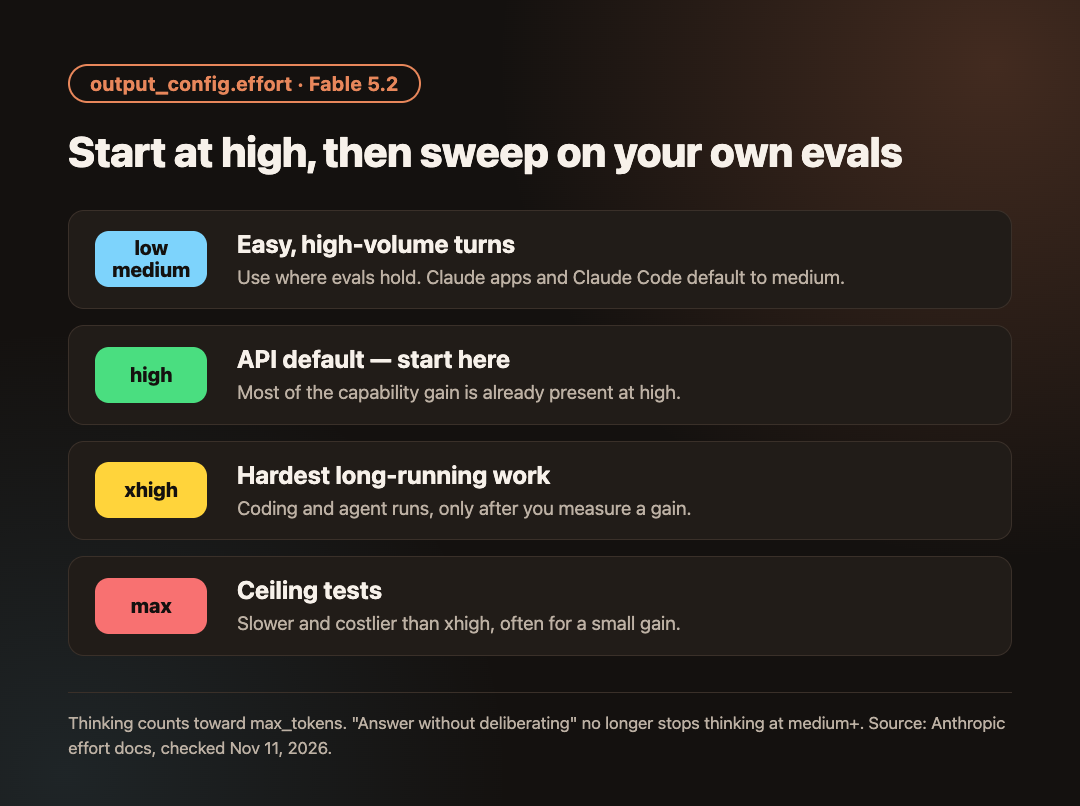
Two behavior changes are tied to effort. First, a prompt line like "answer directly without deliberating" no longer stops Fable 5.2 from thinking at medium and above. Remove it and lower effort for those turns instead. Second, thinking tokens count toward max_tokens, so a small max_tokens can end with stop_reason: "max_tokens" before any text. Give high-effort requests a large max_tokens.
Fast mode and cloud platforms
Fast mode on Fable 5.2 runs output up to 2.5× faster at double the price ($16 / $80). On the Claude API you set speed: "fast" on the request. On Microsoft Foundry it is a separate deployment, claude-fable-5-2-fast, and you leave speed out. In Claude Managed Agents, remove speed: "fast" from the agent's model object.
Step 4: Roll out with a safe fallback

View PlantUML source
@startuml
skinparam shadowing false
skinparam defaultFontSize 14
skinparam rectangleBorderColor #2563EB
skinparam rectangleBackgroundColor #EFF6FF
left to right direction
rectangle "Search code\n(IDs, tools)" as A
rectangle "Prefix test\n(drop_block)" as B
rectangle "Staging\nfable-5-2" as C
rectangle "Canary\n5-10%" as D
rectangle "Full\nrollout" as E
rectangle "Watch 400s\n+ cost" as F
A --> B
B --> C
C --> D
D --> E
E --> F
@enduml
A few rollout rules that follow from the docs:
- Route new conversations, not live ones, back and forth. A conversation can move from 5.1 to 5.2 and keep its reasoning. Moving from 5.2 back to 5.1 drops 5.2's thinking. For rollback, send new conversations to 5.1 and let running ones finish on 5.2.
- Change the advisor model in new conversations only. The advisor's
modelsits intools, so changing it mid-conversation is an edit and fails the prefix check. - Production setting: keep
prefix_mismatch_behaviorat its default,"error", if a mismatch can only mean a bug. Use"drop_block"only as a stopgap. Dropped blocks can raise output tokens. - Refusal fallback: Fable 5.2's permitted fallback targets are
claude-opus-4-8andclaude-opus-5. If you set an explicitfallbackslist, name only those.
If your agents keep long conversations with replays, my earlier guide to Claude message threads covers storing and replaying turns exactly as returned, which is what the prefix check wants. If you run Claude from scripts, see how to run Claude Code headless with n8n.
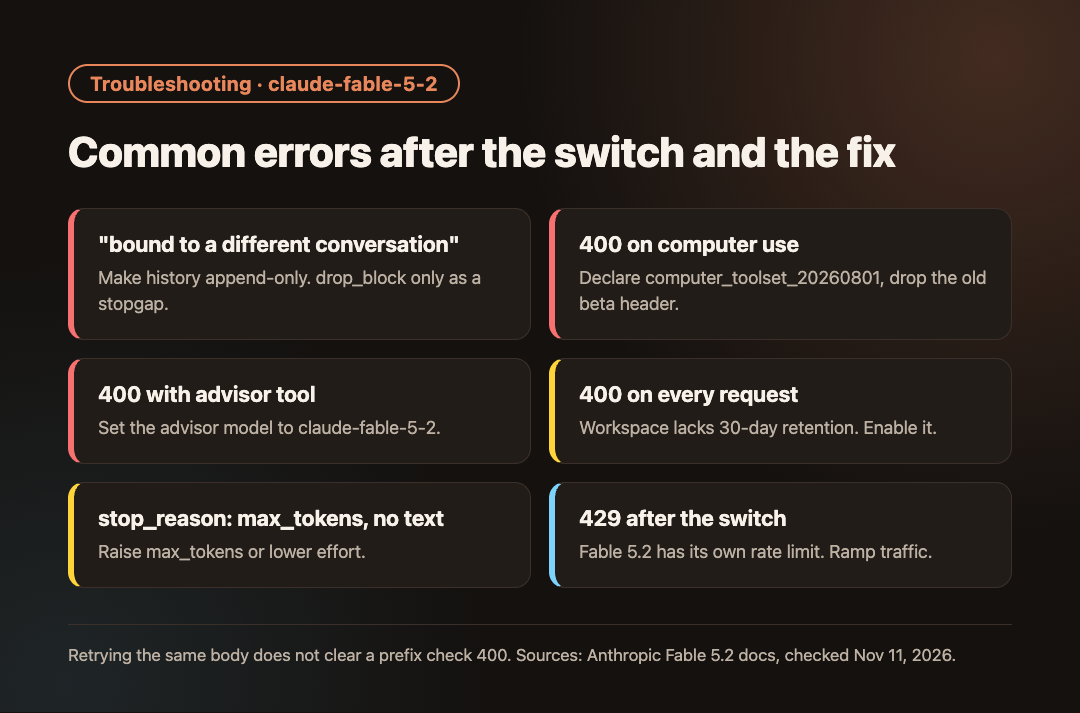
Troubleshooting Claude Fable 5.2 API errors
| Symptom | Likely cause | Fix |
|---|---|---|
| 400 "The block is bound to a different conversation" | History edited before a thinking block | Make history append-only, or drop_block as a stopgap |
400 invalid_request_error on a computer use tool | computer_20251124 declared | Declare computer_toolset_20260801, drop the beta header |
| 400 with the advisor tool | Advisor is Fable 5.1 or Mythos 5.1 | Set advisor model to claude-fable-5-2 |
| 400 on every request | Workspace without 30-day retention | Enable 30-day retention for that workspace |
stop_reason: "max_tokens", no text | Thinking used the whole budget | Raise max_tokens or lower effort |
| 429 right after the switch | Separate, new rate limit | Check Fable 5.2 limits, ramp traffic slowly |
Retrying the same body does not clear a prefix check 400. You have to change what you send.
Should you move now, or start on Opus 5.5?
Anthropic itself recommends starting most workloads on Claude Opus 5.5 ($4 / $20, default effort medium) and moving to Fable 5.2 when your evals on Opus at higher effort still fall short. If you already run Fable 5.1, the 5.2 switch is the easy win: lower price, same API, and a separate rate limit. If you run Opus 5.5 and are thinking of moving up, expect double the price, a default effort one level higher, and the prefix check on every account. I made the same kind of cost comparison for OpenAI in the GPT-6.1 Terra API migration guide.
FAQ
Is Claude Fable 5.1 being retired? Not yet. As of November 11, 2026, Anthropic's deprecation table lists claude-fable-5-1 as Active, with retirement "not sooner than September 1, 2027". Anthropic gives at least 60 days' notice before retiring a public model.
Is there a claude-fable-latest alias I can use? The Fable 5.2 docs list only claude-fable-5-2 (and anthropic.claude-fable-5-2 on Bedrock). Pin the full ID and change it on purpose after you test.
Do I need to change anything if I use Claude Managed Agents? Only the model name. If the agent has an advisor, update the advisor's model to claude-fable-5-2 too, and remove speed: "fast" from the agent's model object.
Can I use Fable 5.2 with zero data retention? No, unless Anthropic expressly authorizes it. Like Fable 5.1, it requires 30-day retention. On the Claude API, requests from a workspace without it return a 400.
What is Claude Mythos 5.2? The same model with different safeguards, for organizations approved through Anthropic's verification programs, such as the Cyber Verification Program. It shares Fable 5.2's specs and prices.
References
- Claude Fable 5.2 model overview — Anthropic docs, checked Nov 11, 2026
- What's new in Claude Fable 5.2 — Anthropic docs, checked Nov 11, 2026
- Claude Fable 5.2 and Mythos 5.2 migration guide — Anthropic docs, checked Nov 11, 2026
- Preserved thinking and the prefix check — Anthropic docs, checked Nov 11, 2026
- Effort parameter — Anthropic docs, checked Nov 11, 2026
- Model deprecations — Anthropic docs, checked Nov 11, 2026
- Claude Fable 5.2 and Mythos 5.2 launch page — Anthropic, checked Nov 11, 2026
- Anthropic releases Claude Fable 5.2 and Mythos 5.2 — VentureBeat, Nov 9, 2026, checked Nov 11, 2026
Next, if you route between models, check how your fallback handles thinking blocks: that is where Fable 5.2 conversations quietly lose reasoning.