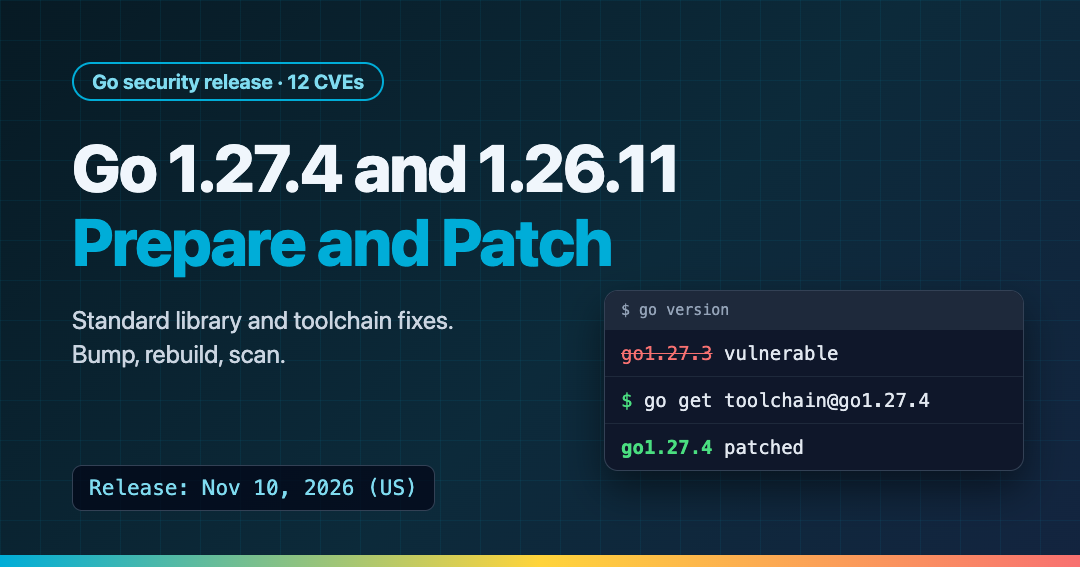
The Go 1.27.4 security release, together with Go 1.26.11, is scheduled for Tuesday, November 10, 2026, during US business hours, with private security fixes for 12 CVEs in the Go standard library and toolchain. If you build or ship Go code, get ready now: find every place your Go version is pinned, then bump the toolchain and rebuild your binaries and images on release day. Go 1.25 and older won't get these fixes.
Written November 10, 2026, 13:30 KST (November 10, 04:30 UTC). At that time Go 1.27.4 was not out yet, and the Go team had not published which packages the fixes touch. Facts checked on November 10, 2026 against the Go pre-announcement on golang-announce (forwarded to oss-security on November 5, 2026), the Go release history, the Go security policy and the Go toolchain docs. I have not run Go 1.27.4. The commands below are standard Go commands from the official docs. Try them on one repository first.
What the Go 1.27.4 security release fixes
The Go team sent the pre-announcement on November 5, 2026 (22:10 UTC). It says Go 1.27.4 and Go 1.26.11 will include "PRIVATE security fixes to the standard library and the toolchain" and lists 12 reserved CVE IDs: CVE-2026-97033 through CVE-2026-97043, plus CVE-2026-97054.
Under the Go security policy, PRIVATE track issues are "violations of committed security properties". They stay private until the scheduled minor release. The pre-announcement goes out three to seven days before. It only says whether the standard library, the toolchain or both are affected. No details.
| Item | What we know on Nov 10 (KST) |
|---|---|
| New versions | Go 1.27.4 and Go 1.26.11 |
| Release window | Tue, Nov 10, 2026, US business hours |
| CVEs | 12 reserved IDs |
| Affected parts | Standard library and toolchain |
| Packages, severity | Not disclosed until release |
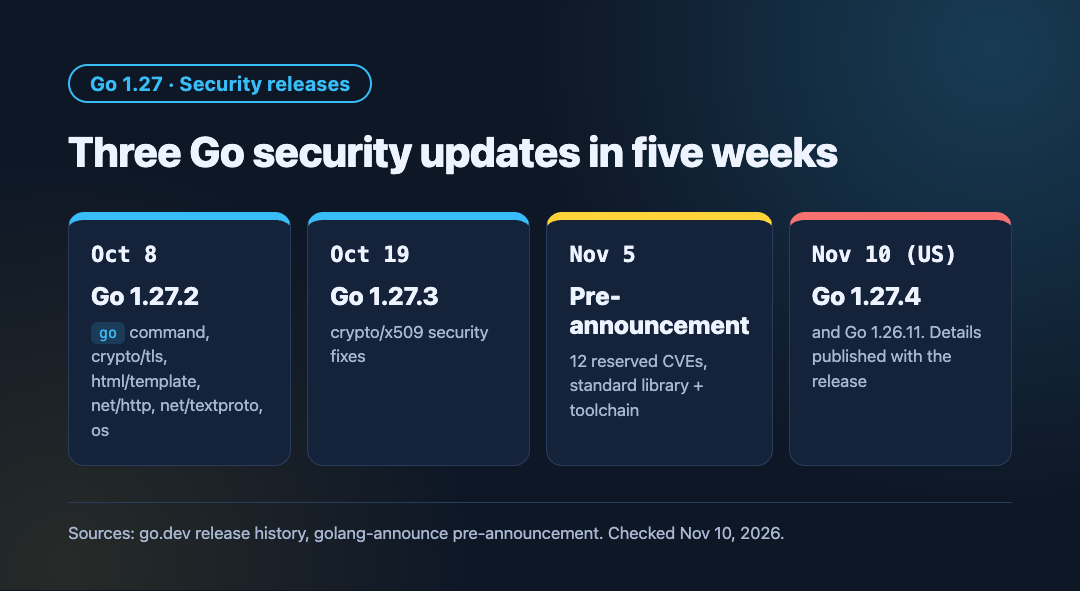
So you can't judge the risk yet. You can only make the upgrade cheap. The last two Go security releases show why it's worth it: Go 1.27.2 (October 8) fixed the go command plus crypto/tls, html/template, net/http, net/textproto and os, and Go 1.27.3 (October 19) fixed crypto/x509. Those are packages almost every Go service imports.
Which Go versions get the Go 1.27.4 fixes
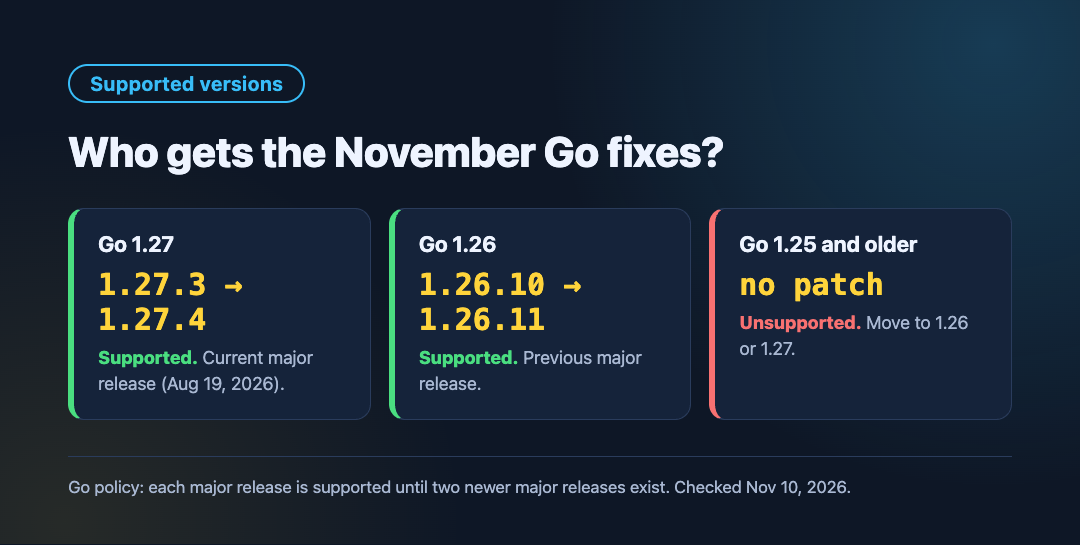
Go supports each major release until two newer major releases are out. Go 1.27 shipped on August 19, 2026, so only the 1.27 and 1.26 lines are supported now.
| Go line | Latest before fix | Fixed version | Status |
|---|---|---|---|
| 1.27 | 1.27.3 (Oct 19) | 1.27.4 | Supported |
| 1.26 | 1.26.10 (Oct 19) | 1.26.11 | Supported |
| 1.25 and older | — | None | Unsupported |
If you're still on Go 1.25, this release is a good deadline to move to 1.26 or 1.27. No 1.25.x patch is coming for these CVEs.
Check your Go version in five places
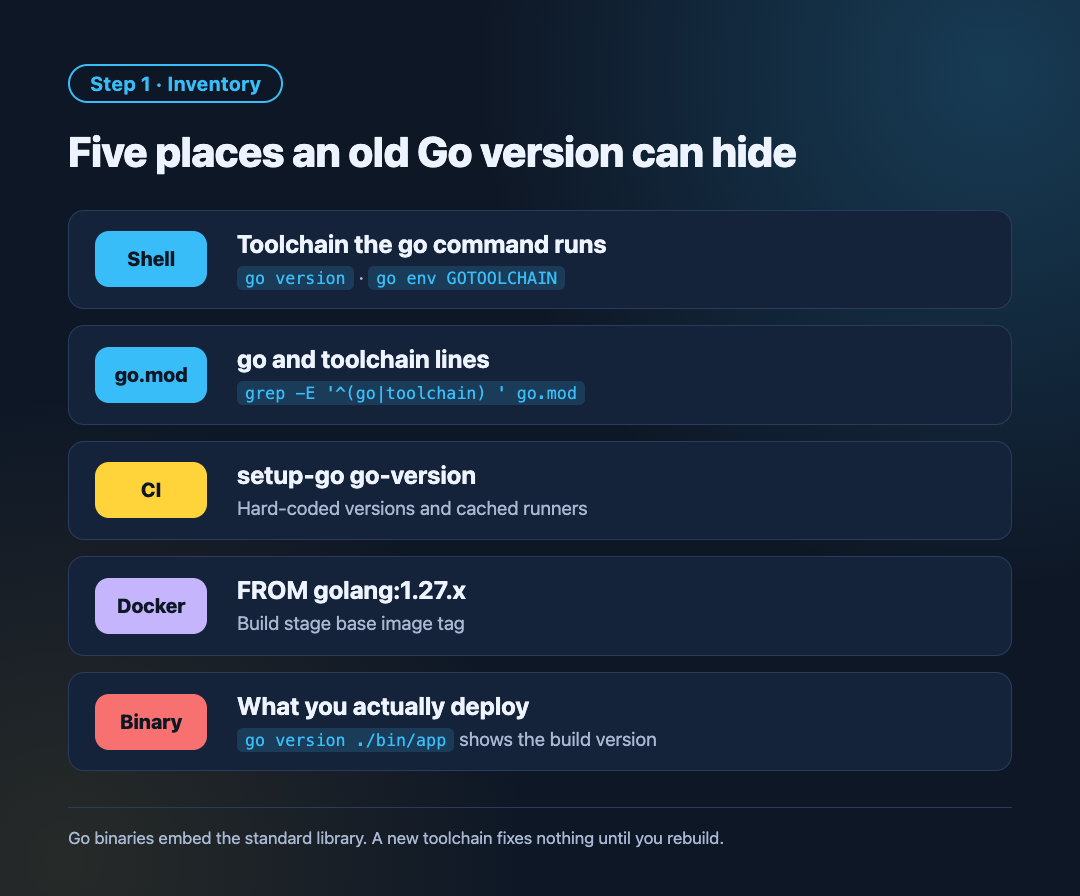
A Go upgrade fails quietly when you update your laptop but not the build. Go binaries are statically linked: the standard library is compiled into each binary. Updating the toolchain fixes nothing until you rebuild and redeploy.
Check these five places:
go version                       # 1. toolchain the go command runs (go.mod can switch it)
GOTOOLCHAIN=local go version     #    the bundled toolchain
go env GOTOOLCHAIN               #    auto, local, go1.27.3+auto, ...

grep -E '^(go|toolchain) ' go.mod                             # 2. module requirements
grep -rnE 'go-version|setup-go' .github/workflows/            # 3. CI workflows
grep -rnE '^FROM golang:' --include='Dockerfile*' .           # 4. Dockerfiles

go version ./bin/<YOUR_APP>                # 5. binaries you already built
go version -m ./bin/<YOUR_APP> | head -3   #    no Go source needed
go version <file> prints the Go version a binary was built with. Run it on what you deploy, not only on your build machine. A binary that reports go1.27.3 or go1.26.10 needs a rebuild after the release.
How to upgrade to Go 1.27.4 after release
Wait for the release announcement on golang-announce or the entry on go.dev/dl. You can check from a terminal:
curl -s 'https://go.dev/dl/?mode=json' | grep -o '"version": "go1\.2[67]\.[0-9]*"'When go1.27.4 (or go1.26.11) shows up, pick the method that matches how you manage Go.
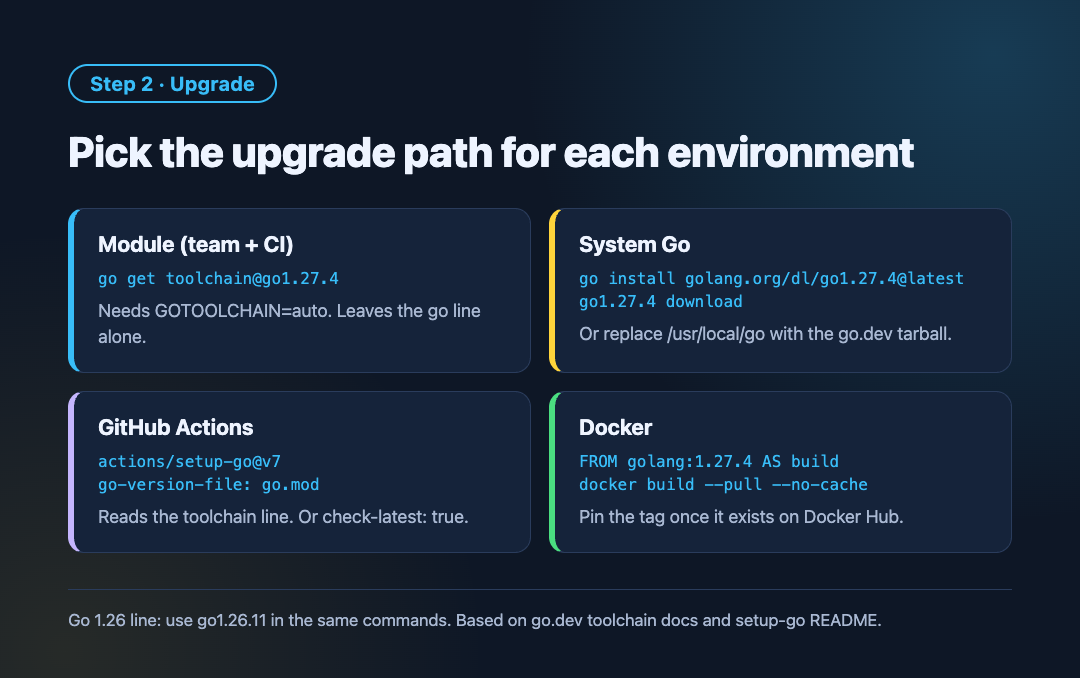
Option 1: Pin the toolchain in go.mod
With the default GOTOOLCHAIN=auto, the go command downloads the toolchain named in go.mod. Toolchain downloads go through GOPROXY and are verified against the Go checksum database. This is the fastest way to move a whole team and CI at once:
go get toolchain@go1.27.4    # Go 1.27 modules
go get toolchain@go1.26.11   # Go 1.26 modules

go mod tidy
git diff go.mod
This adds or updates the toolchain line and leaves the go line alone, so you don't raise the minimum language version for people who import your module. If you'd rather raise the minimum too, use go get go@1.27.4. Per the docs, the toolchain line is then deleted because it matches the go line.
Option 2: Update the system Go install
With GOTOOLCHAIN=local, the go command always runs the bundled toolchain and ignores the toolchain line. If that's your setup, or your build machines can't download toolchains, install the new version directly:
go install golang.org/dl/go1.27.4@latest   # side-by-side install, official wrapper
go1.27.4 download
go1.27.4 version

curl -LO https://go.dev/dl/go1.27.4.linux-amd64.tar.gz
sudo rm -rf /usr/local/go && sudo tar -C /usr/local -xzf go1.27.4.linux-amd64.tar.gz
The curl and tar lines are the other route: they replace /usr/local/go with the official Linux amd64 tarball. Package managers (Homebrew, apt, distro images) can lag a few hours or days behind go.dev. Check the version they install before you trust them.
Option 3: CI and container images
For GitHub Actions, actions/setup-go v6 and later read the toolchain directive from go.mod, so Option 1 updates CI too:
- uses: actions/setup-go@v7
  with:
    go-version-file: go.mod   # uses the toolchain line if present
If you pin go-version: '1.27.x' instead, add check-latest: true so the runner doesn't reuse a cached 1.27.3.
For Docker, pin the patch version in your build stage once the official image tag exists on Docker Hub, then rebuild without the cache:
FROM golang:1.27.4 AS build
WORKDIR /src
COPY . .
RUN CGO_ENABLED=0 go build -o /out/app ./cmd/app

FROM gcr.io/distroless/static-debian12
COPY --from=build /out/app /app
ENTRYPOINT ["/app"]
docker build --pull --no-cache -t <YOUR_IMAGE>:go1.27.4 .If you're tightening CI anyway, our guides on locking GitHub Actions dependencies and fixing pull_request_target before the brownout cover the workflow side.
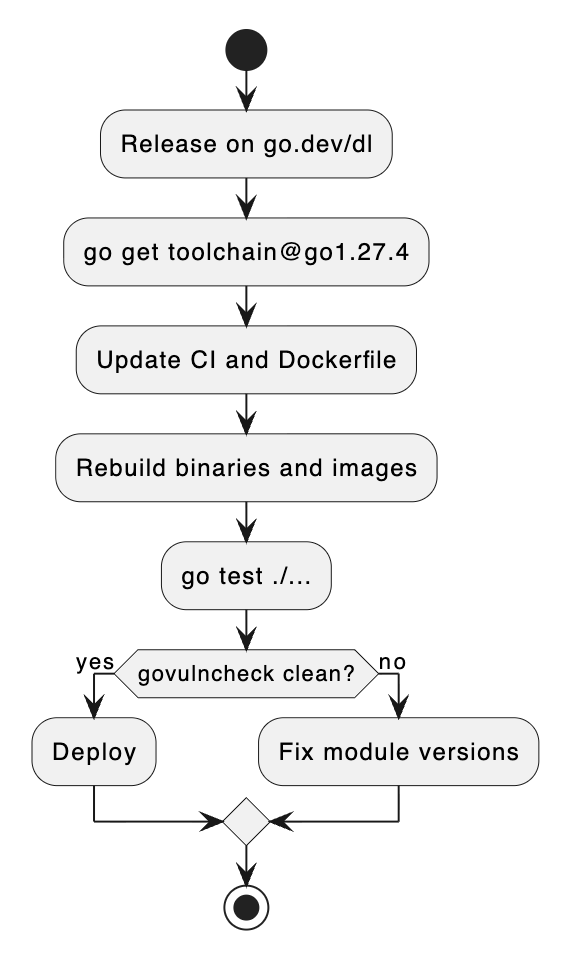
View PlantUML source
@startuml
start
:Release on go.dev/dl;
:go get toolchain@go1.27.4;
:Update CI and Dockerfile;
:Rebuild binaries and images;
:go test ./...;
if (govulncheck clean?) then (yes)
  :Deploy;
else (no)
  :Fix module versions;
endif
stop
@enduml
Verify the fix with govulncheck
After the release, the Go vulnerability database gets entries for the new CVEs. govulncheck then flags standard library findings when your code calls an affected function with an old Go version.
go install golang.org/x/vuln/cmd/govulncheck@latest

govulncheck ./...                            # source scan, run in the module root
govulncheck -mode=binary ./bin/<YOUR_APP>    # binary scan: Go version and modules compiled in
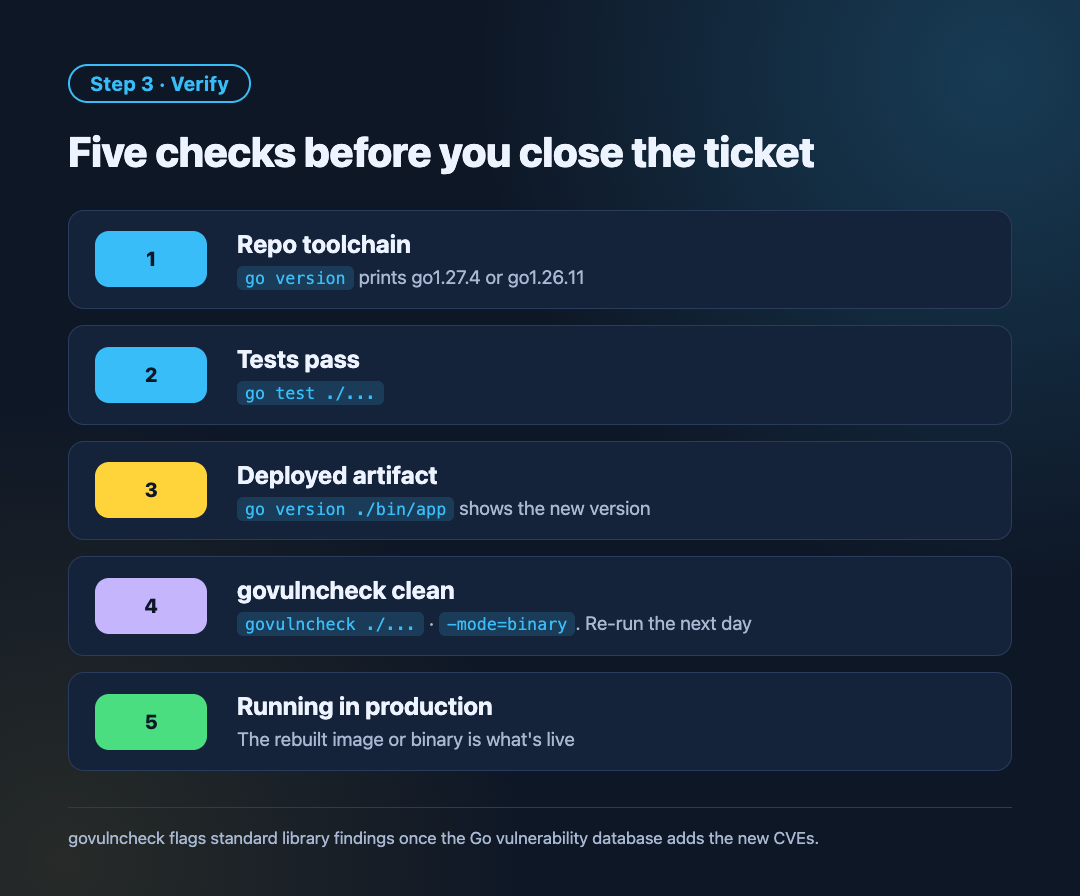
Before you call it done, run this short checklist:
go versionprintsgo1.27.4(orgo1.26.11) in the repo.go test ./...passes.go version ./bin/<YOUR_APP>on the deployed artifact shows the new version.govulncheckshows no standard library findings for the November CVEs.- The new image or binary is actually running in production.
The database entries may appear a little after the release itself, so run the scan again the next day.
If something breaks after the update
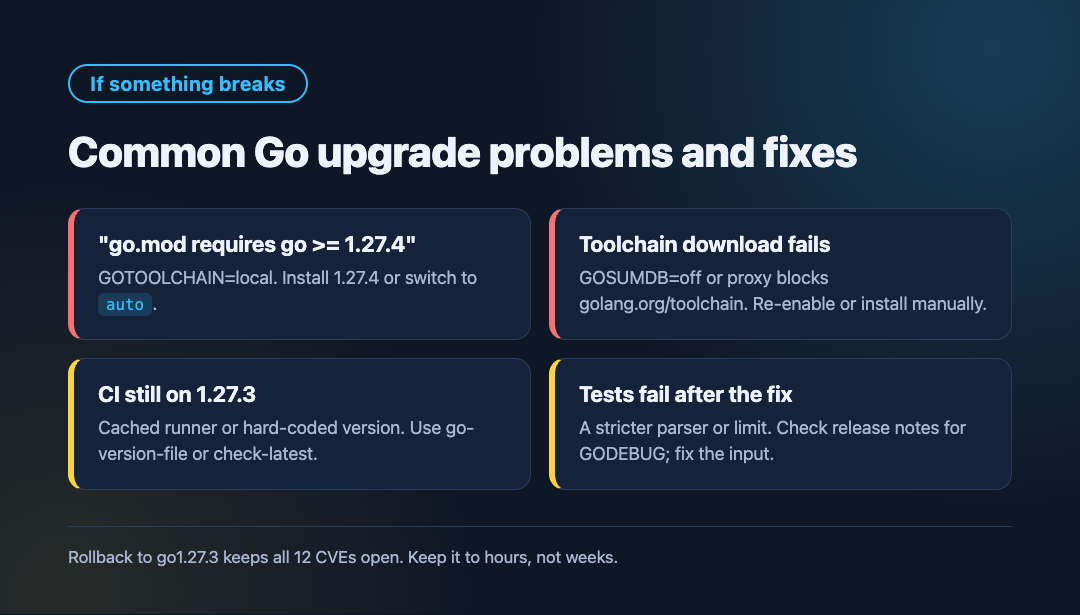
Most Go minor releases are drop-in. Problems usually come from toolchain switching or a security fix that tightens behavior.
| Symptom | Likely cause | Fix |
|---|---|---|
go.mod requires go >= 1.27.4 (running go 1.27.3; GOTOOLCHAIN=local) | go line raised, toolchain switching off | Install 1.27.4 locally, or set GOTOOLCHAIN=auto |
go version still says 1.27.3 after go get toolchain@ | GOTOOLCHAIN=local ignores the toolchain line | Same as above |
| Toolchain download fails | GOSUMDB=off, or the proxy blocks golang.org/toolchain | Re-enable the checksum DB, allow the module in your proxy, or install manually |
| CI still builds with 1.27.3 | Runner cache or hard-coded go-version | Use go-version-file: go.mod or check-latest: true |
| Tests fail after a security fix | Fix made a parser or limit stricter | Read the release notes for any new GODEBUG setting; fix the input rather than turn it off |
Per the toolchain docs, toolchain downloads fail on purpose when GOSUMDB=off, and GOPRIVATE or GONOSUMDB patterns don't apply to them. Air-gapped builds need a manual install (Option 2).
If you have to roll back, go get toolchain@go1.27.3 takes you back. But that version still has all 12 CVEs. Treat a rollback as hours, not weeks. Node.js has its own security release on November 11. Our Node.js security release prep guide uses the same inventory approach, so you can do both in one pass.
FAQ
Is Go 1.27.4 out yet? Not when this was written (November 10, 2026, 04:30 UTC). The Go team planned it for US business hours on Tuesday, November 10. Check go.dev/dl or golang-announce for the release post.
Which CVEs does Go 1.27.4 fix? The pre-announcement lists 12 reserved IDs: CVE-2026-97033 to CVE-2026-97043 and CVE-2026-97054. Which packages they affect and how severe they are will be published with the release.
Do I need to rebuild if I only ship binaries? Yes. The standard library is compiled into every Go binary, so a server with a new Go install still runs the old code until you rebuild and redeploy. go version <binary> tells you which version a file was built with.
I'm on Go 1.25. Will I get a patch? No. Go supports only the two latest major releases, now 1.27 and 1.26. Move to 1.26.11 or 1.27.4.
Should I use go get go@1.27.4 or go get toolchain@go1.27.4? For applications, either works. For libraries, prefer toolchain@, because raising the go line forces every module that imports yours onto Go 1.27.4 or later.
References
Checked on November 10, 2026.
- Go release history — go.dev (1.27.3 and 1.26.10, released October 19, 2026)
- Go security policy — go.dev (PRIVATE track and pre-announcements)
- Go toolchains — go.dev (GOTOOLCHAIN,
go get toolchain@, checksum rules) - Tutorial: Find and fix vulnerable dependencies with govulncheck — go.dev
- Go downloads — go.dev
- golang-announce mailing list — Go team (pre-announcement dated November 6 in the list view)
- Fwd: Go 1.27.4 and Go 1.26.11 pre-announcement — oss-security, November 5, 2026
- actions/setup-go README — GitHub (go-version-file, toolchain directive, check-latest)
1 thought on “Go 1.27.4 Security Release: How to Prepare and Patch 12 CVEs”