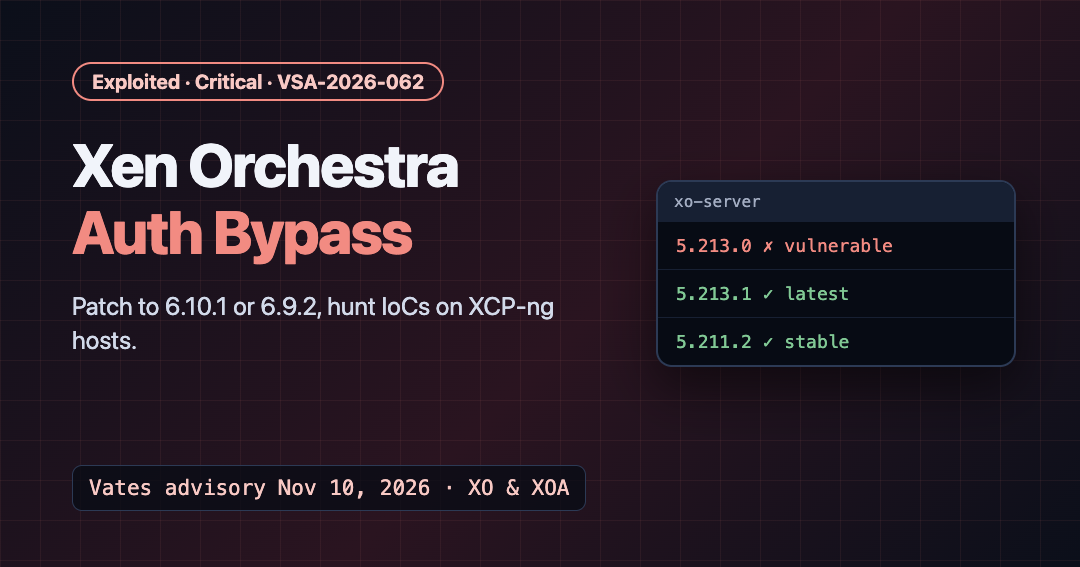
The Xen Orchestra auth bypass (VSA-2026-062) lets anyone who can reach the XO web interface log in as an existing user, often an admin, with a crafted cookie and no password. Vates says it is being actively exploited, and the attacker went on to take over XCP-ng hosts as root. Update to Xen Orchestra 6.10.1 (latest channel, xo-server 5.213.1) or 6.9.2 (stable channel, xo-server 5.211.2). Then check your hosts for the published indicators, and limit VM import to admins, because a second flaw (VSA-2026-063) has no fix yet.
Written November 17, 2026, 07:30 KST (November 16, 22:30 UTC). Facts checked on November 17, 2026 against the Vates advisories VSA-2026-062 and VSA-2026-063 (published November 10, 2026), the fix pull request #10748, the Xen Orchestra CHANGELOG, and the Xen Orchestra updater and install-from-sources docs. I have not run these commands on a live XO or XCP-ng system for this post. The detection commands come from the advisory. The firewall and proxy examples are generic Linux configs, so adapt them to your network.
What the Xen Orchestra auth bypass changes
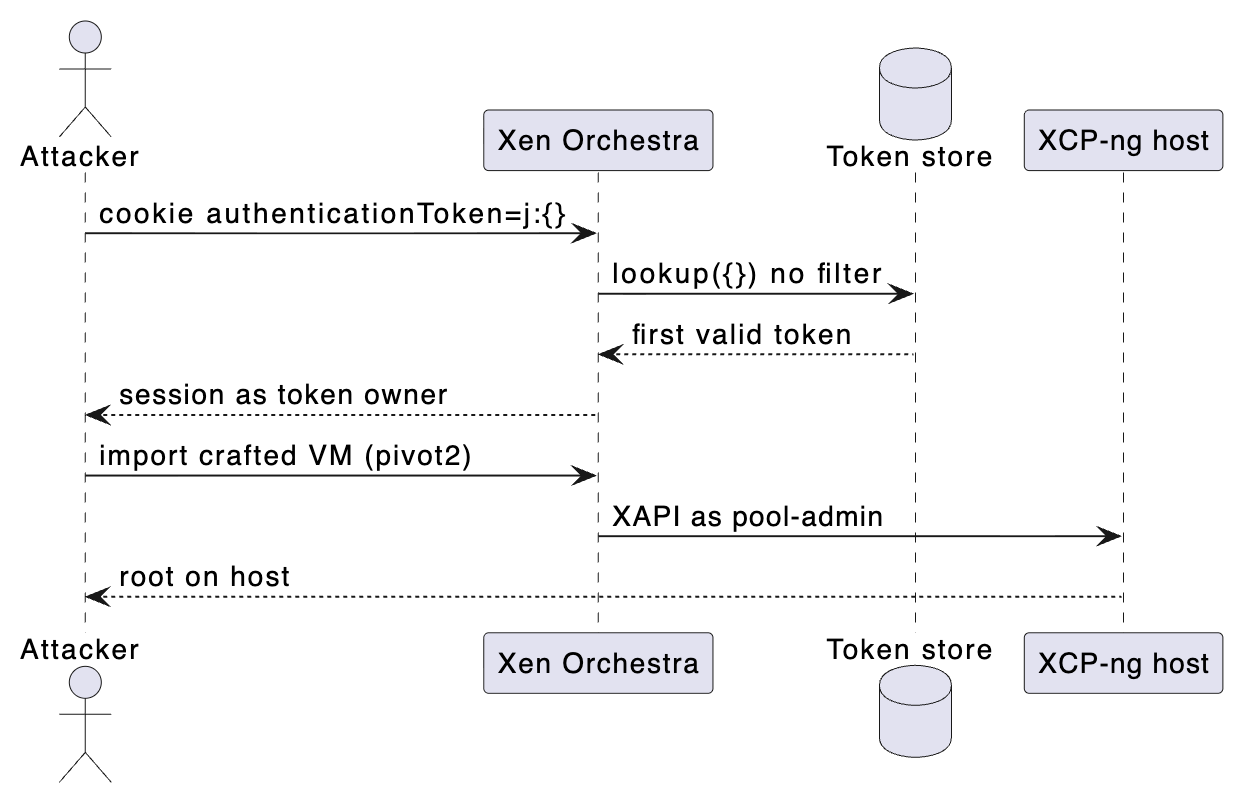
Xen Orchestra reads a REST cookie called authenticationToken. A value of j:{} is parsed as JSON, so the server gets an empty object instead of a token string. The token lookup then treats that object as a query with no filter. It returns the first unexpired token in the database and logs the attacker in as that token's owner. The response also exposes reusable login token IDs. With admin rights, the attacker can run code on managed pools and take over XCP-ng hosts as root.
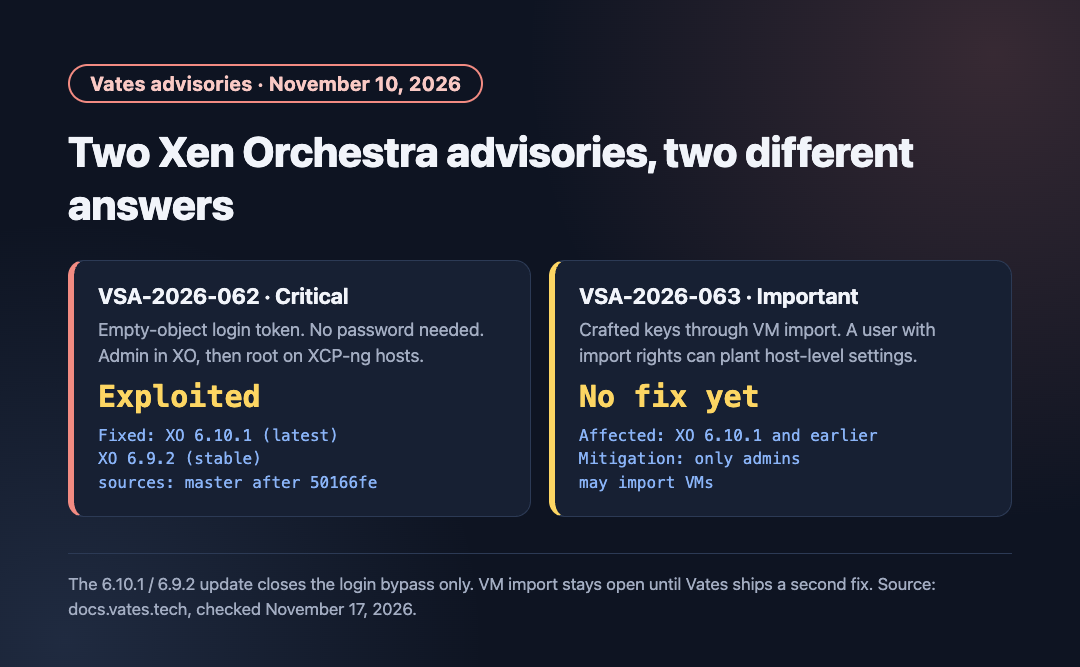
| Item | VSA-2026-062 | VSA-2026-063 |
|---|---|---|
| Title | Empty-object login token | Crafted keys through vm.import |
| Severity | Critical | Important |
| Exploited | Yes | Yes, after 062 gave admin |
| Fixed in | XO 6.10.1 / 6.9.2 | No fix yet |
Neither advisory had a CVE ID or CVSS score when I checked. The fix is pull request #10748, "fix(xo-server): validate authentication token IDs", merged on November 10 as commit 50166fe. It rejects token IDs that are empty or not strings before any database lookup.
View PlantUML source
@startuml
skinparam shadowing false
skinparam defaultFontSize 14
actor Attacker
participant "Xen Orchestra" as XO
database "Token store" as DB
participant "XCP-ng host" as Host
Attacker -> XO : cookie authenticationToken=j:{}
XO -> DB : lookup({}) no filter
DB --> XO : first valid token
XO --> Attacker : session as token owner
Attacker -> XO : import crafted VM (pivot2)
XO -> Host : XAPI as pool-admin
Host --> Attacker : root on host
@enduml
The second step, the crafted VM import, is VSA-2026-063. Vates says the attacker imported a VM with keys such as VM.platform:hvm_serial set, which the host then acted on. Any non-admin user who holds import rights can use the same path, so the update alone does not close it.
Check if your Xen Orchestra is vulnerable
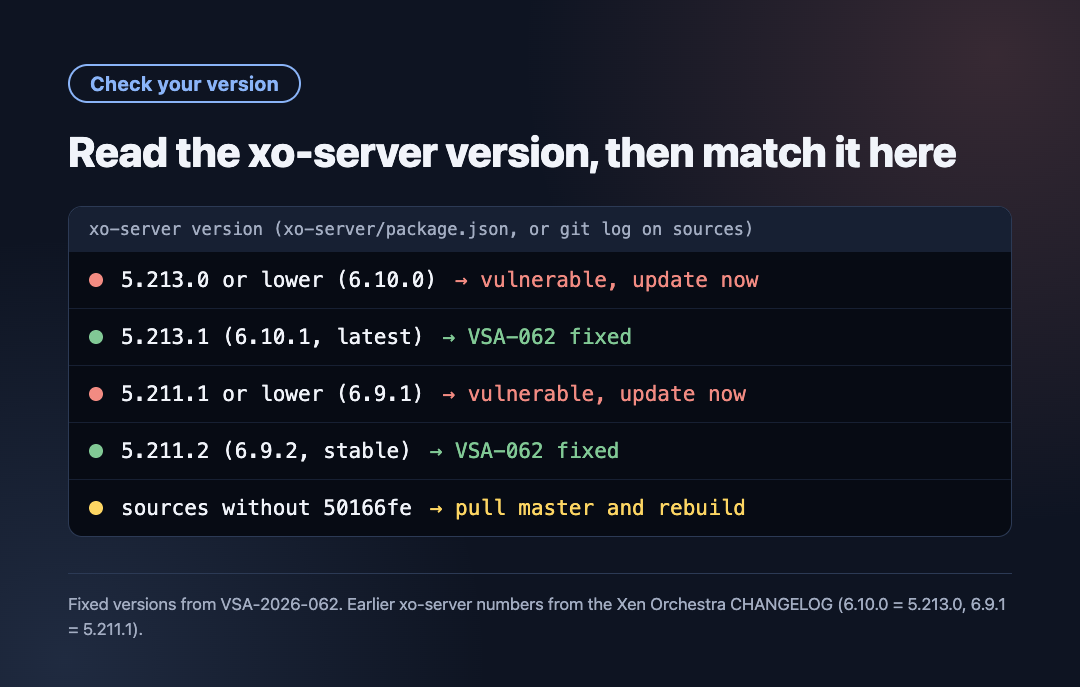
The fixed builds are tied to the xo-server package version. Older numbers come from the Xen Orchestra CHANGELOG: 6.10.0 shipped xo-server 5.213.0, and 6.9.1 shipped xo-server 5.211.1.
| xo-server version | XO release | Status |
|---|---|---|
| 5.213.0 or lower | 6.10.0 and older | Vulnerable |
| 5.213.1 | 6.10.1 (latest) | Fixed |
| 5.211.1 or lower | 6.9.1 and older | Vulnerable |
| 5.211.2 | 6.9.2 (stable) | Fixed |
XOA (the Vates appliance)
In the web interface, open XOA → Updates. The page shows the release channel and whether an upgrade is waiting. If it offers an upgrade, you are not on the fixed build for that channel. Over SSH, the updater gives the same answer:
xoa-updater # on the XOA appliance, as rootIt lists new packages if any are available. A pending xo-server update means you are behind.
To read the installed version directly, find the xo-server package.json. The path differs between installs, so search for it:
find / -path '*xo-server/package.json' -not -path '*/node_modules/*' 2>/dev/null \
  | xargs grep -H '"version"'
The output looks like …/xo-server/package.json: "version": "5.213.1",.
Built from sources
Source installs track master, so check for the fix commit instead of a version number:
cd ~/xen-orchestra   # your clone
git fetch origin
git merge-base --is-ancestor 50166fe3a49c02069d35ba9046ca4a1f77f4e11d HEAD \
  && echo "VSA-2026-062 fix present" \
  || echo "fix missing: update now"
grep '"version"' packages/xo-server/package.json
If the commit is in your history but you never ran yarn build, the running server is still old. Rebuild and restart, as shown below.
Patch Xen Orchestra to 6.10.1 or 6.9.2
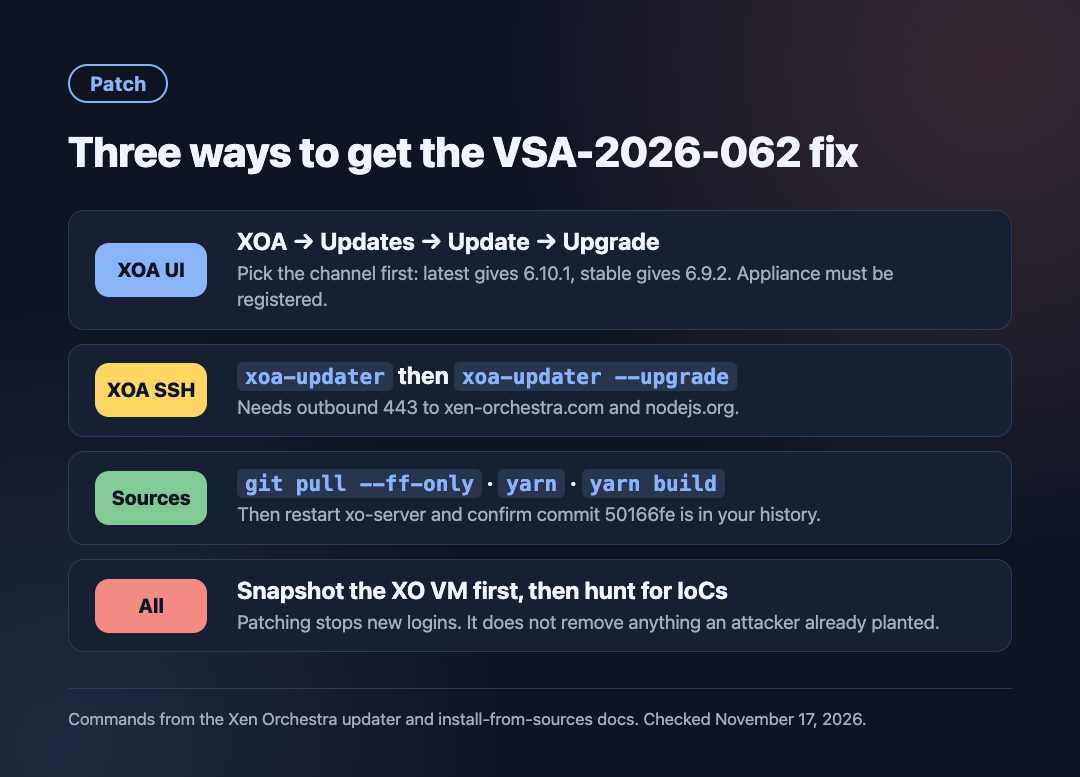
Take a snapshot of the XO VM first. If the update breaks something, you can go back while you troubleshoot. Keep reading for what that means for security.
XOA from the web interface
- Open XOA → Updates. A yellow bell means the appliance is not registered. Register with your Vates account first, or you get no updates.
- Pick the channel: latest installs 6.10.1, stable installs 6.9.2. Both carry the fix.
- Click Update to check, then the upgrade button. The interface reloads when xo-server restarts.
- Check the version again with the commands above.
XOA from SSH
xoa-updater            # check
xoa-updater --upgrade  # install
The updater needs outbound HTTPS (port 443) to xen-orchestra.com and nodejs.org. If you use a proxy, set it in the updater panel under XOA → Updates.
From sources
These are the official update steps. git checkout . throws away local changes to tracked files, so save any patches first.
cd ~/xen-orchestra
git checkout .
git pull --ff-only
yarn
yarn build
sudo systemctl restart xo-server   # or restart however you run it
Xen Orchestra wants the current Node.js LTS. Check it with node -v before you build. Vates offers no support or QA for source installs and recommends XOA for production.
Can't patch today? Temporary mitigations
Vates lists no setting that turns the bug off. It gives these mitigations. Each one has a cost.
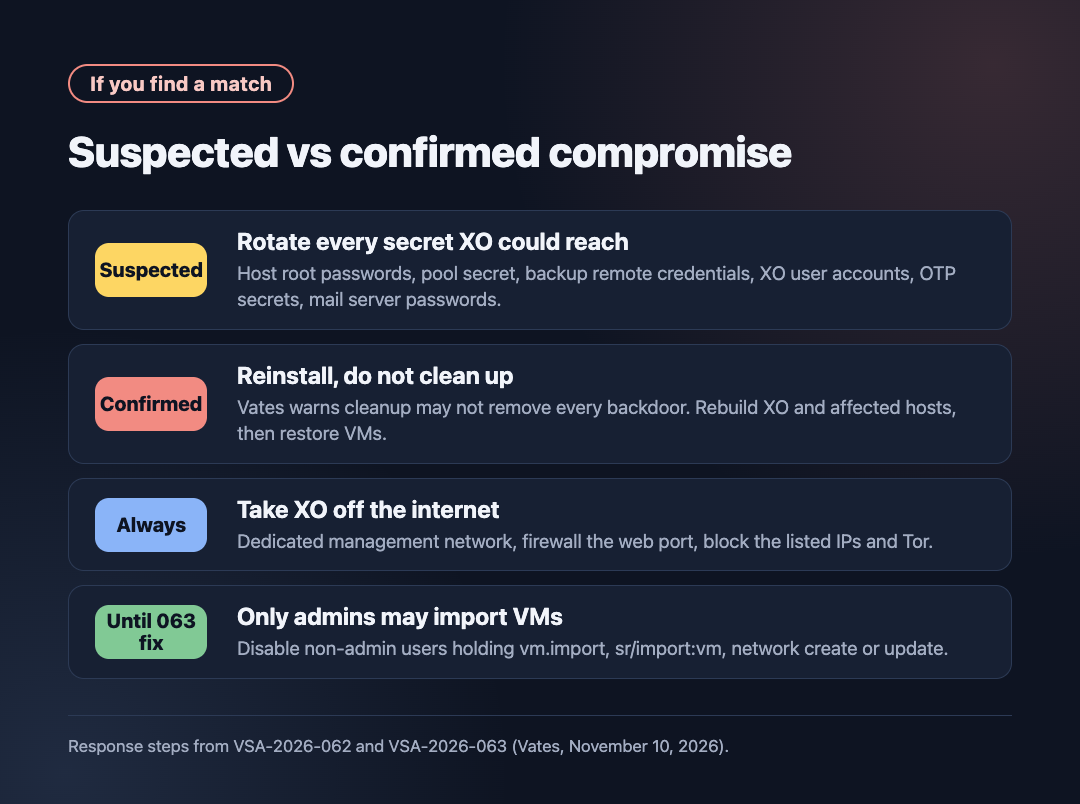
- Take XO off the internet. Put it on a dedicated management network. Cost: remote admins need a VPN or a bastion host.
- Block the attacker addresses, both ways. The advisory lists
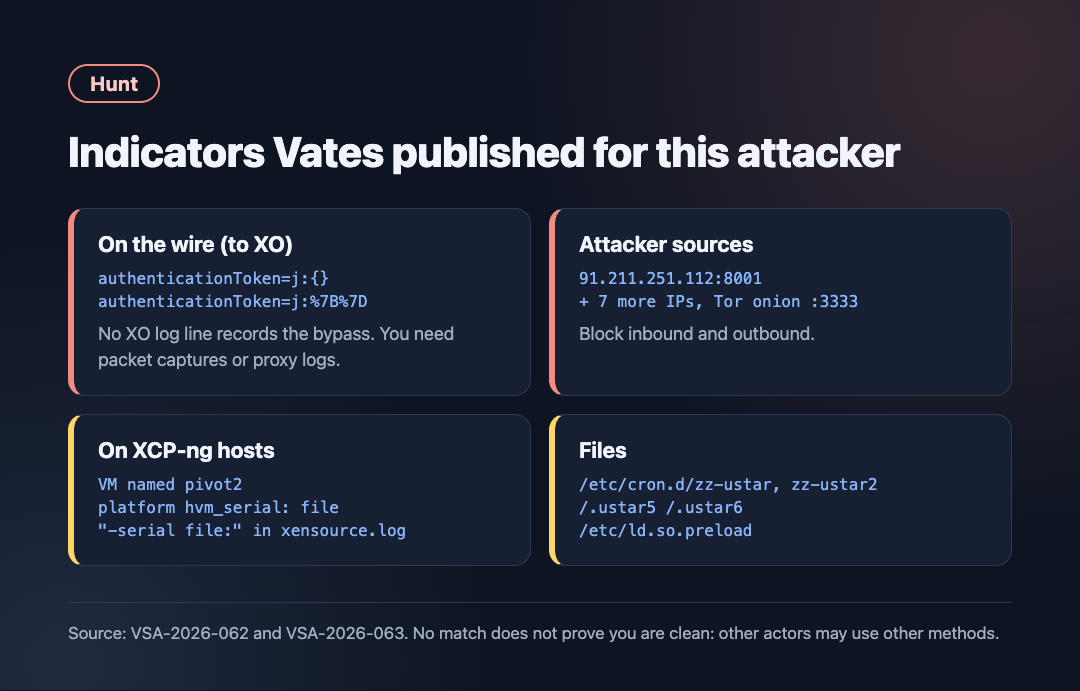
91.211.251.112,193.148.56.72,37.221.208.216,45.66.35.11,64.65.0.120,64.65.62.160,89.47.51.90and92.60.37.247, plus a Tor onion service on port 3333. Cost: none, but a new attacker will use other addresses. - Filter the cookie at a reverse proxy or WAF. Match
authenticationToken=j:{}andauthenticationToken=j:%7B%7D. Vates warns that regex rules may be bypassable, so treat this as a stopgap only.
A minimal nftables example for a Debian or Ubuntu XO VM that serves the UI on 80/443. Replace 10.0.10.0/24 with your admin subnet:
sudo nft add table inet xo
sudo nft add chain inet xo input '{ type filter hook input priority 0; policy accept; }'
sudo nft add rule inet xo input tcp dport '{ 80, 443 }' ip saddr != 10.0.10.0/24 drop
sudo nft add chain inet xo output '{ type filter hook output priority 0; policy accept; }'
sudo nft add rule inet xo output ip daddr '{ 91.211.251.112, 193.148.56.72, 37.221.208.216, 45.66.35.11, 64.65.0.120, 64.65.62.160, 89.47.51.90, 92.60.37.247 }' drop
If nginx sits in front of XO, a stopgap rule in the server block:
if ($http_cookie ~* "authenticationToken=j:(\{\}|%7B%7D)") {
    return 403;
}
For VSA-2026-063 there is one mitigation: let only admins import VMs. In the XO 5 interface, review Settings → Users and Settings → ACLs. Disable any non-admin user who holds vm.import, sr/import:vm, network/action:create or network/action:update. Cost: those users must ask an admin to import VMs until the fix ships.
Hunt for signs of compromise
Patching stops new logins through this bug. It does not remove anything the attacker already left behind. Vates notes that no XO log entry records the unauthenticated access, so a successful attack may leave no trace in XO itself.
On the XO side, look at network traffic. This only works where you can see plain HTTP, such as behind a TLS-terminating proxy:
sudo tcpdump -i any -l -A -s 0 'tcp port 80' \
  | grep -E 'authenticationToken=j:(\{\}|%7B%7D)'
On every XCP-ng host in the pools XO manages, run the advisory checks:
xe vm-list params=name-label,platform | grep -B2 'hvm_serial: file'   # file-backed serial port
xe vm-list name-label=pivot2                                           # attacker VM name
zgrep -- '-serial file:' /var/log/xensource.log*                       # host log evidence
ls -la /etc/cron.d/zz-ustar /etc/cron.d/zz-ustar2 /.ustar5 /.ustar6 /etc/ld.so.preload   # dropped files
Run the ls line on the XO VM too. On a clean system, ls should report "No such file or directory" for each path, and the xe and zgrep lines should print nothing. Any output deserves a closer look. Vates also warns that finding nothing does not prove you are clean, since other actors may use different methods.
If you find a match, the advisory gives two levels of response:
- Suspected compromise: rotate every secret XO could reach. That means host root passwords, the pool secret, backup remote credentials, XO user accounts, OTP secrets and mail server passwords.
- Confirmed compromise: reinstall. Vates says cleanup may not remove every backdoor. Rebuild XO and the affected hosts, then restore your VMs.
The same batch of advisories on November 10 also covered XCP-ng 8.3 host flaws, including a critical pool secret comparison issue (VSA-2026-057). Patch your hosts as well. If you followed our Linux kernel CVE-2026-98432 patch guide, VSA-2026-056 is the XCP-ng and XOA side of that bug.
Should you update now? Decision table
| Your setup | Exposure | Action |
|---|---|---|
| XO reachable from the internet, older than 6.10.1 / 6.9.2 | Highest | Update now, then hunt IoCs |
| XO on an internal network, older build | Anyone on that LAN | Update today |
| XOA or sources already on a fixed build | 062 closed, 063 open | Restrict VM import this week |
XCP-ng hosts managed only by xe or XAPI, no XO | Not affected by 062/063 | Patch hosts per VSA-2026-057 to 060 |
This is the same pattern as other exploited management-plane bugs this month, such as the Check Point CVE-2026-123039 patch: the management interface is the target, so network exposure decides how fast you move.
If the update fails
The updater cannot reach the server. Restart it with systemctl restart xoa-updater. Then check ping xen-orchestra.com, fix /etc/resolv.conf if DNS fails, and make sure the firewall allows outbound 443 to xen-orchestra.com and nodejs.org. If you just added the nftables rules above, make sure they only drop the listed attacker IPs on output.
"No manifest found for channel". XCP-ng forum users report this when the channel setting holds a value other than latest or stable. Set it back to one of the two under XOA → Updates and check again.
Source build finished, but the About page shows the old commit. The build tool skips packages it thinks are unchanged. Forum users fixed it with a forced rebuild:
yarn build --force
sudo systemctl restart xo-server
If a dependency fails to build, check node -v against the current Node.js LTS first.
Rolling back. On XOA, revert the snapshot you took before the update. For sources, git checkout <previous-commit>, then yarn and yarn build. Either way you are vulnerable again, so keep XO off the network until you can retry the update.
FAQ
Do I need to patch if Xen Orchestra is not exposed to the internet? Yes. The attacker only needs network access to the XO web interface, not a password. Anyone on that network segment, or any device an attacker controls there, can use it.
Does updating to 6.10.1 or 6.9.2 fix the VM import flaw too? No. VSA-2026-063 lists 6.10.1 and earlier as affected, and Vates had no fix in either channel as of November 10. Limit VM import and network create/update rights to admins until a fix is released.
Is there a CVE for the Xen Orchestra auth bypass? Not when I checked on November 17, 2026. Track it as VSA-2026-062. Some news reports list 6.10.0 and 6.9.1 as fixed versions, but the Vates advisory says 6.10.1 and 6.9.2.
Are XCP-ng hosts vulnerable on their own? Not to VSA-2026-062, which is an XO bug. Hosts become a target once an attacker has admin access in XO. XCP-ng 8.3 has its own separate critical advisories from the same day, so update hosts too.
Should I rotate secrets even if I found nothing? If XO was reachable from untrusted networks while unpatched, rotating is the safer call, since the bypass leaves no XO log entry. Vates recommends rotation when compromise is suspected.
References
- Vates, VSA-2026-062 "Empty-object login token": docs.vates.tech (checked November 17, 2026)
- Vates, VSA-2026-063 "Crafted keys through XO vm.import privilege": docs.vates.tech (checked November 17, 2026)
- Vates security advisories list (VSA-2026-055 to 063): docs.vates.tech (checked November 17, 2026)
- Xen Orchestra pull request #10748, "fix(xo-server): validate authentication token IDs": github.com (checked November 17, 2026)
- Xen Orchestra CHANGELOG: github.com (checked November 17, 2026)
- Xen Orchestra docs, Updater: github.com/vatesfr/xen-orchestra (checked November 17, 2026)
- Xen Orchestra docs, Install from sources: github.com/vatesfr/xen-orchestra (checked November 17, 2026)
- XCP-ng forum, stale build after update (
yarn build --force): xcp-ng.org (checked November 17, 2026) - BleepingComputer, "Critical Xen Orchestra auth bypass flaw exploited to hijack VM servers": bleepingcomputer.com (checked November 17, 2026)
1 thought on “Xen Orchestra Auth Bypass: Patch to 6.10.1 or 6.9.2 Now”