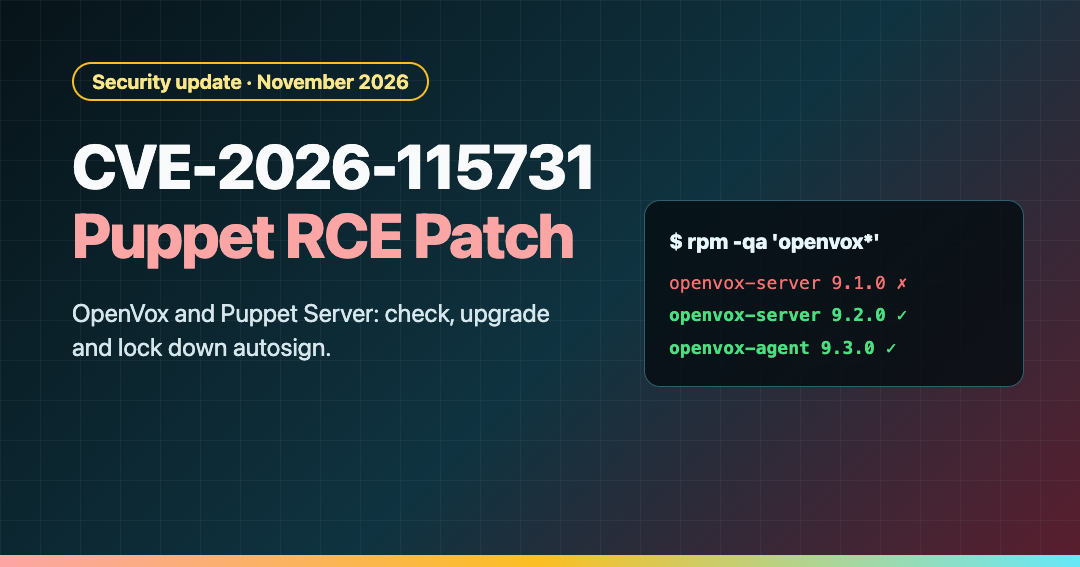
CVE-2026-115731 lets any node with a signed agent certificate run code on your Puppet or OpenVox server by sending one crafted report. It shipped with a second critical bug, CVE-2026-115732, that lets a certificate for evil.web01.example.com act as web01.example.com. The fix is a package upgrade: openvox-agent 8.32.0 or 9.3.0 plus openvox-server and openvoxdb 8.18.0 or 9.2.0 on the server host, or Puppet Enterprise 2023.8.13, 2025.12.1 or 2026.0.1. Open source Puppet from Perforce gets no fix, so plan a move to OpenVox.
Written November 8, 2026. Facts checked on November 8, 2026 (KST) against the Vox Pupuli advisory (November 3, updated November 4), the OpenVox oss-security post (November 3), the CVE records published by Perforce (November 3) with CISA enrichment (November 6), the openvox-server release notes on GitHub, the OpenVox install page and the Neodyme research write-up. The commands below follow the OpenVox and Puppet documentation. They were not run against a live Puppet server for this post.
What CVE-2026-115731 and CVE-2026-115732 change
Puppet agents send a JSON report to the server after every run. The Vox Pupuli advisory explains that, for some custom resource types, a report event can carry a serialized Ruby object. The server deserializes it, and a crafted object runs code there. Neodyme, who found the bug, says the code runs as the puppet service user, and that from there an attacker can read the CA signing key.
The second bug sits in trapperkeeper-authorization, the library that reads auth.conf. Plain hostnames in rules were matched like wildcards. A certificate whose name extends an allowed hostname passed the check.
A third issue hit only the OpenVoxDB container image. A missing tool made the certificate allowlist script fail at startup, so the API accepted any certificate.
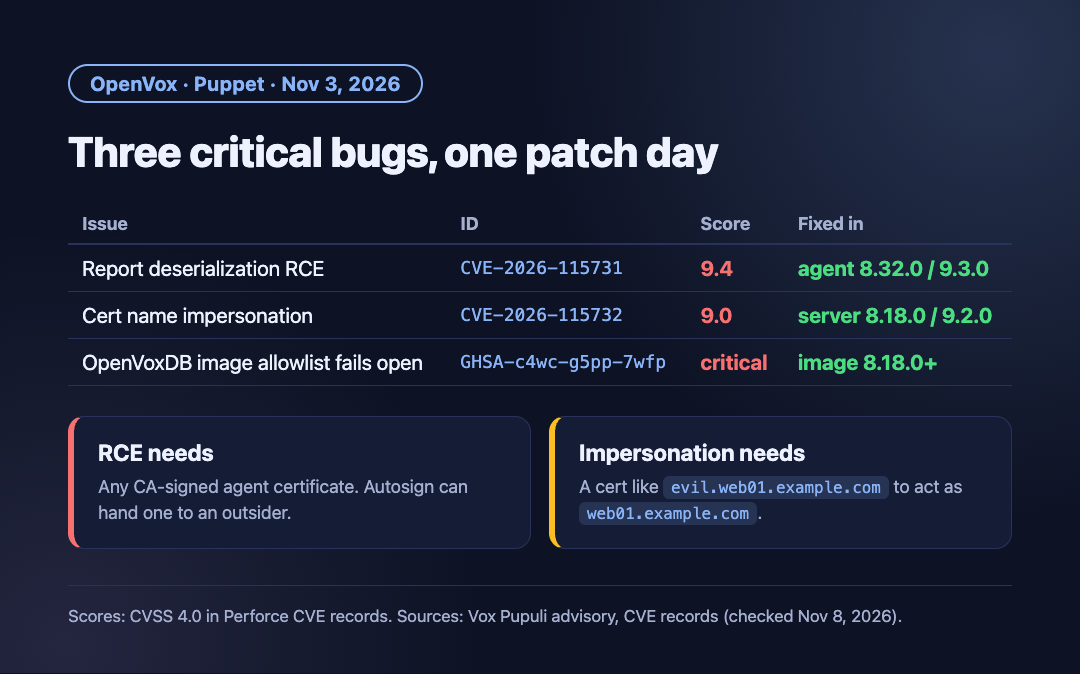
| Issue | ID | Score | Fixed in |
|---|---|---|---|
| Report deserialization RCE | CVE-2026-115731 / GHSA-ffr6-rwpm-p5wq | CVSS 4.0 9.4 | openvox-agent 8.32.0 / 9.3.0 |
| Certificate name impersonation | CVE-2026-115732 / GHSA-q4hm-33rc-572g | CVSS 4.0 9.0 (9.5 in the GitHub advisory) | openvox-server 8.18.0 / 9.2.0 |
| OpenVoxDB container allowlist fails open | GHSA-c4wc-g5pp-7wfp | Critical | openvoxdb image 8.18.0 or later |
Who is at risk
The report endpoint needs mutual TLS, so the attacker needs a signed agent certificate. That sounds like a high bar, but it is not always one:
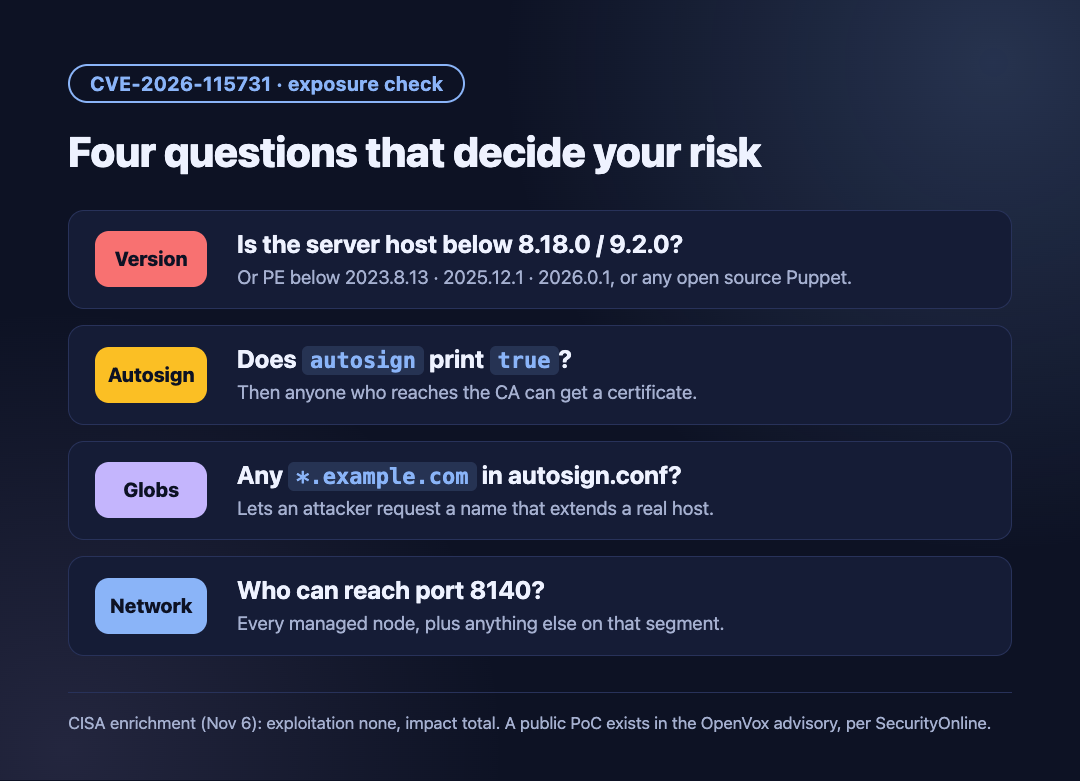
- Autosign. The CVE record says that if your CA autosigns requests without strong checks, an unauthenticated attacker on the network can get a certificate. Neodyme notes autosign is common in large fleets and in provisioning tools.
- Any compromised node. Every managed server already holds a valid certificate. One hacked web server can now reach code execution on the Puppet server that manages all the others.
- Wildcard autosign patterns. A rule like
*.example.comlets an attacker requestevil.db01.example.comand then use CVE-2026-115732 to act asdb01.example.com. Neodyme says that gives access to that host's catalog, which may hold credentials.
Exploitation status on November 8, 2026
- CISA's enrichment of both CVE records (November 6) lists exploitation as none and technical impact as total.
- SecurityOnline reported on November 4 that the OpenVox GitHub advisory includes a working malicious report. That is a public proof of concept.
- The same article later linked a Reddit thread as evidence that CVE-2026-115732 was exploited. I could not confirm that against an official source. Treat it as unverified, not as proof that it is safe.
Check your OpenVox or Puppet version
Run this on the server host first. That is where the vulnerable report code runs.
dpkg-query -W -f='${Package} ${Version}\n' 'openvox*' 'puppet*' 2>/dev/null   # Debian / Ubuntu
rpm -qa 'openvox*' 'puppet*'                                                    # RHEL family, Fedora, Amazon Linux

/opt/puppetlabs/bin/puppet --version          # agent (either family)
/opt/puppetlabs/bin/puppetserver --version    # server
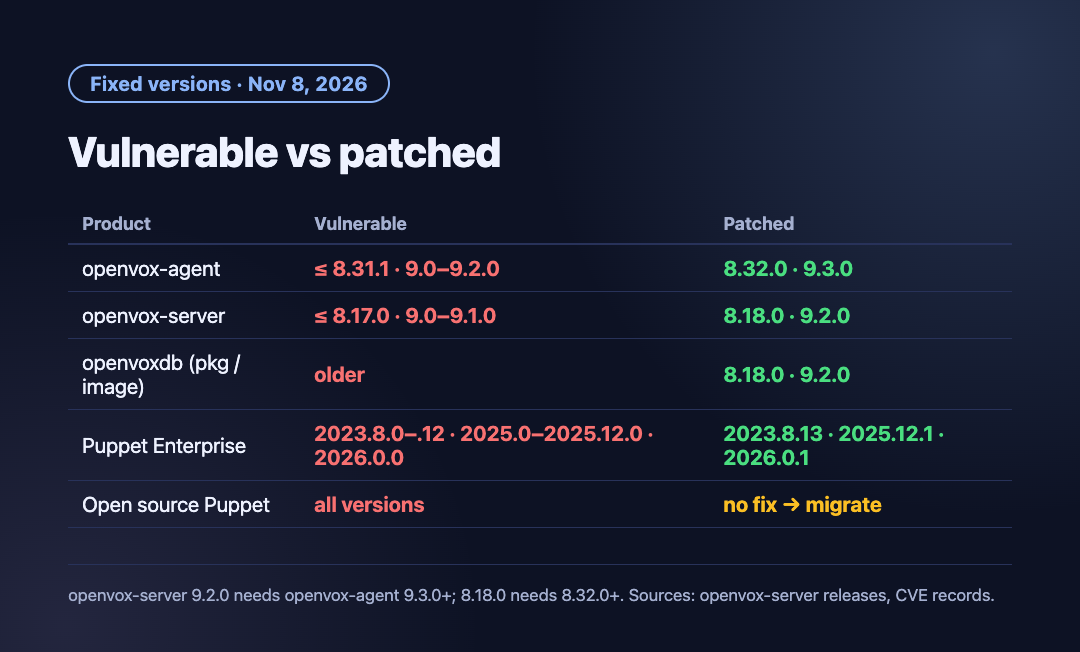
Compare the output with this table. If the package name starts with puppet (for example puppet-agent, puppetserver), you run Perforce's build, not OpenVox.
| You run | Vulnerable | Patched |
|---|---|---|
| openvox-agent | 8.31.1 and older, 9.0–9.2.0 | 8.32.0, 9.3.0 |
| openvox-server | 8.17.0 and older, 9.0–9.1.0 | 8.18.0, 9.2.0 |
| openvoxdb (package or image) | older than 8.18.0 / 9.2.0 | 8.18.0, 9.2.0 |
| Puppet Enterprise | 2023.8.0–2023.8.12, 2025.0.0–2025.12.0, 2026.0.0 | 2023.8.13, 2025.12.1, 2026.0.1 |
| Open source Puppet (Perforce) | All versions | No fix planned |
The Puppet Enterprise ranges come from the CVE records. The record for CVE-2026-115731 says the fixed PE releases bundle puppet-agent 8.22.2 or 9.1.3, and that Puppet Server must be restarted after the upgrade.
Check autosign and auth.conf
sudo /opt/puppetlabs/bin/puppet config print autosign --section server
sudo cat /etc/puppetlabs/puppet/autosign.conf 2>/dev/null
sudo grep -n -B2 -A6 'allow' /etc/puppetlabs/puppetserver/conf.d/auth.confautosignprintstrue(sign everything), a file path (policy script orautosign.conf), orfalse(manual signing).- Glob patterns such as
*.example.cominautosign.confare the risky part for CVE-2026-115732. - Plain-hostname
allowrules inauth.confare the ones that were matched too loosely before the fix.
If autosign prints true, anyone who can reach port 8140 can get a certificate. Fix that today, even before you patch.
Upgrade OpenVox to 8.18.0 or 9.2.0
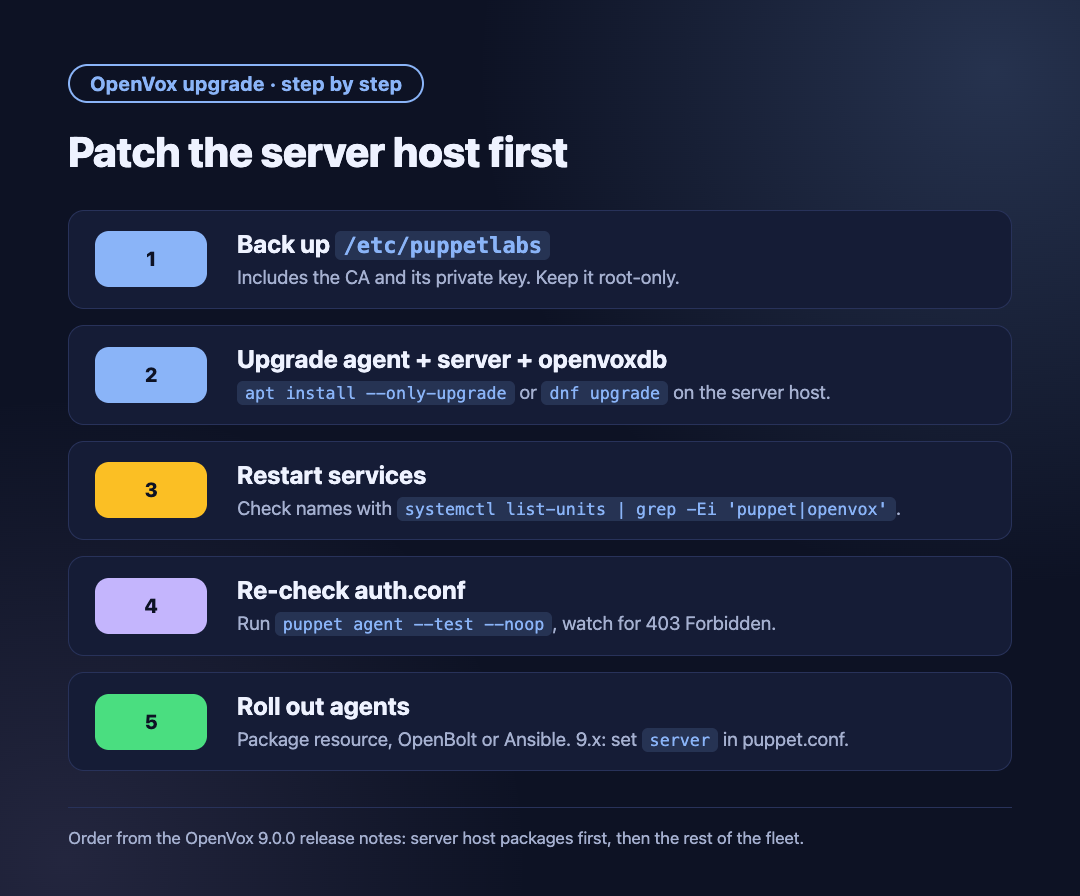
The OpenVox 9.0.0 release notes give the order: upgrade the agent, server and database packages on the server host, then the agents in the rest of the fleet. The server packages pin the agent version. openvox-server 9.2.0 needs openvox-agent 9.3.0 or newer, and 8.18.0 needs 8.32.0 or newer.

View PlantUML source
@startuml
skinparam shadowing false
skinparam defaultFontSize 15
left to right direction
rectangle "Back up\n/etc/puppetlabs" as A
rectangle "Server host:\nagent + server\n+ openvoxdb" as B
rectangle "Restart\nservices" as C
rectangle "Re-check\nauth.conf" as D
rectangle "Fleet\nagents" as E
A --> B
B --> C
C --> D
D --> E
@enduml
1. Back up the config and CA
sudo tar czf /root/puppetlabs-backup-$(date +%F).tgz /etc/puppetlabsThis archive includes the CA directory and its private key. Keep it somewhere only root can read.
2. Upgrade the server host
Find the exact service names first. They can differ between builds.
systemctl list-units --type=service | grep -Ei 'puppet|openvox'Debian and Ubuntu:
sudo apt update
sudo apt install --only-upgrade openvox-agent openvox-server openvoxdb openvoxdb-termini
sudo systemctl restart puppetserver     # use the name from list-units
sudo systemctl restart puppetdb         # if OpenVoxDB runs on this host
RHEL family:
sudo dnf upgrade openvox-agent openvox-server openvoxdb openvoxdb-termini
sudo systemctl restart puppetserver
sudo systemctl restart puppetdb
Then confirm the versions with the dpkg-query or rpm -qa command from the check section. Skip openvoxdb and openvoxdb-termini if they are not installed.
3. Containers
The advisory says to use the OpenVoxDB image tag 8.18.0 or newer, or latest. Pin a version rather than latest so you know what runs:
services:
  openvoxdb:
    image: <YOUR_OPENVOXDB_IMAGE>:8.18.0   # or 9.2.0
  openvoxserver:
    image: <YOUR_OPENVOXSERVER_IMAGE>:8.18.0   # or 9.2.0
docker compose pull
docker compose up -d
docker compose ps4. Re-check auth.conf
Vox Pupuli warns that some custom auth.conf rules may have worked only because of the old, loose matching. After the restart, run one agent in test mode against the server and watch for 403 Forbidden:
sudo /opt/puppetlabs/bin/puppet agent --test --noop
sudo journalctl -u puppetserver --since "15 min ago" | grep -i -E 'forbidden|denied'
If a rule now denies a host it should allow, write the full hostname or a real regex in that rule. Do not loosen it back to a broad match.
5. Upgrade agents across the fleet
Use whatever already rolls out packages for you: a Puppet package resource, OpenBolt, Ansible or your image pipeline. A minimal manifest:
package { 'openvox-agent':
  ensure => latest,   # or pin the exact 8.32.0 / 9.3.0 package version
}
If you move agents from 8.x to 9.x at the same time, check the 9.0.0 notes first. OpenVox 9 no longer falls back to the server name puppet, so set server in each agent's puppet.conf.
Puppet Enterprise and open source Puppet
Puppet Enterprise. Upgrade to 2023.8.13, 2025.12.1 or 2026.0.1 with the normal PE upgrade process, then restart Puppet Server as the CVE record says. Neodyme showed that on PE an attacker could reach root on managed hosts through the PXP orchestration agent, so do not wait for a maintenance window if your primary server is reachable from many networks.
Open source Puppet. Vox Pupuli says Puppet will not get any more updates, security or otherwise, and Neodyme reports the RCE works back to Puppet 6.24.0 from 2021. The fix is a migration. The OpenVox install page says Puppet and OpenVox cannot be installed on the same system, and to back up /etc/puppetlabs/ first. On Debian or Ubuntu the outline is:
sudo tar czf /root/puppetlabs-backup-$(date +%F).tgz /etc/puppetlabs
sudo systemctl stop puppetserver puppetdb puppet
sudo apt remove puppet-agent puppetserver puppetdb puppetdb-termini   # remove, not purge
sudo apt install ./<OPENVOX8_RELEASE_PACKAGE>.deb   # repo package for your distro from apt.voxpupuli.org
sudo apt update
sudo apt install openvox-agent openvox-server openvoxdb openvoxdb-termini
Vox Pupuli publishes migration guides from Puppet 7 to OpenVox 8 and from OpenVox 8 to 9. Go to OpenVox 8 first if you are on Puppet 7 or 8, then move to 9 later.
If you cannot patch today
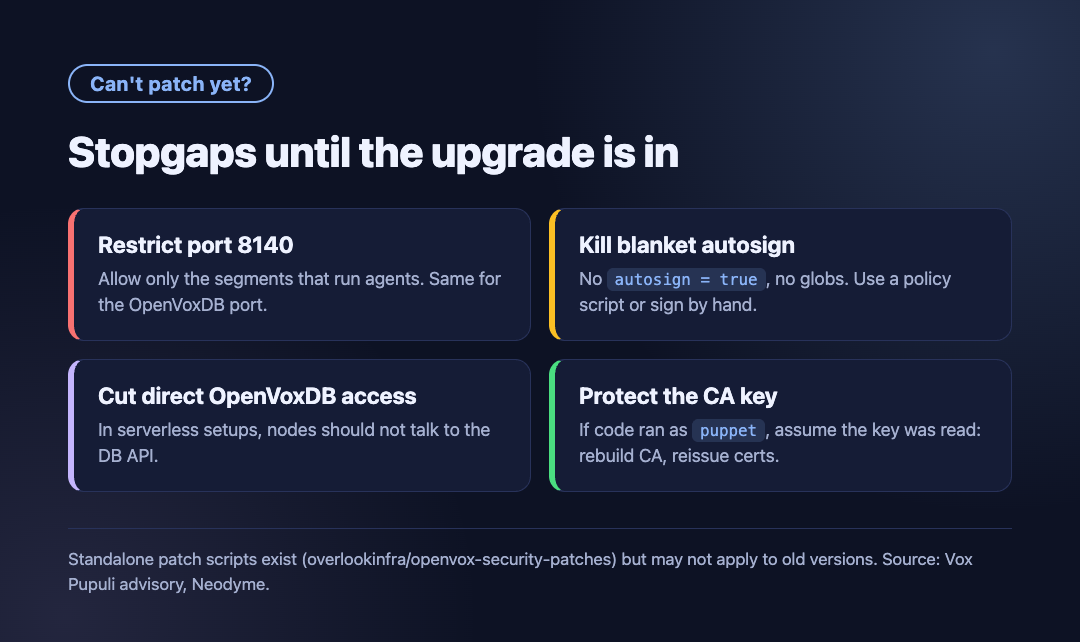
The advisory lists these stopgaps:
- Limit network access to port 8140 (and the OpenVoxDB port) to the segments that need it.
- Turn off or tighten autosign. Replace
autosign = trueand glob patterns with a policy script that checks a pre-shared value in the CSR, or sign by hand. - In serverless setups, cut direct OpenVoxDB access from individual nodes.
- Standalone patch scripts exist in the overlookinfra/openvox-security-patches repository. Vox Pupuli says they may not apply cleanly to old versions and that you use them at your own risk.
Neodyme adds hardening that still helps after you patch: protect the CA private key, keep catalog files owned by a user other than puppet, and turn off orchestration (PXP, Choria) if you do not use it.
Look for signs of abuse
There are no official indicators of compromise. These checks follow from how the bugs work.
Certificates that extend another node's name. This prints every signed certname that ends with . plus another certname:
cd /etc/puppetlabs/puppetserver/ca/signed
ls *.pem | sed 's/\.pem$//' | sort > /tmp/certnames
while read -r a; do
  while read -r b; do
    [ "$a" != "$b" ] && case "$a" in *".$b") echo "CHECK: $a extends $b";; esac
  done < /tmp/certnames
done < /tmp/certnames
Older open source Puppet installs may keep the CA under /etc/puppetlabs/puppet/ssl/ca/signed instead. Revoke anything you cannot explain with puppetserver ca revoke --certname <NAME>.
Unexpected processes or jobs owned by the puppet user.
ps -u puppet -o pid,ppid,etime,cmd
sudo crontab -l -u puppet
sudo find / -user puppet -newer /etc/puppetlabs/puppet/puppet.conf -type f 2>/dev/null | grep -v -E '^/(proc|opt/puppetlabs|var/log)'
Anything besides the Java server process is worth a closer look. If you find signs that code ran as puppet, assume the CA key was read. That means rebuilding the CA and reissuing every agent certificate, and treating secrets in your catalogs as exposed. Our cPGuard compromise cleanup guide walks through the same "contain, check, rotate" order for a root-level server compromise.
FAQ
Do I need to patch if autosign is off? Yes. Any node you manage already has a valid certificate. If one of them is compromised, it can send the malicious report. Autosign only makes it easier for an outsider.
Is updating agents enough? No. Patch the server host first: the agent package there carries the report code the server uses, and openvox-server carries the auth.conf fix. Agents across the fleet come after.
Why do the scores differ between sources? Perforce's CVE record scores CVE-2026-115732 at 9.0 with CVSS 4.0. The openvox-server release notes cite 9.5 from the GitHub advisory. Both rate it critical, so the patch priority does not change.
I use Perforce's Puppet Core, not Enterprise. What applies? The CVE records list only Puppet Enterprise ranges. The CVE-2026-115731 record names puppet-agent 8.22.2 and 9.1.3 as the fixed builds. Check Perforce's support pages for the Puppet Core package that matches.
Do my Debian or Ubuntu servers need anything else this week? If they pull packages through a mirror or proxy, also check our APT CVE-2026-109518 patch guide. After this patch, a regular review of who can get a certificate from your Puppet CA is the next useful step.
References
- Vox Pupuli: Critical CVE updates in all known versions of Puppet and OpenVox — official advisory, fixed versions and mitigations (checked November 8, 2026)
- CVE-2026-115731 record and CVE-2026-115732 record — Perforce as CNA, with CISA enrichment (checked November 8, 2026)
- Perforce: Report Deserialization Code Execution and Certificate Name Authorization Bypass — official (checked November 8, 2026)
- openvox-server releases on GitHub — 9.2.0 and 8.18.0 notes (checked November 8, 2026)
- OpenVox install page — repositories and packages (checked November 8, 2026)
- OpenVox 9.0.0 release notes — upgrade order and agent
serversetting (checked November 8, 2026) - oss-security: OpenVox Server RCE and client impersonation vulnerabilities (checked November 8, 2026)
- Neodyme: Pulling the right strings for RCE on a Puppet — researcher write-up (checked November 8, 2026)
- SecurityOnline: PoC and technical details for CVE-2026-115731 — news coverage (checked November 8, 2026)