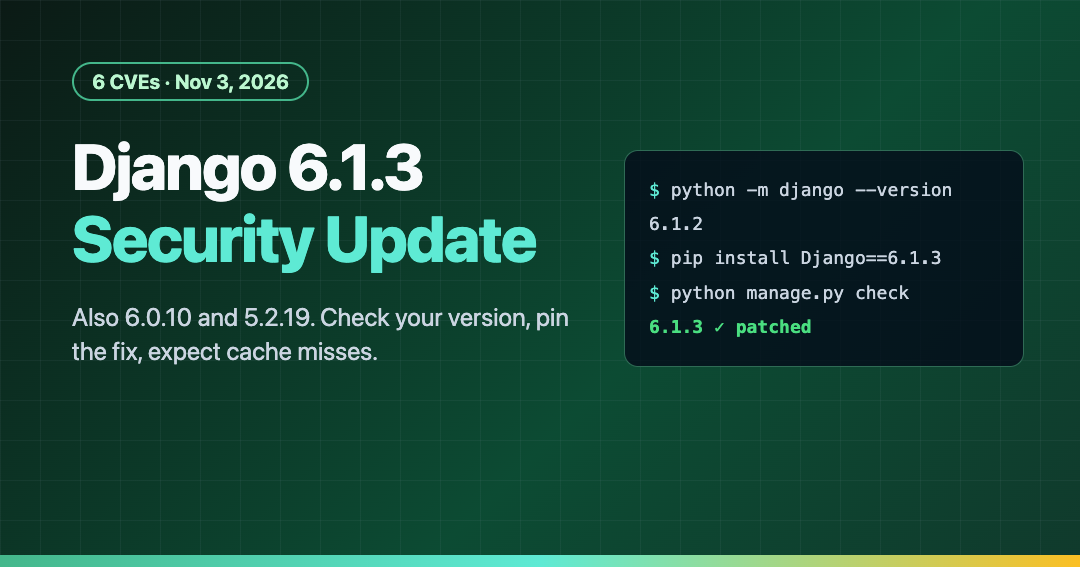
The Django 6.1.3 security update, released on November 3, 2026 together with 6.0.10 and 5.2.19, fixes six CVEs: one rated moderate (an SSRF in GeoDjango's GeoJSON handling) and five rated low. Every supported branch is affected, so upgrade to 6.1.3, 6.0.10 or 5.2.19 now. If you use per-view or site-wide caching, expect a short burst of cache misses after the deploy, because cache keys for Vary headers changed.
Written November 7, 2026. Facts checked on November 7, 2026 (KST) against the Django project's security release announcement (November 3, 2026), the official release notes for 6.1.3, 6.0.10 and 5.2.19, and the Django supported versions table. The commands are standard pip, uv, Poetry and Django management commands. They were not run against a production project for this post.
What changed in the Django 6.1.3 security update
The Django team published three patch releases on November 3, 2026. All three are security releases. 6.1.3 also carries a few bug fixes and adds Python 3.15 compatibility.
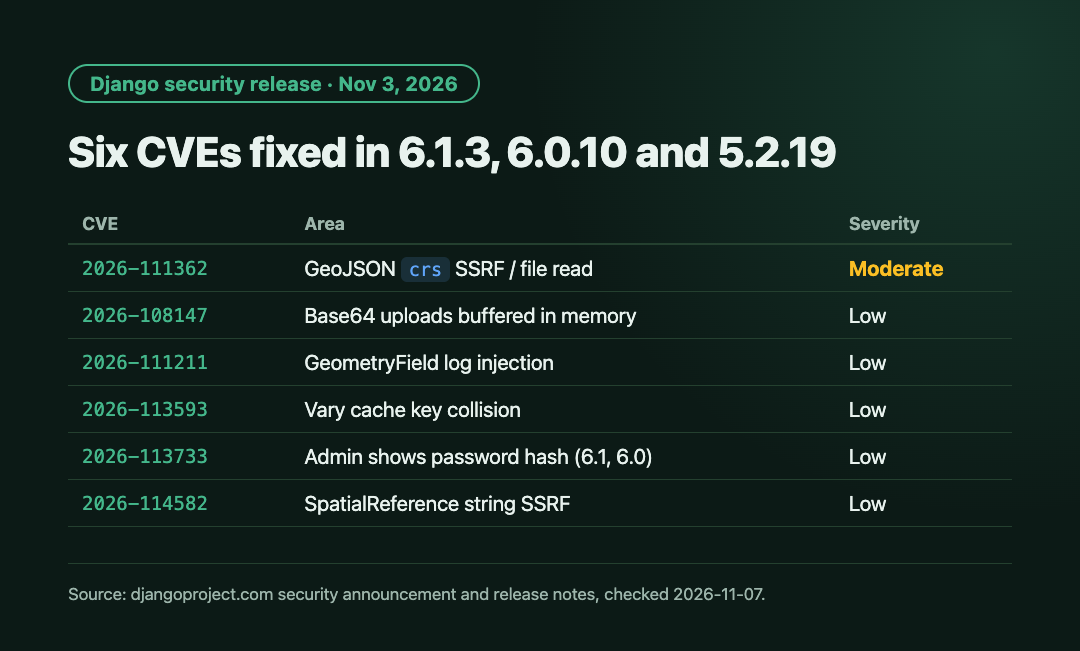
| CVE | Area | What it allows | Severity |
|---|---|---|---|
| CVE-2026-111362 | GeoDjango (GeoJSON crs) | SSRF or local file read through GDAL | Moderate |
| CVE-2026-108147 | MultiPartParser | Base64 uploads buffered fully in memory | Low |
| CVE-2026-111211 | GeometryField widgets | Log injection with control characters | Low |
| CVE-2026-113593 | cache_page(), UpdateCacheMiddleware | Cached private response served to the wrong user | Low |
| CVE-2026-113733 | Admin, custom user models | View-only admins see the full password hash | Low |
| CVE-2026-114582 | GeoDjango SpatialReference | SSRF or file read from string input | Low |
Three of the six CVEs are in django.contrib.gis. If you do not use GeoDjango, the ones that can still touch you are the upload memory bug, the cache key bug and the admin password hash bug.
The six CVEs in plain terms
- GeoJSON CRS SSRF (CVE-2026-111362). A GeoJSON geometry can carry a
crsmember that points to an external URL. GDAL resolved it, so a user who submits GeoJSON could make your server fetch a URL or read a file as the Django process user. Spatial lookups,GeometryFieldandGEOSGeometrynow reject external CRS references.DataSourceandLayerMappingstill accept them, because they are meant for trusted data. - Base64 upload memory (CVE-2026-108147). A multipart upload with
Content-Transfer-Encoding: base64was buffered entirely in memory, ignoringFILE_UPLOAD_MAX_MEMORY_SIZE. Large crafted uploads could push memory use up. - Geometry log injection (CVE-2026-111211). Invalid values submitted to
GeometryFieldwere logged without escaping, so newlines or ANSI escape sequences could fake log lines. - Vary cache key collision (CVE-2026-113593). A request that omitted a header listed in
Varyand one that sent it empty got the same cache key. A cached private response could reach the wrong requester. - Admin password hash (CVE-2026-113733). View-only admin users could see the full password hash on a custom user model that is not
AUTH_USER_MODEL, or whenAUTH_USER_MODELinheritspasswordfrom a concrete parent through multi-table inheritance. This one is fixed in 6.1 and 6.0 only. The 5.2.19 release notes do not list it. - SpatialReference string SSRF (CVE-2026-114582). Strings passed to
SpatialReference, thetransform()methods and severalsrs/sridsetters went to GDAL, which could resolve URLs and file paths.
Which Django versions need the patch
The announcement lists Django main, 6.1, 6.0 and 5.2 as affected. Those are also the only supported release series. Django 5.1 and 4.2 LTS no longer get security fixes, so they are affected by default and will not receive a patch.
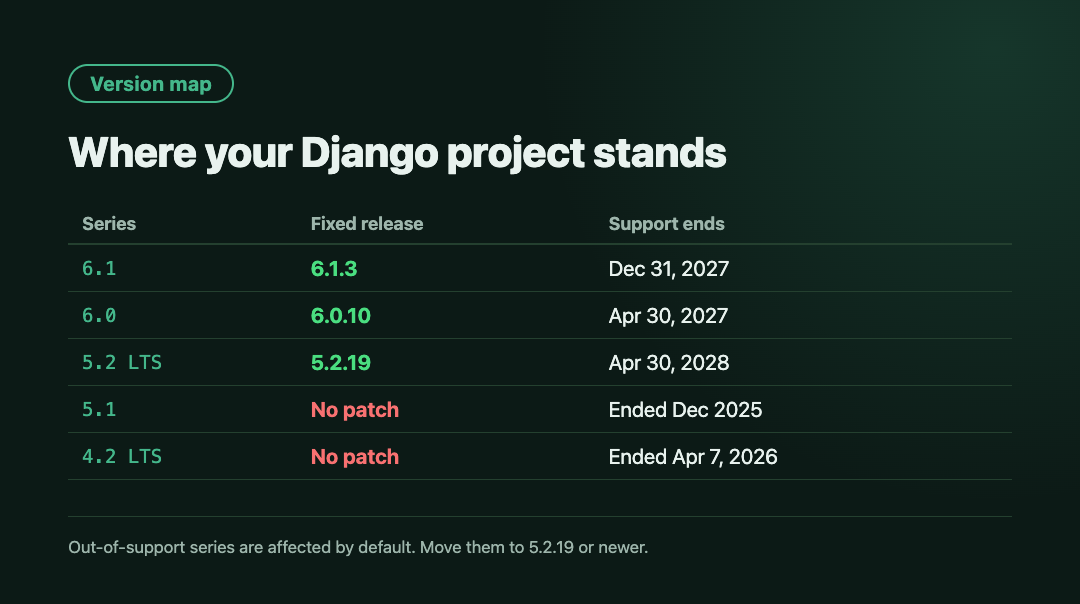
| Series | Fixed release | Security support ends | Action |
|---|---|---|---|
| 6.1 | 6.1.3 | Dec 31, 2027 | Upgrade now |
| 6.0 | 6.0.10 | Apr 30, 2027 | Upgrade now |
| 5.2 LTS | 5.2.19 | Apr 30, 2028 | Upgrade now |
| 5.1, 4.2 LTS and older | None | Already ended | Move to 5.2.19 or newer |
Support dates come from the endoflife.date Django table, which mirrors the Django project's supported versions page. 4.2 LTS reached the end of security support on April 7, 2026.
Check your environment
Two things to check per project: the installed Django version and whether the changed code paths are in use.
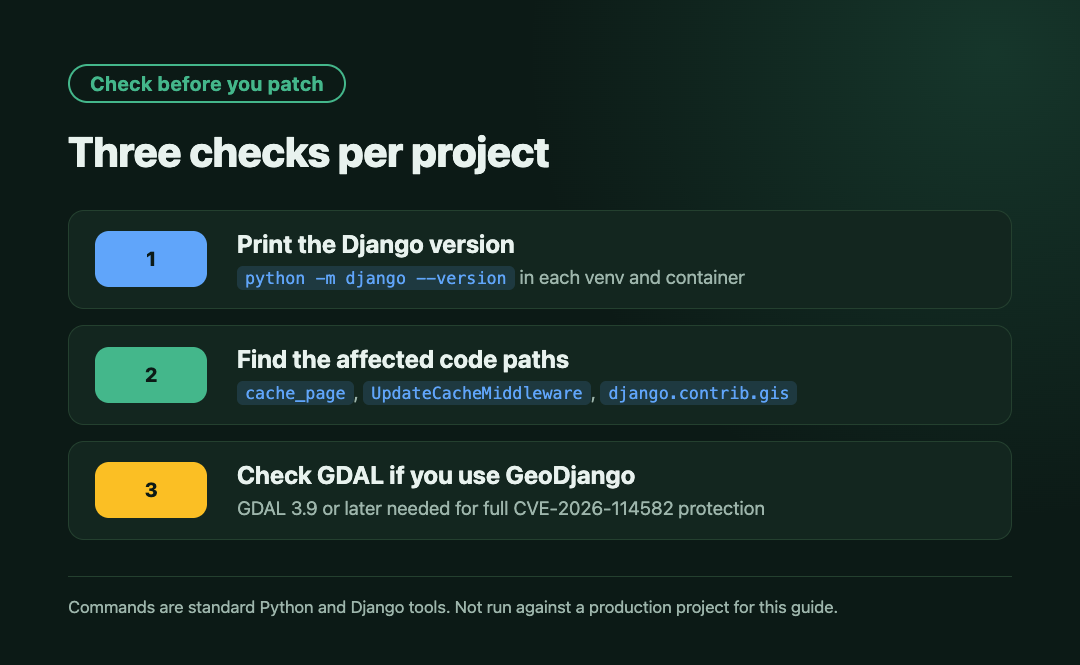
1. Print the installed Django version
Run this inside the project's virtual environment or container:
python -m django --version
pip show django | grep -i '^version'
For a running container, use your own image or service name:
docker compose exec <YOUR_WEB_SERVICE> python -m django --versionAny version below the fixed release for its series needs the update: below 6.1.3 on 6.1, below 6.0.10 on 6.0, below 5.2.19 on 5.2.
If you use pip-audit in CI, it reads the same data from the Python packaging advisory database. Run it after the database has picked up the new CVEs:
pip install pip-audit
pip-audit -r requirements.txt
2. Find the code paths the CVEs touch
grep -rnE "cache_page|UpdateCacheMiddleware|FetchFromCacheMiddleware" --include=*.py .
grep -rn "django.contrib.gis" --include=*.py .
grep -rnE "SpatialReference|GEOSGeometry|GeometryField" --include=*.py .
Hits on the first line mean the cache key change will affect you after the upgrade. Hits on the second and third mean the GeoDjango CVEs apply, and you should also check your GDAL version.
3. Check GDAL if you use GeoDjango
Full protection for CVE-2026-114582 needs GDAL 3.9 or later. Print the version GeoDjango loads:
python -c "from django.contrib.gis.gdal import gdal_version; print(gdal_version())"After the upgrade, Django also warns about this itself. The new system check gis.W001 fires when the installed GDAL is older than 3.9.
How to upgrade Django to 6.1.3, 6.0.10 or 5.2.19
Pin the patch release inside your current series. You do not need to jump to a new feature release to get the fixes.
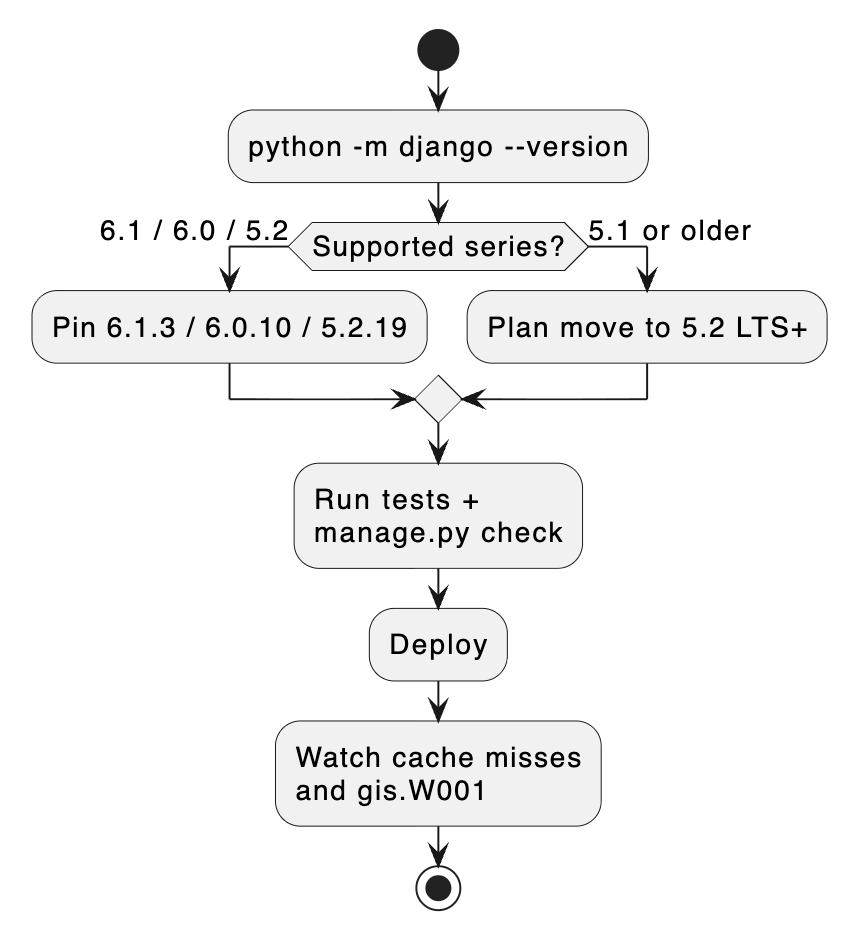
View PlantUML source
@startuml
skinparam shadowing false
skinparam defaultFontSize 14
start
:python -m django --version;
if (Supported series?) then (6.1 / 6.0 / 5.2)
  :Pin 6.1.3 / 6.0.10 / 5.2.19;
else (5.1 or older)
  :Plan move to 5.2 LTS+;
endif
:Run tests +\nmanage.py check;
:Deploy;
:Watch cache misses\nand gis.W001;
stop
@enduml
pip with requirements.txt
Change the pin in requirements.txt, then install. Use the line for your series:
| Series | Line in requirements.txt |
|---|---|
| 6.1 | Django==6.1.3 |
| 6.0 | Django==6.0.10 |
| 5.2 LTS | Django==5.2.19 |
pip install -r requirements.txt
python -m django --version
If you prefer a range that keeps picking up future patches in the same series, use Django>=6.1.3,<6.2 (or >=6.0.10,<6.1, >=5.2.19,<5.3).
uv and Poetry
With uv:
uv add "django>=6.1.3,<6.2"
uv lock --upgrade-package django
With Poetry:
poetry add "django@~6.1.3"
poetry show django
Commit the updated lock file so CI and production install the same version.
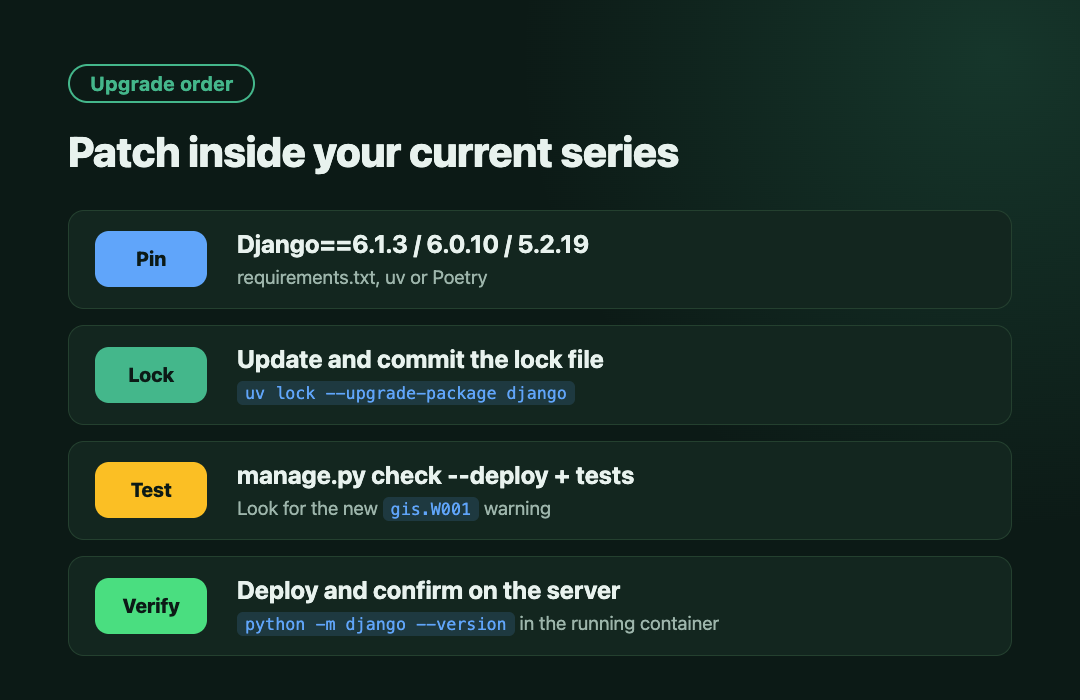
Test and deploy
python manage.py check
python manage.py check --deploy
python manage.py test
check will show gis.W001 if GeoDjango is installed with an older GDAL. check --deploy runs the production settings checks you should already have in CI. Then deploy as usual and run python -m django --version on the server or in the running container to confirm.
If you also run Python 3.15 or plan to, 6.1.3 is the first 6.1 release that adds Python 3.15 compatibility. Our Python lazy imports in 3.15 guide covers one of the 3.15 features worth testing at the same time.
After the upgrade: cache misses and GeoDjango errors
Two of the fixes change behavior on purpose. Both are documented in the release notes.
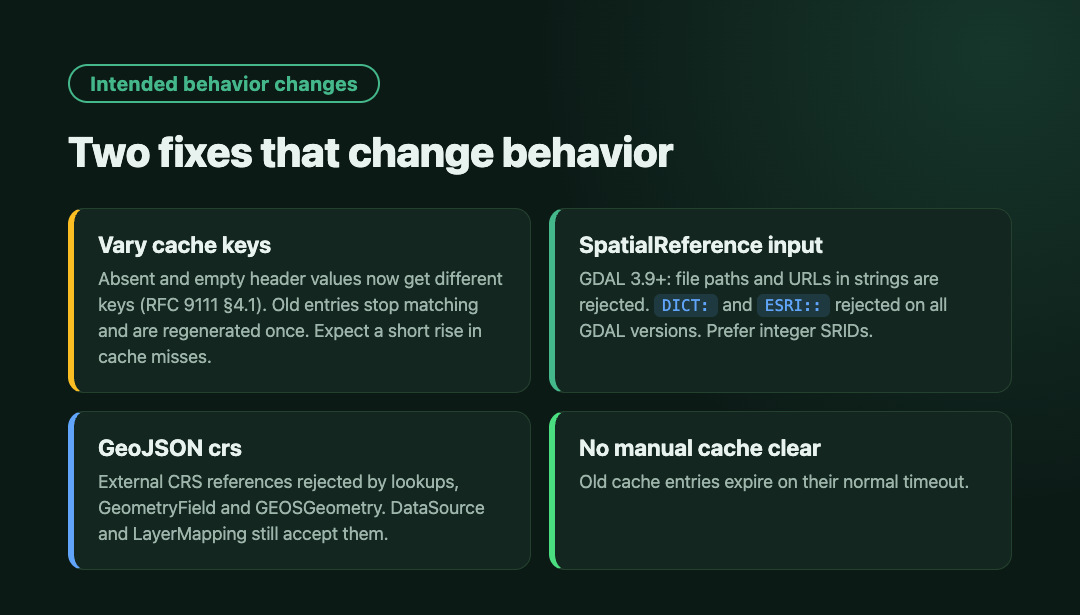
Cache keys for Vary headers
Cache keys now tell an absent header apart from an empty one, as RFC 9111 section 4.1 requires. Responses that were cached for requests that omitted a Vary header will no longer match. Django regenerates and caches them again on the next request.
What to expect: a temporary rise in cache misses and database load right after the deploy. On a busy site, deploy outside peak hours and watch your cache hit rate and database CPU for the first hour. You do not need to clear the cache by hand. Old entries simply stop matching and expire on their normal timeout.
SpatialReference and GeoJSON input
- On GDAL 3.9+,
SpatialReferenceno longer accepts file paths or URLs in string input. DICT:references, includingESRI::, are rejected on all GDAL versions.- GeoJSON geometries with an external
crsreference are rejected by spatial lookups,GeometryFieldandGEOSGeometry.
The Django docs suggest integer SRIDs for untrusted input, because they are looked up directly in the EPSG database:
from django.contrib.gis.gdal import SpatialReference

ALLOWED_SRIDS = {4326, 3857}

def safe_srs(srid: int) -> SpatialReference:
    if srid not in ALLOWED_SRIDS:
        raise ValueError("SRID not allowed")
    return SpatialReference(srid)  # integer SRID, no string parsing
On GDAL older than 3.9, compare string inputs against an allow list of the SRIDs or WKT strings you actually expect.
If something breaks after the upgrade
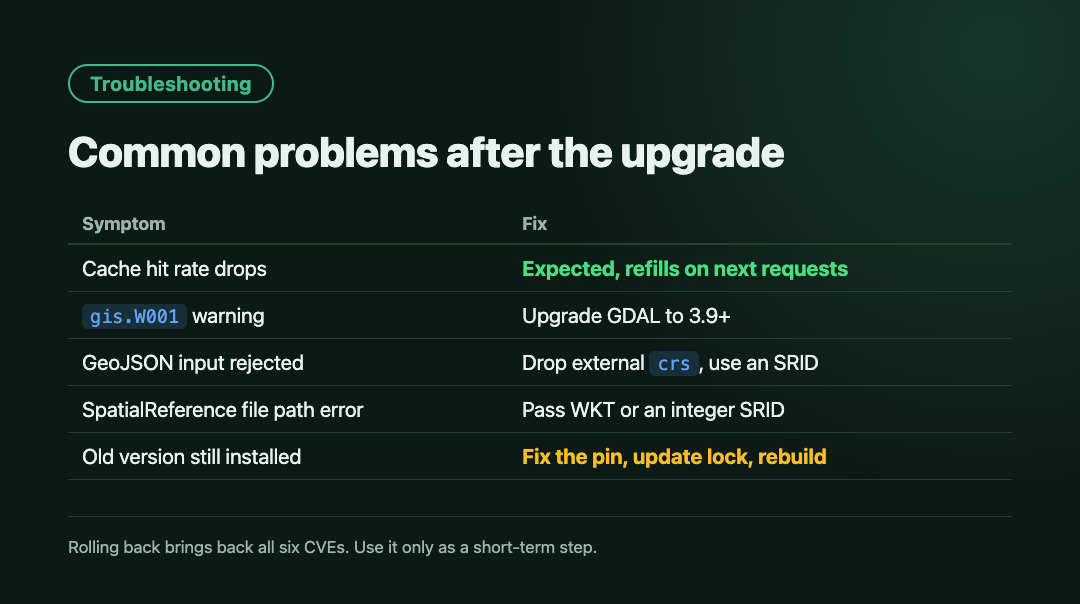
| Symptom | Likely cause | Fix |
|---|---|---|
| Cache hit rate drops right after deploy | Vary cache key change (CVE-2026-113593) | Expected; entries refill on the next requests |
gis.W001 in manage.py check | GDAL older than 3.9 | Upgrade GDAL (system package or image), or allow-list string SRS input |
| GeoJSON form input now fails validation | External crs reference rejected | Strip crs on the client or use an SRID |
SpatialReference("/path/file.prj") raises an error | File paths blocked on GDAL 3.9+ | Read the file yourself from a trusted path, pass WKT or an SRID |
python -m django --version still shows the old version | Old pin or stale lock file | Check the pin, update the lock file, rebuild the image |
If you must roll back, pin the previous release, but treat that as a short-term step. The rollback brings back all six CVEs.
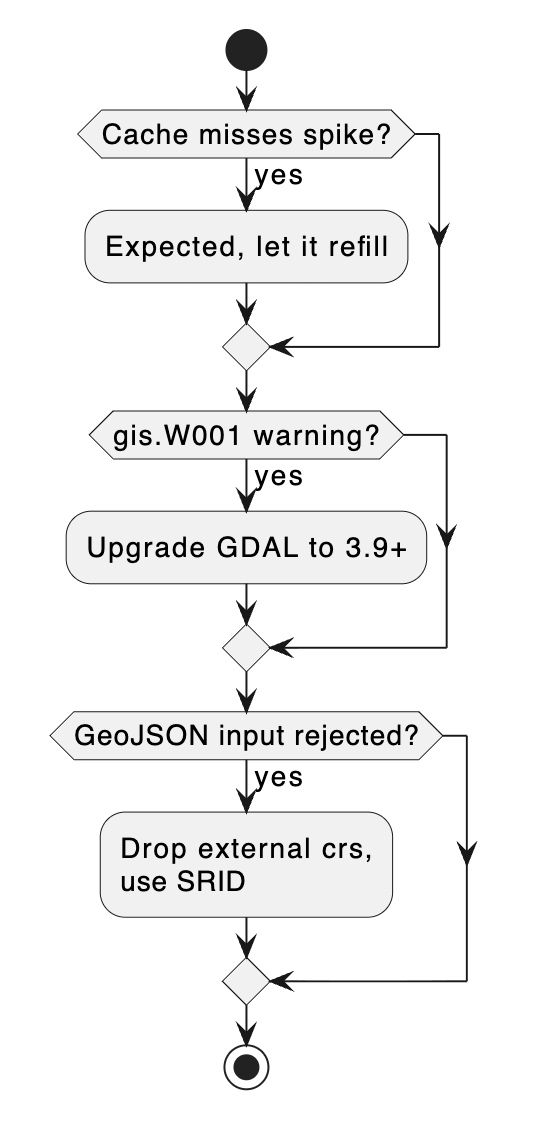
View PlantUML source
@startuml
skinparam shadowing false
skinparam defaultFontSize 14
start
if (Cache misses spike?) then (yes)
  :Expected, let it refill;
endif
if (gis.W001 warning?) then (yes)
  :Upgrade GDAL to 3.9+;
endif
if (GeoJSON input rejected?) then (yes)
  :Drop external crs,\nuse SRID;
endif
stop
@enduml
For other patches due this month, see our Node.js security release November 2026 prep guide and the Next.js security update to 16.4.5 or 15.5.29 if you run a JavaScript frontend next to Django.
FAQ
Is the Django 6.1.3 security update urgent if I don't use GeoDjango? Yes, but less so. Without django.contrib.gis, three CVEs still apply: base64 upload memory use, the Vary cache key collision and the admin password hash display. All three are rated low. Patch in your next deploy rather than waiting for the next feature release.
Does Django 5.2.19 fix the admin password hash bug? No. The 5.2.19 release notes list five CVEs and do not include CVE-2026-113733. The announcement lists patches for that CVE on main, 6.1 and 6.0 only.
Do I need to clear my cache after upgrading? No. Old entries for requests that omitted a Vary header stop matching and are regenerated on the next request. Expect a temporary rise in cache misses.
Is Django 4.2 LTS getting a patch? No. 4.2 LTS reached the end of security support on April 7, 2026. Move to 5.2 LTS (5.2.19) or a newer series.
Are any of these CVEs known to be exploited? The Django announcement does not mention exploitation. It rates one CVE moderate and five low.
Summary
Check python -m django --version in every project and container today. On 6.1, 6.0 or 5.2, pin 6.1.3, 6.0.10 or 5.2.19, update the lock file, run manage.py check and your tests, and deploy. Expect a short dip in cache hit rate. If you use GeoDjango, also confirm GDAL 3.9 or later and use integer SRIDs for untrusted input. Projects on 5.1 or 4.2 should plan the move to 5.2 LTS, since they will not get these fixes. Next, add pip-audit to CI so the next Django security release shows up in your build before you read about it.
References
- Django security releases issued: 6.1.3, 6.0.10, and 5.2.19 — Django project, published 2026-11-03, checked 2026-11-07
- Django 6.1.3 release notes — Django documentation, checked 2026-11-07
- Django 6.0.10 release notes — Django documentation, checked 2026-11-07
- Django 5.2.19 release notes — Django documentation, checked 2026-11-07
- Archive of security issues — Django documentation, checked 2026-11-07
- Django supported versions — Django project, checked 2026-11-07
- Django release and support dates — endoflife.date, checked 2026-11-07
- RFC 9111 section 4.1: Calculating cache keys with Vary — IETF, checked 2026-11-07