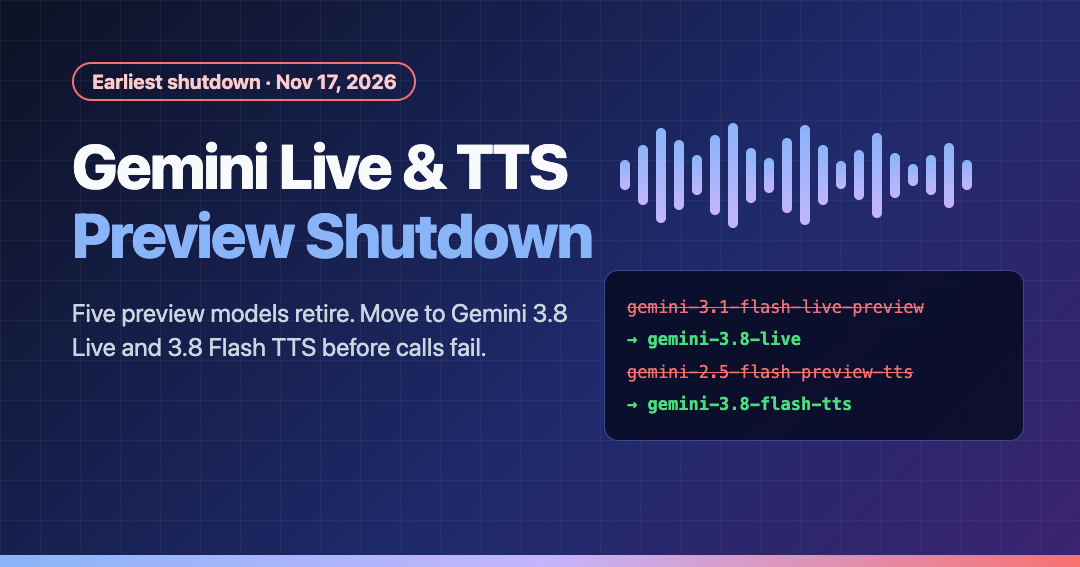
The Gemini preview shutdown on November 17, 2026 hits five audio models at once: two Live API previews and three text-to-speech (TTS) previews. Move Live apps to gemini-3.8-live and TTS jobs to gemini-3.8-flash-tts or gemini-3.8-flash-lite-tts now. Changing the model string is not enough on its own: the new Live model rejects some old config fields, and the new TTS models read your text verbatim and return WAV by default.
Written November 7, 2026. Facts checked on November 7, 2026 (KST) against the Gemini API deprecations page, the Gemini API release notes, the model pages for Gemini 3.8 Live, 3.8 Flash TTS and 3.8 Flash-Lite TTS, the speech generation and Live API guides, and the Gemini API pricing page. The code below follows the official examples. It was not run against a live project for this post.
Which models the Gemini preview shutdown affects
Google's deprecations table lists five audio preview models with a shutdown date of November 17, 2026. Unlike the 2.5 Pro and 2.5 Flash entries further down the same table, none of these five has an "automatic routing" note. Plan for requests to the old IDs to fail, not to be silently redirected.
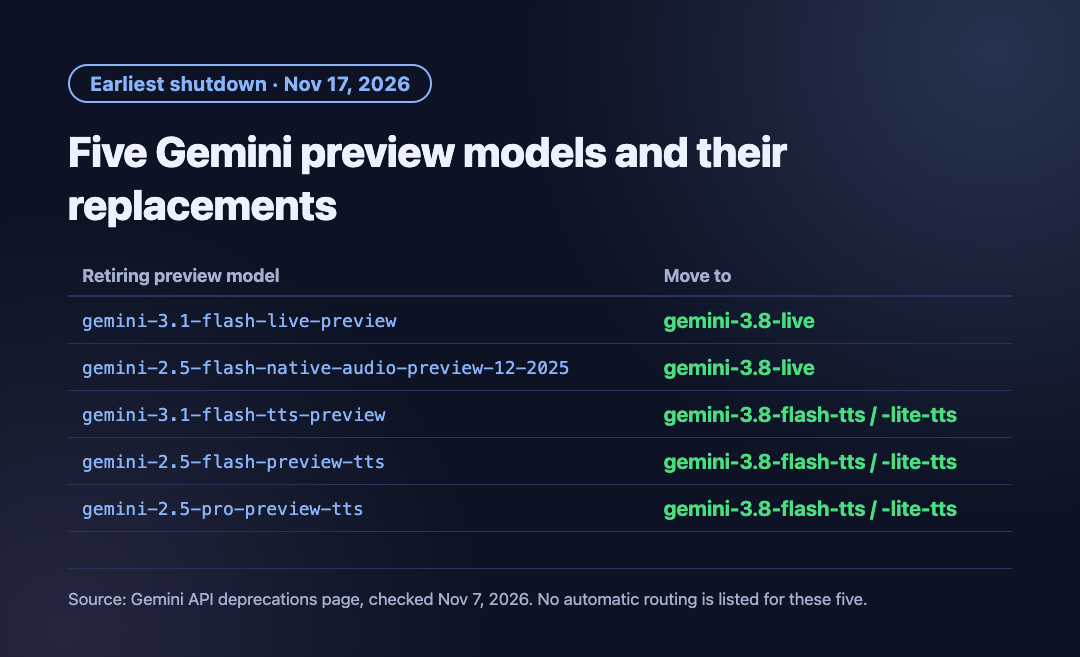
| Retiring model | Type | Shutdown | Replacement |
|---|---|---|---|
gemini-3.1-flash-live-preview | Live API | Nov 17, 2026 | gemini-3.8-live |
gemini-2.5-flash-native-audio-preview-12-2025 | Live API | Nov 17, 2026 | gemini-3.8-live |
gemini-3.1-flash-tts-preview | TTS | Nov 17, 2026 | gemini-3.8-flash-tts or gemini-3.8-flash-lite-tts |
gemini-2.5-flash-preview-tts | TTS | Nov 17, 2026 | gemini-3.8-flash-tts or gemini-3.8-flash-lite-tts |
gemini-2.5-pro-preview-tts | TTS | Nov 17, 2026 | gemini-3.8-flash-tts or gemini-3.8-flash-lite-tts |
Google describes the dates in this table as the earliest possible retirement dates, with exact dates "communicated with advance notice." In practice, that means a model can keep answering for a while after November 17, but you should not build on that.
Why this is urgent now
The replacements have been generally available for about seven weeks, and the preview cutoff is ten days away.
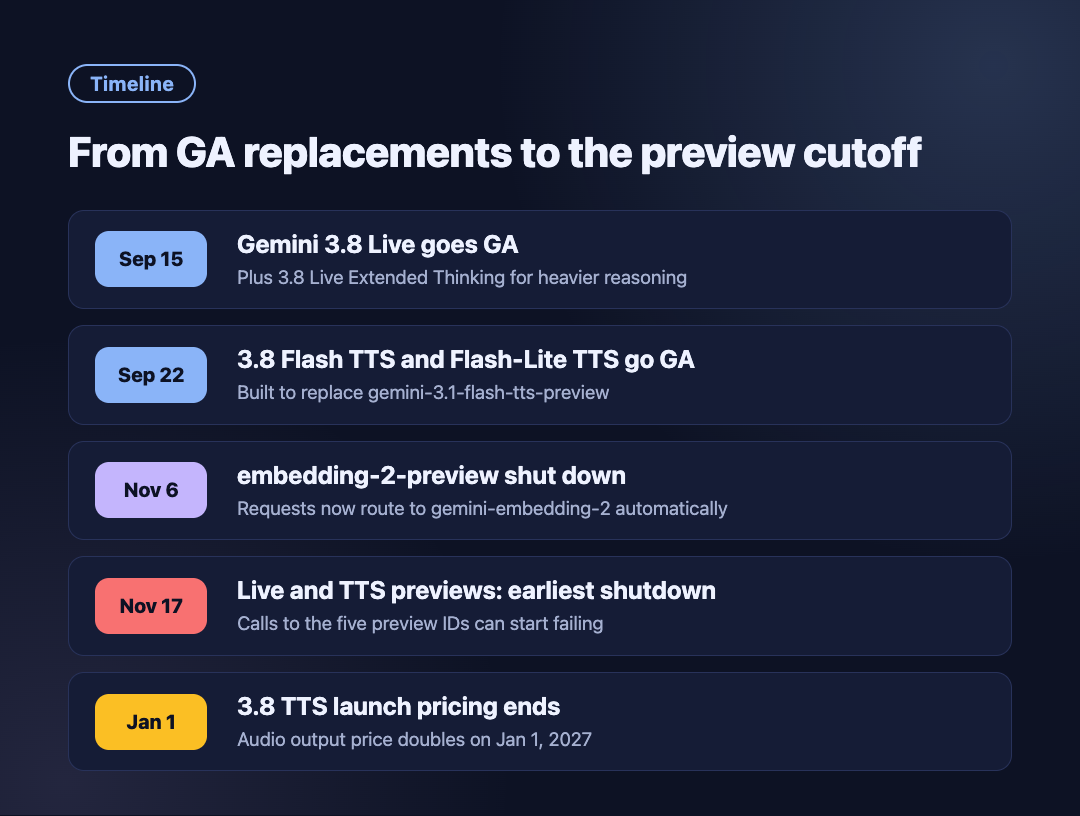
- September 15, 2026: Gemini 3.8 Live and 3.8 Live Extended Thinking became generally available.
- September 22, 2026: Gemini 3.8 Flash TTS and Flash-Lite TTS became generally available, "built to replace"
gemini-3.1-flash-tts-preview. - November 4, 2026: Voice remixing was added for Gemini 3.8 TTS.
- November 6, 2026:
gemini-embedding-2-previewreached its shutdown date. That one does route automatically togemini-embedding-2. It shows the schedule is real. - November 17, 2026: Earliest shutdown for the five Live and TTS previews.
Two more retirements follow on the same page: gemini-2.5-pro and gemini-2.5-flash on December 1, 2026, both with automatic routing. If you are already on a model migration, our Gemini 4 Argon API migration guide covers the text side.
Find every place you call a preview model
Model IDs rarely live in one file. Check code, configuration and actual traffic.
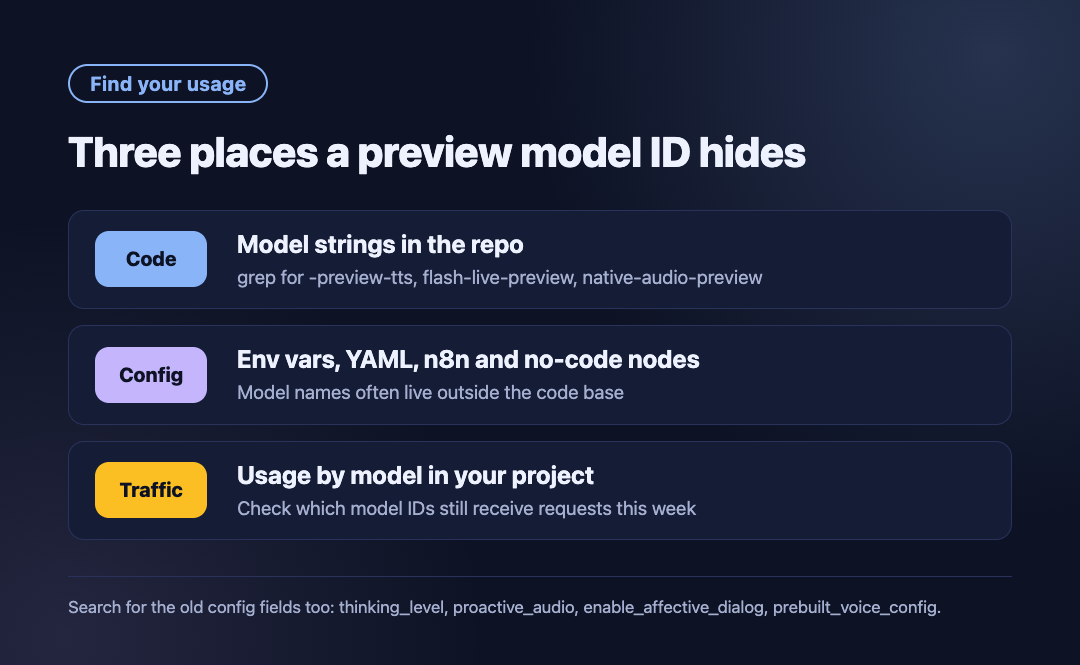
1. Search the code base
Run this from the root of each repository:
grep -rnE "gemini-3\.1-flash-live-preview|gemini-2\.5-flash-native-audio-preview|gemini-3\.1-flash-tts-preview|gemini-2\.5-(flash|pro)-preview-tts" \
  --include="*.py" --include="*.js" --include="*.ts" --include="*.go" --include="*.java" \
  --include="*.json" --include="*.yaml" --include="*.yml" --include="*.env*" .
Then search for config fields that the new models treat differently. A hit here means you have more to change than the model string:
grep -rnE "thinking_level|thinkingLevel|proactive_audio|proactiveAudio|enable_affective_dialog|enableAffectiveDialog|prebuilt_voice_config|prebuiltVoiceConfig" .2. Check config outside the repo
Look at environment variables in your hosting platform, secrets managers, Helm values and CI variables. Also check no-code tools. An n8n, Make or Zapier node with a hard-coded model name will break the same way as code.
3. Check live traffic
Open your Google Cloud project's API metrics or your own request logs and filter by model name. Any preview ID that still gets calls this week needs an owner and a fix date before November 17.
Gemini preview shutdown fix for Live API apps
For gemini-3.1-flash-live-preview, the model page for Gemini 3.8 Live lists the changes. Change the model string first:
from google import genai
from google.genai import types

client = genai.Client()  # reads GEMINI_API_KEY from the environment
model = "gemini-3.8-live"  # was "gemini-3.1-flash-live-preview"
config = {"response_modalities": ["AUDIO"]}

async def run(chunks):
    async with client.aio.live.connect(model=model, config=config) as session:
        for chunk in chunks:  # raw 16-bit PCM, 16 kHz, little-endian
            await session.send_realtime_input(
                audio=types.Blob(data=chunk, mime_type="audio/pcm;rate=16000")
            )
        async for response in session.receive():
            ...  # audio is in response.server_content.model_turn.parts[].inline_data.data
Then work through the config differences.
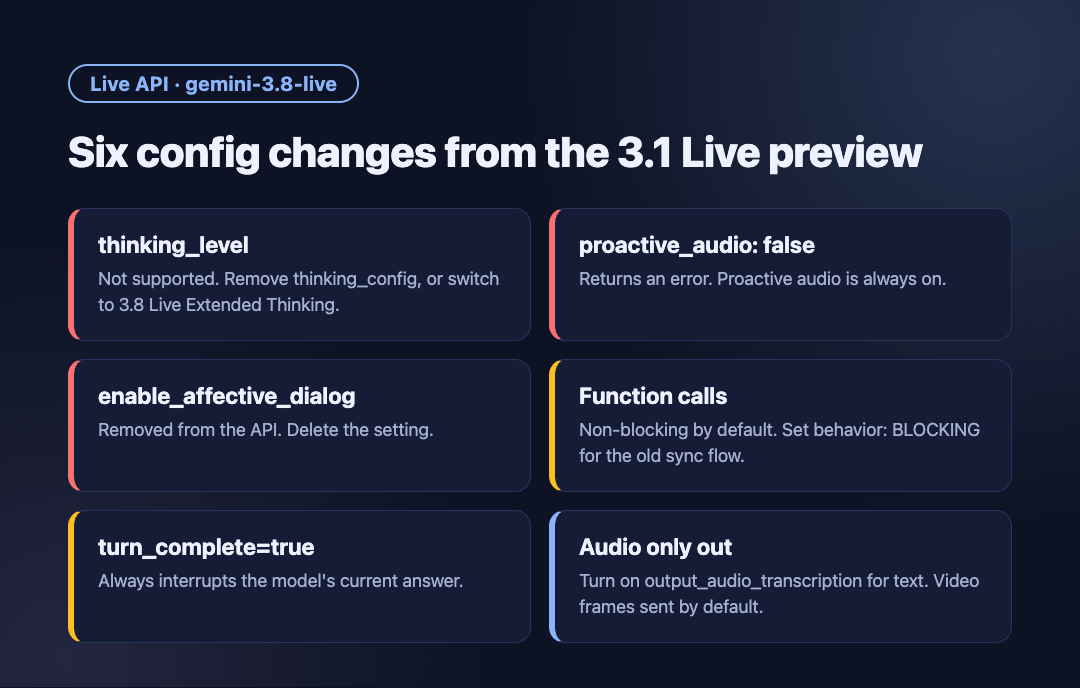
| Old setting or behavior | On gemini-3.8-live | What to do |
|---|---|---|
thinking_level / thinking_config | Not supported | Remove them. Use gemini-3.8-live-extended-thinking if you need more reasoning |
proactive_audio: false | Returns an error | Remove the field. Proactive audio is always on |
enable_affective_dialog | Removed from the API | Remove the field |
| Function calling | Non-blocking by default | Set behavior: BLOCKING where your code expects a synchronous call |
send_client_content with turn_complete=true | Always interrupts the active answer | Send it only when you mean to cut the model off |
| Text responses | Audio is the only response modality | Enable output_audio_transcription to get text |
Two more defaults changed. Turn coverage now defaults to TURN_INCLUDES_AUDIO_ACTIVITY_AND_ALL_VIDEO, so video frames you stream are sent by default. And SILENT, WHEN_IDLE and INTERRUPTED scheduling options are supported for function responses.
Coming from the 2.5 native audio preview
The 3.8 Live model page has migration notes for the 3.1 Live preview only. It has none for gemini-2.5-flash-native-audio-preview-12-2025. Our suggestion: apply the same table above, because the same fields are the ones that error out, then test a full conversation including tool calls and interruptions. Also check your token use. Output text is priced higher on 3.8 Live ($4.50 per 1M tokens) than on the 2.5 native audio preview ($2.00). Audio output is the same at $12.00 per 1M tokens.
Live API audio formats stay the same: input is raw 16-bit PCM at 16 kHz, little-endian. Output is raw 16-bit PCM at 24 kHz. For browser clients, the Live API guide recommends ephemeral tokens instead of a standard API key.
Move TTS jobs to Gemini 3.8 Flash TTS
Pick the model first:
gemini-3.8-flash-ttsfor expressive output and complex multi-speaker dialogue. Over 130 languages.gemini-3.8-flash-lite-ttsfor high-volume, single-speaker jobs and real-time voice pipelines. 101 languages, lower price.
Both share the same request schema, so you can switch between them by changing the model string. Both accept up to 8,192 input tokens and return up to 16,384 output tokens per request.
The new request shape
The official speech generation guide uses the Interactions API. Speaker and style move into speech_metadata annotations, and the text field holds only the words to speak:
import base64
from google import genai

client = genai.Client()

interaction = client.interactions.create(
    model="gemini-3.8-flash-tts",  # or "gemini-3.8-flash-lite-tts"
    input=[{
        "type": "user_input",
        "content": [{
            "type": "text",
            "text": "Your order has shipped. <short pause> It should arrive on Monday.",
            "annotations": [{"type": "speech_metadata", "style": "calm and friendly"}],
        }],
    }],
    response_format={"type": "audio"},
    generation_config={"speech_config": [{"voice": "Kore"}]},
)

with open("out.wav", "wb") as f:
    f.write(base64.b64decode(interaction.output_audio.data))
The same call over REST:
curl -X POST "https://generativelanguage.googleapis.com/v1beta/interactions" \
  -H "x-goog-api-key: <YOUR_GEMINI_API_KEY>" \
  -H "Content-Type: application/json" \
  -d '{
    "model": "gemini-3.8-flash-tts",
    "input": [{"type": "user_input", "content": [{"type": "text",
      "text": "Your order has shipped.",
      "annotations": [{"type": "speech_metadata", "style": "calm and friendly"}]}]}],
    "response_format": {"type": "audio"},
    "generation_config": {"speech_config": [{"voice": "Kore"}]}
  }'
The 30 prebuilt voice names you used with the preview models (Kore, Puck, Charon, Zephyr and the rest) are listed in the 3.8 guide too. If you call generateContent instead, the model page says to attach speech_metadata with speaker and style to each part.
Four things that break after a plain model swap
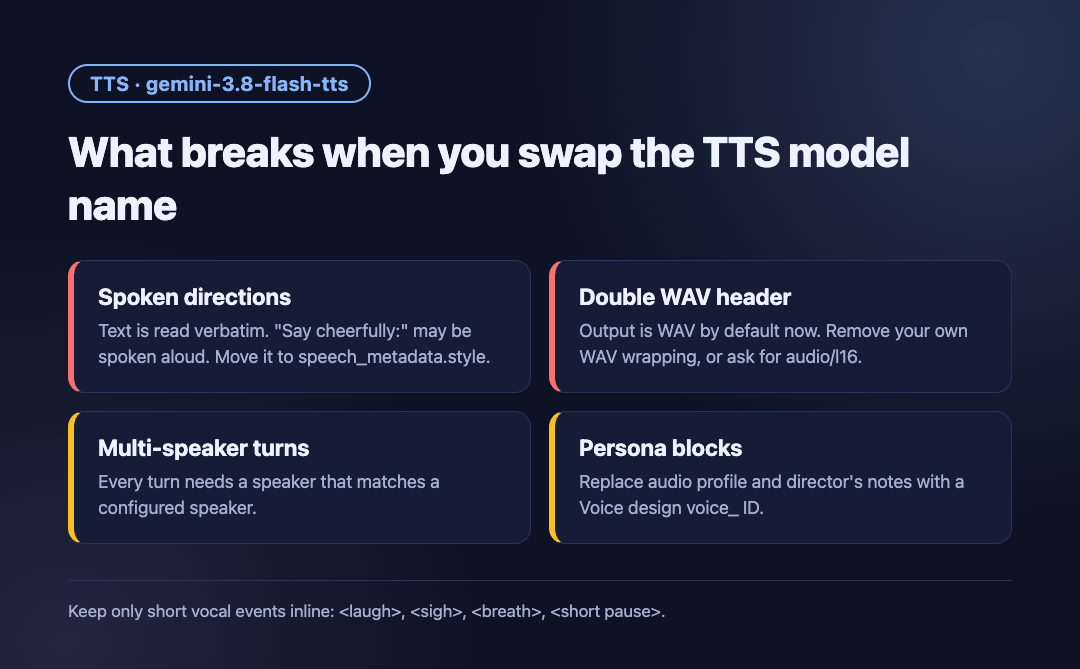
- Directions get read aloud. The 3.8 models treat the text as a verbatim transcript. A prompt like "Say cheerfully: Hello!" may come out with "Say cheerfully" spoken. Move the style to
speech_metadata.style. Keep only short vocal events inline, such as<laugh>,<sigh>,<cough>,<breath>or<short pause>. - WAV header twice. Older TTS models returned headerless PCM (
audio/l16), so most code wrapped it in a WAV header. Unary requests to 3.8 return WAV with a RIFF header by default. Remove your wrapping step, or ask for raw audio explicitly with"response_format": {"type": "audio", "mime_type": "audio/l16", "sample_rate": 24000}.audio/mulawandaudio/alaware available for 8 kHz telephony. Streaming requests still returnaudio/l16at 24 kHz by default. - Multi-speaker turns without a speaker. Every turn must carry a
speakerinspeech_metadatathat matches one inspeech_config.speakers. One request supports up to two speakers with prebuilt voices. - Long persona prompts. Audio Profile and Director's Notes blocks from the 3.1 preview should become a custom voice made with Voice design. You then pass its
voice_...ID. Stateful custom voices are capped at 200 per project and expire after one year without use.
If you are comparing hosted TTS with local options, see our guides to running Phonon text to speech locally with Ollama and OpenAI prompt-to-voice.
What the 3.8 TTS models cost
Paid-tier audio output prices from the Gemini API pricing page, converted to a per-minute figure. The pricing page counts audio as 25 tokens per second, so one minute is 1,500 tokens.
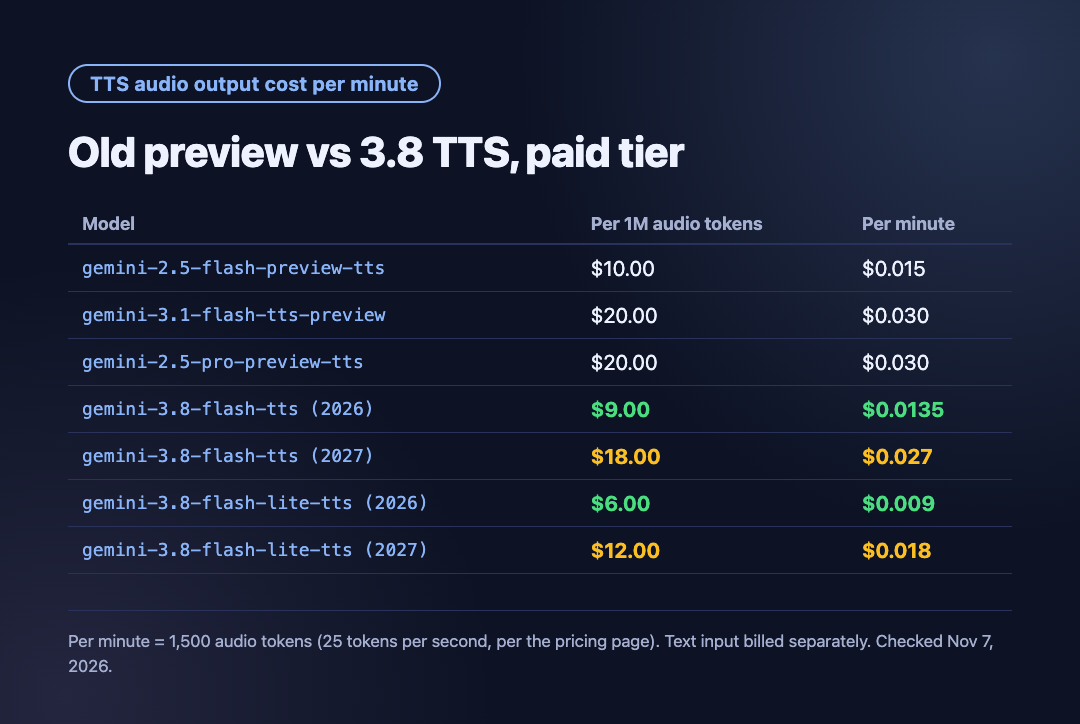
| Model | Audio output per 1M tokens | Per minute of audio | Text input per 1M |
|---|---|---|---|
gemini-2.5-flash-preview-tts | $10.00 | $0.015 | $0.50 |
gemini-3.1-flash-tts-preview / gemini-2.5-pro-preview-tts | $20.00 | $0.030 | $1.00 |
gemini-3.8-flash-tts until Dec 31, 2026 | $9.00 | $0.0135 | $0.50 |
gemini-3.8-flash-tts from Jan 1, 2027 | $18.00 | $0.027 | $1.00 |
gemini-3.8-flash-lite-tts until Dec 31, 2026 | $6.00 | $0.009 | $0.50 |
gemini-3.8-flash-lite-tts from Jan 1, 2027 | $12.00 | $0.018 | $1.00 |
Example: a job that produces 1,000 minutes of audio a month costs about $15 in audio output on gemini-2.5-flash-preview-tts. On gemini-3.8-flash-tts it is about $13.50 through December, then about $27 from January. On Flash-Lite it is about $9, then about $18. Text input is extra in every case. If you move from the 2.5 Flash preview to 3.8 Flash, budget for roughly double the audio cost in 2027, or test Flash-Lite for single-speaker work.
Both 3.8 TTS models and 3.8 Live have a free tier. gemini-2.5-pro-preview-tts never had one.
Migration order
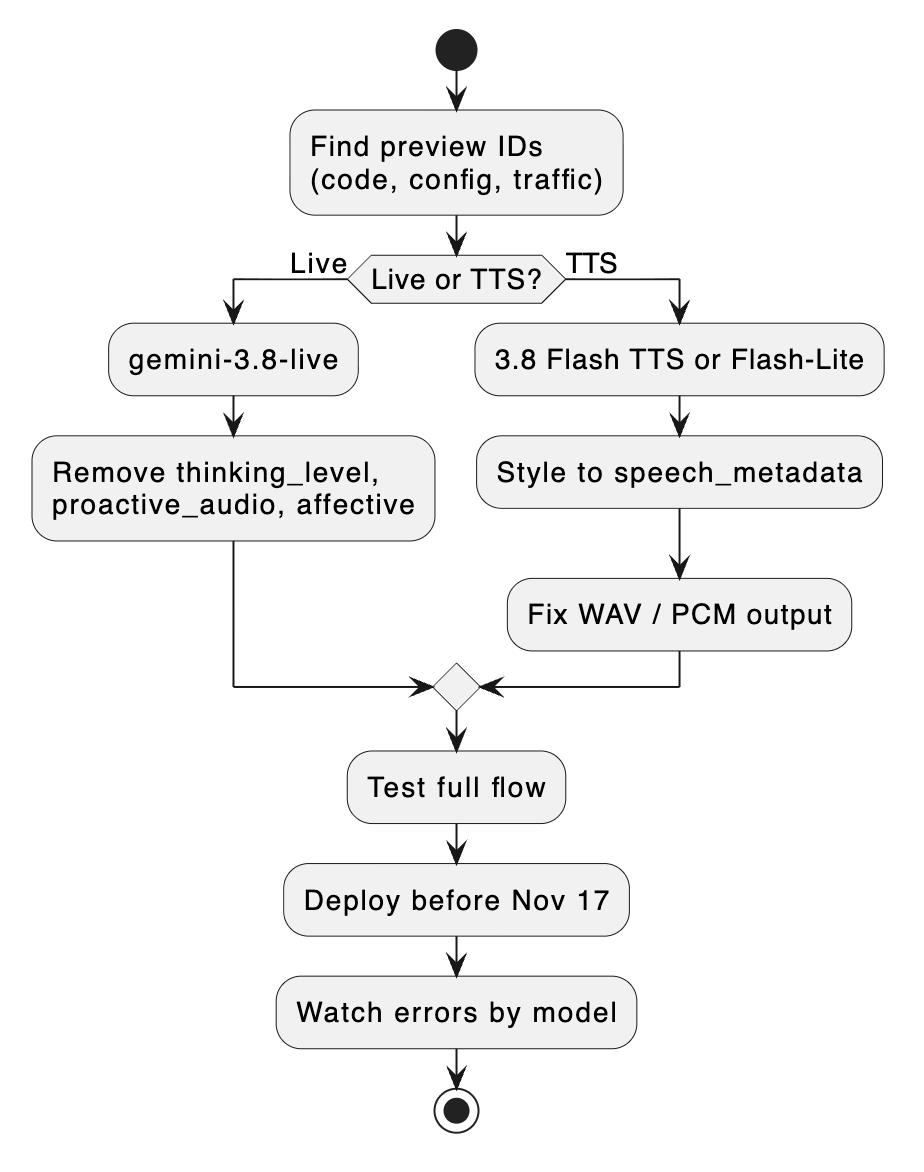
View PlantUML source
@startuml
skinparam shadowing false
skinparam defaultFontSize 14
start
:Find preview IDs\n(code, config, traffic);
if (Live or TTS?) then (Live)
  :gemini-3.8-live;
  :Remove thinking_level,\nproactive_audio, affective;
else (TTS)
  :3.8 Flash TTS or Flash-Lite;
  :Style to speech_metadata;
  :Fix WAV / PCM output;
endif
:Test full flow;
:Deploy before Nov 17;
:Watch errors by model;
stop
@enduml
Ship the change behind a config flag if you can, so you can switch model IDs without a redeploy.
If something goes wrong after the switch
| Symptom | Likely cause | Fix |
|---|---|---|
| Live session fails at setup with a config error | proactive_audio: false, thinking_level or enable_affective_dialog still set | Remove those fields |
| Live answers cut off mid-sentence | send_client_content sent with turn_complete=true | Send it only to interrupt on purpose |
| Tool results arrive late or out of order | Function calls are now non-blocking | Set behavior: BLOCKING on those functions |
| No text in Live responses | Audio is the only response modality | Enable output_audio_transcription |
| TTS file plays a click or will not open | WAV header added twice | Drop your WAV wrapper, or request audio/l16 |
| TTS speaks "say cheerfully" or stage directions | Text is read verbatim | Move directions to speech_metadata.style |
| Multi-speaker request rejected | A turn has no matching speaker | Add speaker to every turn's speech_metadata |
| Requests to the old ID start failing | Preview model retired | Switch the model ID; there is no automatic routing listed |
FAQ
Will my calls to the preview models be routed to Gemini 3.8 automatically? The deprecations page lists automatic routing for some models, such as gemini-embedding-2-preview, gemini-2.5-pro and gemini-2.5-flash. It lists no routing for the five Live and TTS previews. Treat November 17 as the day those calls may start failing.
Is November 17 the exact shutdown date? Google calls the table dates the earliest possible retirement dates and says exact dates come with advance notice. The model may work for a short time afterward, but you should finish the move before November 17.
Should I pick 3.8 Flash TTS or 3.8 Flash-Lite TTS? Use Flash for expressive output, multi-speaker dialogue and the widest language list (over 130). Use Flash-Lite for high-volume single-speaker audio and lower cost (101 languages). The schema is the same, so you can A/B test by changing only the model string.
Do I need a new API key or SDK? No new key is needed. The official TTS examples use the Interactions API in the Google Gen AI SDK, so update the SDK to a current version if client.interactions is not available in your install.
What replaces thinking_level on the Live API? Nothing on gemini-3.8-live, which does interleaved reasoning on its own. If you need more background reasoning in voice sessions, use gemini-3.8-live-extended-thinking.
Once this migration is done, the next item on the same deprecations page is the gemini-2.5-pro and gemini-2.5-flash retirement on December 1, 2026. Check whether your text workloads still pin those IDs.
References
- Gemini API deprecations — Google AI for Developers, checked 2026-11-07
- Gemini API release notes — Google AI for Developers, checked 2026-11-07
- Gemini 3.8 Live model page — Google AI for Developers, checked 2026-11-07
- Gemini 3.8 Flash TTS model page — Google AI for Developers, checked 2026-11-07
- Gemini 3.8 Flash-Lite TTS model page — Google AI for Developers, checked 2026-11-07
- Speech generation (text-to-speech) guide — Google AI for Developers, checked 2026-11-07
- Live API overview and Get started with the Live API (GenAI SDK) — Google AI for Developers, checked 2026-11-07
- Gemini API pricing — Google AI for Developers, checked 2026-11-07