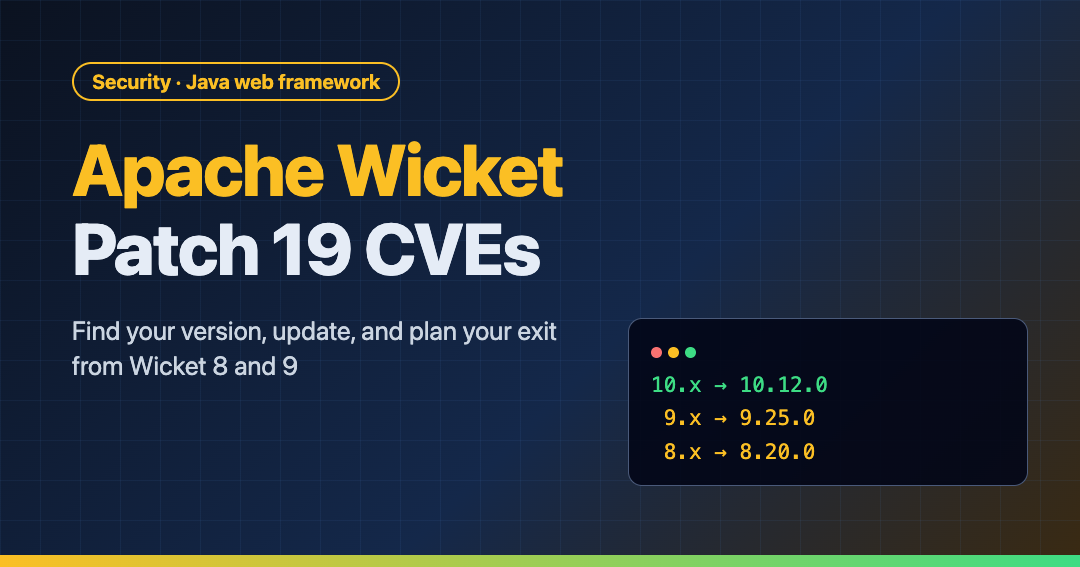
The Apache Wicket security update closes 19 CVEs, nine of them High. Patch 10.x to 10.12.0 today, 9.x to 9.25.0, and 8.x to 8.20.0. Those last two are final releases, so 8.x and 9.x users also need a plan to reach Wicket 10.
Written 2026-11-02. Facts come from the Apache Wicket site, Maven Central and CVE records, all checked that day. I read 16 of the 19 CVE records. I tested the source search in step 3 on a dummy Java file on macOS. I did not run the Maven, Gradle, unzip, curl or OpenRewrite commands, and I did not test against a live Wicket app.
You could easily miss this one. The release notes for 8.20.0, 9.25.0 and 10.12.0 list no CVE IDs. They only mention "updated vulnerable dependencies" (WICKET-7199). The CVE records followed on November 1, days after the first patches shipped, and they describe the bugs in enough detail to act on.
I found no report of active exploitation as of November 2. The CVE records I read carry no exploitation data, so treat that as "none found" and don't read it as proof that nobody is trying.
What changed in the Apache Wicket security update
Wicket shipped its fixes between October 29 and 31, and it retired two release lines in the same week.
| Date (2026) | Release | What it means |
|---|---|---|
| Oct 21 | Notice | 8.x and 9.x each get one last release |
| Oct 29 | 8.20.0, 9.25.0 | Final releases. Both lines reach end of life |
| Oct 31 | 10.12.0 | Fixed LTS release, supported until July 2027 |
| Nov 1 | 11.0.0 | New current line, needs Java 21 |
| Nov 1 | CVE records | Bug details go public |
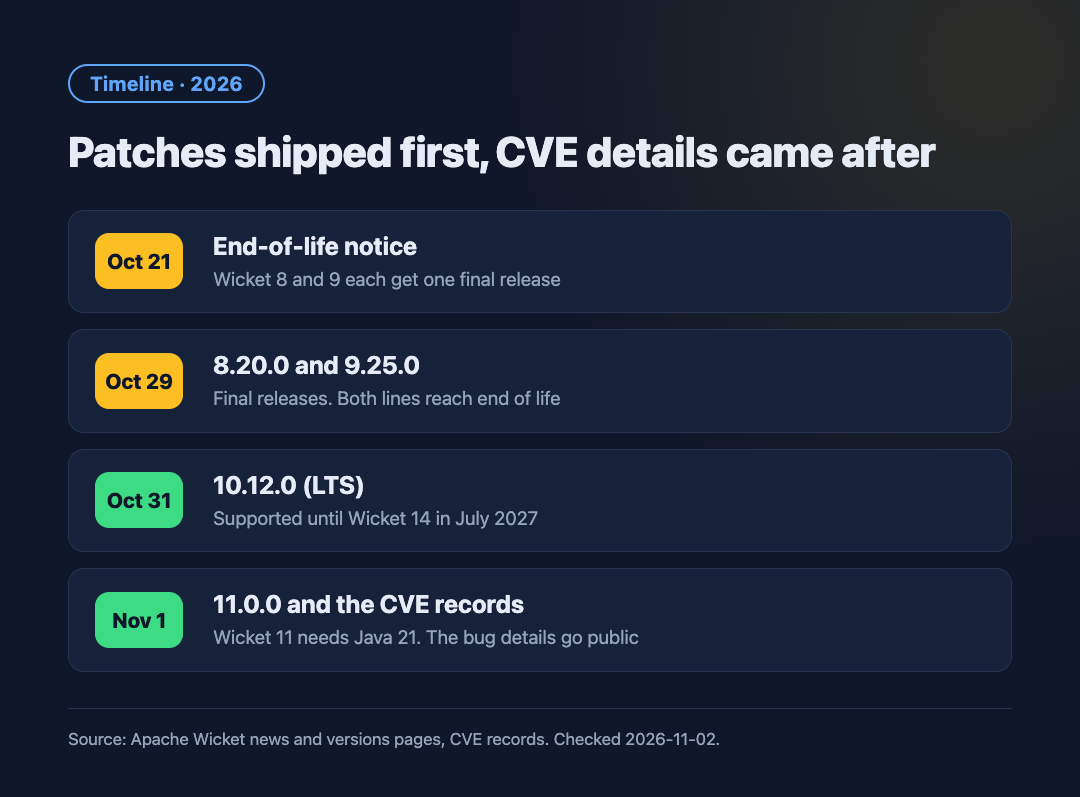
End of life means what it says. The 8.20.0 and 9.25.0 announcements both state there will be no more releases on those lines, including for security bugs. Older lines (7.x and earlier) get no fix at all.
Which Wicket version to patch to
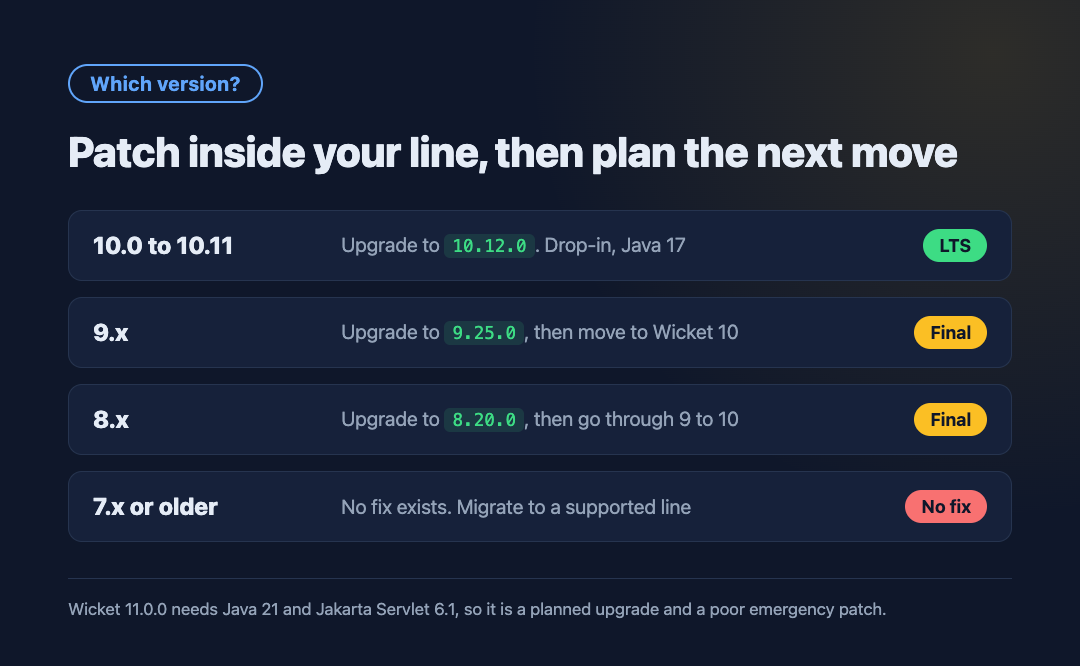
Stay on your current line for today's fix. That's the smallest change that closes the bugs, and the release notes call it a drop-in replacement within a line.
| You run | Patch to | Java | Next step |
|---|---|---|---|
| 10.0 to 10.11 | 10.12.0 | 17 | None. This is the LTS line |
| 9.x | 9.25.0 | 11 | Move to 10 soon |
| 8.x | 8.20.0 | Not stated | Move to 9, then 10 |
| 7.x or older | No fix exists | Varies | Migrate to a supported line |
Don't use Wicket 11 as your emergency patch. Wicket 11.0.0 needs Java 21 and Jakarta Servlet 6.1, and it can't decrypt content encrypted by Wicket 10. Bookmarked encrypted URLs stop resolving, too. The CVE records I read don't list 11.0.0 as affected or as a fixed version, so 10.12.0 is the documented route.
View PlantUML source
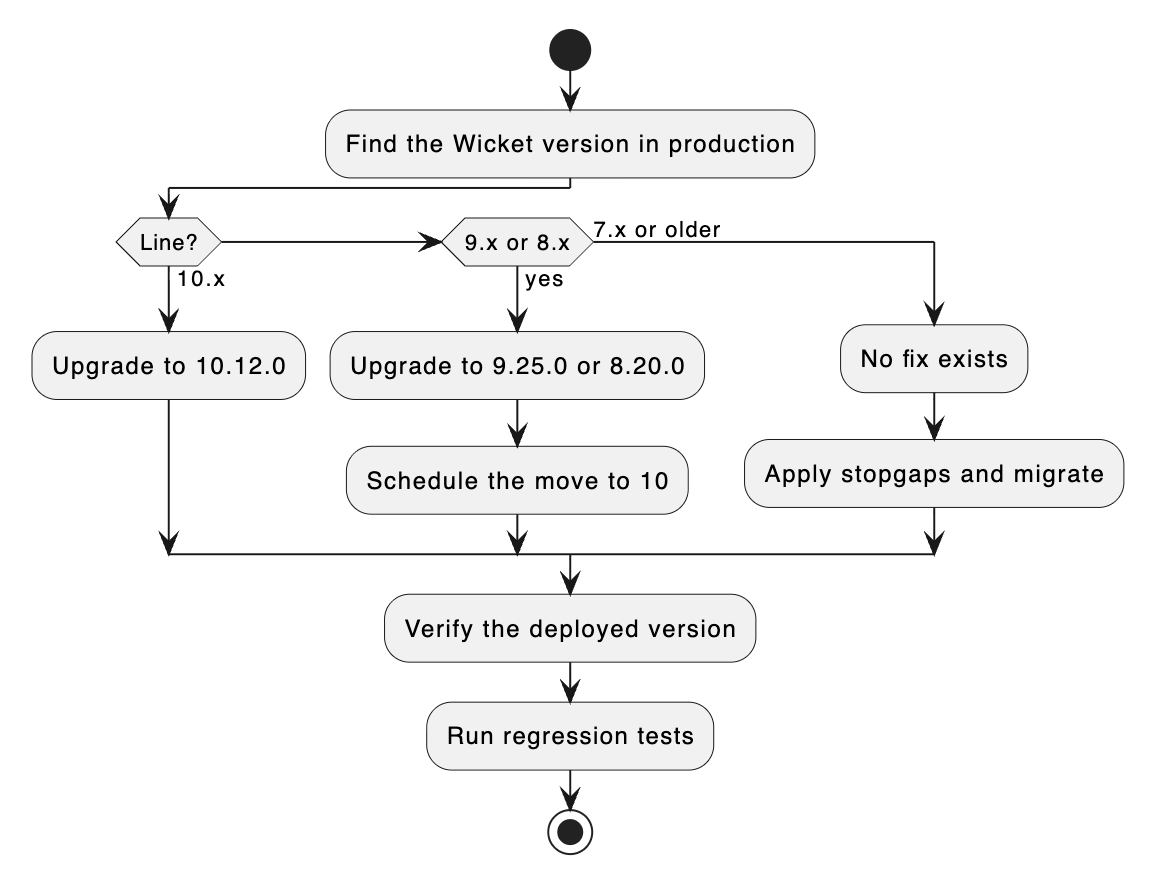
@startuml
start
:Find the Wicket version in production;
if (Line?) then (10.x)
  :Upgrade to 10.12.0;
elseif (9.x or 8.x) then (yes)
  :Upgrade to 9.25.0 or 8.20.0;
  :Schedule the move to 10;
else (7.x or older)
  :No fix exists;
  :Apply stopgaps and migrate;
endif
:Verify the deployed version;
:Run regression tests;
stop
@enduml
How to check your Wicket version
The running version is what matters, and it may differ from the one in your build file. A dependency can pull in its own Wicket.
Step 1: Read the dependency tree
For Maven:
mvn dependency:tree -Dincludes=org.apache.wicketFor Gradle:
./gradlew dependencies --configuration runtimeClasspath | grep 'org.apache.wicket'Step 2: Check what actually shipped
Look inside the artifact you deploy. Spring Boot fat JARs work the same way:
unzip -l <YOUR_APP>.war | grep 'wicket-'Also check shared library folders if your server loads Wicket from one. On Tomcat:
find "$CATALINA_HOME/lib" -name 'wicket-*.jar'Step 3: Find out which bugs reach your code
Upgrade regardless of the result. This search only helps you decide what to test first and how much to worry until the deploy lands.
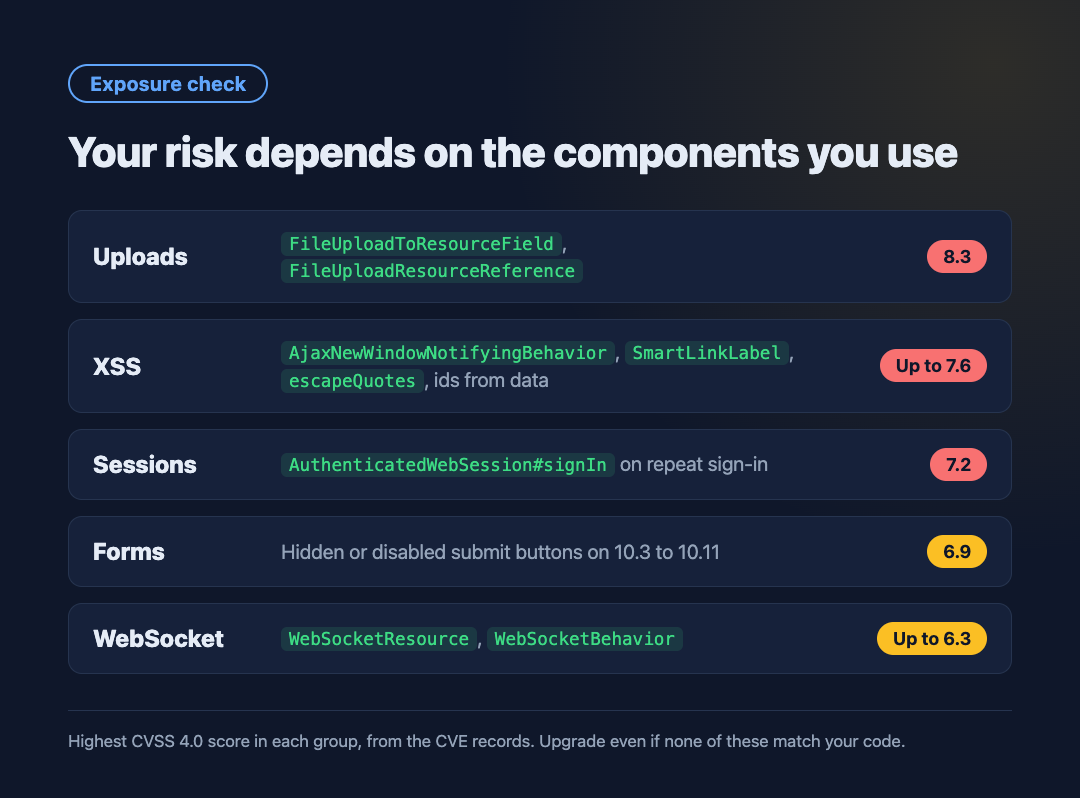
grep -rnE 'FileUploadToResourceField|FileUploadResourceReference|AjaxNewWindowNotifyingBehavior|SmartLinkLabel|SmartLinkMultiLineLabel|escapeQuotes|WebSocketBehavior|WebSocketResource|AjaxEditableLabel|MultiFileUploadField|UploadProgressBar|FilterForm|TrapFocusBehavior|AuthenticatedWebSession' src/On 8.x, also search for ExternalLink, because CVE-2026-84231 only affects that line.
The Apache Wicket CVEs and who is exposed
SecurityOnline counts 19 flaws: 9 High, 6 Medium and 4 Low. These are the 16 records I could read, sorted by CVSS 4.0 score, including all nine High ones. I couldn't identify the other three (by that count, two Medium and one Low). The fixed versions cover all 19, according to the same report.
| CVE | CVSS | Bug | Exposed if |
|---|---|---|---|
| 84170 | 8.3 | Upload limits read from request parameters | You use FileUploadToResourceField or mount FileUploadResourceReference. 9.14 to 9.24, 10.0 to 10.9.1 |
| 83594 | 8.3 | Memory allocated from a client-supplied size | You call UploadInfo#get() on that field. 9.14 to 9.24, 10.0 to 10.11 |
| 111089 | 7.6 | XSS through resource bundle text | An attacker can influence text used by components such as MultiFileUploadField or UploadProgressBar |
| 95863 | 7.6 | XSS through component or markup ids | Your ids contain special characters, for example when built from data |
| 82956 | 7.6 | XSS through window.name | You added AjaxNewWindowNotifyingBehavior |
| 84231 | 7.4 | XSS in ExternalLink | 8.x only, on a non-anchor tag with an attacker-influenced URL |
| 83559 | 7.4 | escapeQuotes skips backslashes | You call it on attacker-influenced data, or AjaxEditableLabel echoes input in a message |
| 83539 | 7.4 | javascript: links in smart labels | SmartLinkLabel shows untrusted text and a user clicks the link |
| 82840 | 7.2 | Session fixation on repeat sign-in | You use wicket-auth-roles. 8.18+, 9.23+, 10.9+ |
| 82557 | 6.9 | Hidden or disabled submit button can fire | 10.3 to 10.11, non-AJAX forms |
| 84172 | 6.3 | Markup template readable | Wicket sits in a shared class loader |
| 84177 | 6.3 | Markup template readable | A component class name contains an underscore |
| 82115 | 6.3 | No authorization on shared WebSocketResource | You rely on the authorization strategy for it |
| 82558 | 2.3 | No access check on WebSocketBehavior messages | It sits on a hidden, disabled or restricted component |
| 82559 | 2.3 | WebSocket outlives the ended session | The container ends authenticated sessions |
| 87718 | 2.3 | CSP header missing | 9.24 or 10.10 to 10.11, with nested request handler delegates |
All IDs start with CVE-2026-. The "High" count uses CVSS scores. Some records also carry a text rating that reads lower, such as "moderate" on CVE-2026-83559, CVE-2026-83539 and CVE-2026-82840, so the scores can overstate the risk for your app. A few details from those records help you judge it:
- The upload bugs need no login by default. One request can use as much disk or heap as the client sends. Regular
FileUploadFieldforms andAjaxFileDropBehaviorare not affected by CVE-2026-84170. - Default CSP does not save you from every XSS bug. Wicket's default Content-Security-Policy blocks the
SmartLinkLabelscript on 9.x and 10.x. It doesn't stop CVE-2026-95863 or the script cases of CVE-2026-111089, because the injected code lands inside a script that already has the nonce. - 8.x has no CSP support at all, so it has no such safety net.
- Three WebSocket bugs reach old lines. CVE-2026-82115 goes back to 7.0.0, and CVE-2026-82558 and CVE-2026-82559 go back to 6.0.0.
How to install the Apache Wicket update
Step 1: Change the version everywhere
Wicket's release notes say to update all Wicket dependencies to the same version. In Maven, a single property keeps them aligned:
<properties>
  <wicket.version>10.12.0</wicket.version>
</properties>

<dependency>
  <groupId>org.apache.wicket</groupId>
  <artifactId>wicket-core</artifactId>
  <version>${wicket.version}</version>
</dependency>
In Gradle:
implementation("org.apache.wicket:wicket-core:10.12.0")Use 9.25.0 or 8.20.0 if you're on those lines, and apply the same change to wicket-extensions, wicket-auth-roles and any other Wicket module you use.
Step 2: Rebuild, deploy and verify
Rebuild the artifact or container image, then deploy it. Run the checks from the version section again and confirm every Wicket JAR shows the new version. If you build in CI, make sure the build isn't using a cached image. If that CI is Jenkins, it had its own round of fixes last week, covered in our Jenkins security update guide.
If you serve Wicket from a shared library folder, replace the JARs there as well. Moving Wicket into WEB-INF/lib removes the exposure to CVE-2026-84172, since standard deployments aren't affected by it.
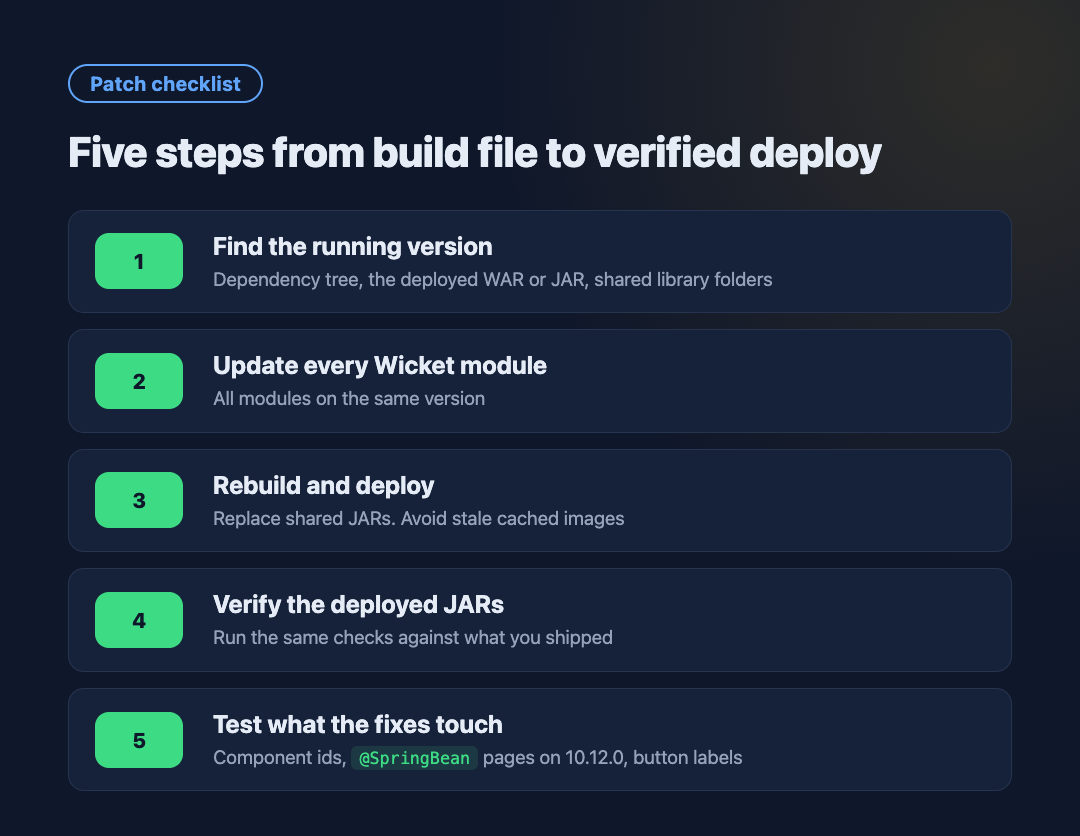
Step 3: Test what the fixes touch
Three changes deserve a test run:
- Component ids. The fix for CVE-2026-95863 rejects ids containing quotes, backquotes, backslashes, braces, angle brackets, semicolons, ampersands or control characters. Markup ids also can't contain parentheses or square brackets. A component built with one of these throws an exception, so check any id built from data or passed to
setMarkupId. @SpringBeanpages on 10.12.0. Lazy-init proxies now use a private lookup in place of ByteBuddy class injection (WICKET-7204).- Button labels.
setEscapeModelStrings(false)on aButtonworks again after a regression in 9.24.0 and 10.11.0 (GH-1576), so any workaround you added can go.
If you can't deploy today
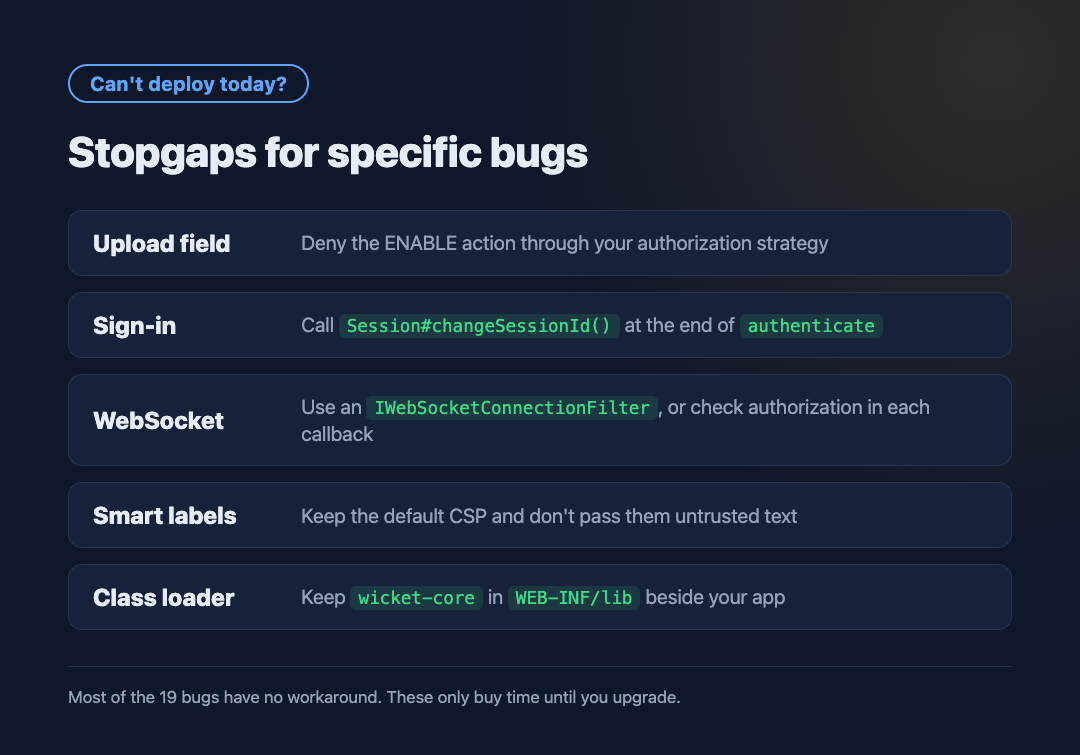
These stopgaps come from the CVE records. None of them replaces the upgrade, and most bugs have no workaround at all.
| CVE | Stopgap |
|---|---|
| CVE-2026-83594 | Deny the ENABLE action on the upload field through your authorization strategy |
| CVE-2026-82840 | Call Session#changeSessionId() at the end of authenticate(String, String) |
| CVE-2026-82115 | Reject connections with an IWebSocketConnectionFilter, or repeat the authorization check at the start of each callback |
| CVE-2026-83539 | Keep the default CSP on 9.x and 10.x, and don't pass untrusted text to smart labels |
| CVE-2026-84172 | Keep wicket-core in WEB-INF/lib beside your application |
Plan your move off Wicket 8 and 9
The end-of-life notice sets the route. From Wicket 9, go straight to 10. From Wicket 8, move to 9 first with Java 11, then to 10.
Wicket 10 requires Java 17 and Jakarta Servlet 5.0 or newer, along with Spring 6, Guice 7 and Commons FileUpload 2 if you use those integrations. The biggest mechanical change is javax.servlet becoming jakarta.servlet, so check that your container supports it before you start.
The Wicket 10 page documents OpenRewrite recipes that automate much of this, including imports and moved classes:
mvn -U org.openrewrite.maven:rewrite-maven-plugin:run \
  -Drewrite.recipeArtifactCoordinates=org.apache.wicket:wicket-migration:LATEST \
  -DactiveRecipes=org.apache.wicket.BestPractices
Review the resulting diff yourself before you merge it, then run your full test suite. If you do this work in IntelliJ IDEA, check that the IDE is patched as well, using our JetBrains security update guide.
Wicket 10 won't last forever either. The versions page shows support until Wicket 14 arrives in July 2027, so that's the next date to put on your calendar.
If something breaks after the update
| Symptom | Likely cause | Fix |
|---|---|---|
| Exception when a component renders | An id contains a character the CVE-2026-95863 fix rejects | Clean the id, or build it from safe values |
| Class or method errors at startup | Mixed Wicket versions | Align all modules, then re-check the dependency tree |
| Production still reports the old version | Shared library or stale image | Replace the shared JARs and rebuild without cache |
@SpringBean errors on 10.12.0 | Possibly the proxy change (WICKET-7204) | Reproduce it, then ask on the users list with your Wicket and Java versions |
| Upgrade to 10 fails to compile | javax imports or an old Java version | Run the recipe and move to Java 17 |
To check that the CSP header is present after the update, run this against a page that uses your normal request mappers:
curl -sI https://<YOUR_APP_HOST>/ | grep -i content-security-policyAn empty result on 9.x or 10.x means the header is missing. Check whether your application turned CSP off, and whether a proxy in front of it removes the header.
FAQ
Is Apache Wicket 10.12.0 a drop-in upgrade? Yes, from any 10.y.z release, according to the release notes. There are no API breaks against 10.0.0. Still test ids and @SpringBean pages, because the security fixes change behavior there.
Should I upgrade to Wicket 11 instead? Not as an urgent fix. Wicket 11 needs Java 21 and Servlet 6.1, and its support ends when 12.0.0 arrives, scheduled for January 2027. Choose it when you want the new features and can test the migration properly.
Are 8.20.0 and 9.25.0 safe to stay on? They're safe against these bugs, but only for now. Any bug found later won't get a fix on those lines. Use them to close today's gap, then move to Wicket 10.
Is anyone exploiting these Wicket CVEs? I found no report of it as of November 2, 2026. One tracker lists CVE-2026-84170 as not in CISA's Known Exploited Vulnerabilities catalog. The records now explain the bugs in detail, so patch without waiting for reports.
Do I need to act if I don't use file uploads or WebSockets? Yes. Several bugs sit in core code such as Form. For example, CVE-2026-82557 affects non-AJAX forms with a hidden or disabled submit button on 10.3 to 10.11.
What to do next
Find the Wicket version in production, patch inside your line, and verify the deployed JARs. If you're on 8.x or 9.x, put the move to Wicket 10 on your schedule this quarter, because the next Wicket bug won't get a patch on those lines.
References
All checked on 2026-11-02.
- Apache Wicket 10.12.0 release notes
- Apache Wicket 9.25.0 release notes
- Apache Wicket 8.20.0 release notes
- Wicket 8 and 9 end-of-life notice
- Apache Wicket 11.0.0 release notes
- Apache Wicket versions and support
- Wicket 10 migration and OpenRewrite recipes
- wicket-core versions on Maven Central
- CVE-2026-84170 record. The other records are linked in the table above. The Apache mailing list advisories linked from them didn't load in my reader, so I used the CVE records.
- SecurityOnline: 19 flaws in the Apache Wicket update (source for the total count)
- Strix: CVE-2026-84170 (source for the KEV status)
1 thought on “Apache Wicket Security Update: Patch 19 CVEs to 10.12.0”