CVE-2026-98432 is a Linux kernel flaw in IPv4 TCP that a remote attacker can trigger with a crafted SYN packet, without logging in. Install your distribution's fixed kernel and reboot. If no fix has shipped yet, as on Ubuntu and RHEL when this was written, drop IPv4 TCP packets that carry IP options until one does.
Written 2026-11-02 (KST). Facts come from the CVE record and from Red Hat, Ubuntu, Debian, SUSE, AWS and AlmaLinux pages, checked that day. Distribution status changes quickly, so confirm yours on the linked page. I did not run these commands or test the flaw, and the Linux kernel team's own advisory file blocked my tool, so the version list comes from the CVE record.
What CVE-2026-98432 changes
The bug is a use-after-free, meaning the kernel reads memory it has already released. While handling a new connection, one CPU can pass a request's IP options to the child socket. Another CPU handling a retransmitted SYN can still read those options after they are freed. The Ubuntu CVE page has the technical description.
| Item | Detail |
|---|---|
| Affected | Linux kernels from 4.4 until the fixed releases |
| Trigger | SYN with IPv4 options, sent to a listening IPv4 TCP port |
| Login needed | No |
| Score | 9.8 (kernel CNA, Red Hat), 8.1 (SUSE) |
| IPv6 | Not affected by the main issue |
| Known attacks | None found as of Nov 2 |
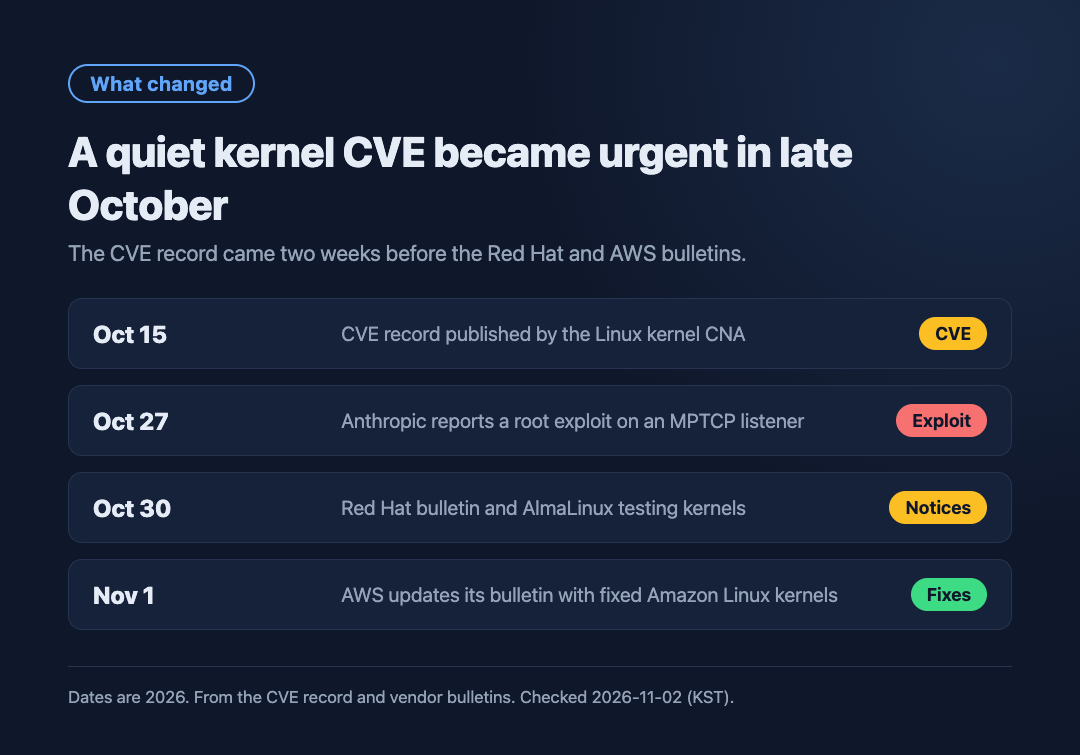
The dates explain why this looks new. The CVE record was published on October 15 as an ordinary kernel fix. Anthropic then reported on October 27 that an unreleased Claude model built a working root exploit. Red Hat published bulletin RHSB-2026-016 on October 30, and AWS last updated its bulletin on November 1.
How serious is it?
Vendors disagree. Red Hat rates it Critical, and says a crash is the immediate risk while reliable code execution "requires precise heap control". SUSE scores it 8.1 because it rates attack complexity as high. Reports from late October quoted lower Red Hat scores, so read the current page.
Anthropic's report describes about 48 minutes to leak a kernel pointer and about five more to reach a root shell, on a server with a Multipath TCP (MPTCP) listener. MPTCP lets one connection use several network paths. The exploit is not public. I found no independent reproduction, and a developer from the MPTCP project argued in a Go thread that it is unlikely to work outside a lab.
The CVE record has no CISA exploitation data, and the CISA KEV catalog entries I checked through October 30 don't list it. Treat that as the status today. A crash is still a real outage risk for an internet-facing server.
Check whether your Linux kernel is exposed
Run these on each server:
uname -r                          # running kernel
grep PRETTY_NAME /etc/os-release  # distribution
sudo ss -4 -ltnp                  # IPv4 TCP listeners
sudo ss -lnMp                     # MPTCP listeners
sysctl net.mptcp.enabled          # 1 = new MPTCP sockets allowed
sysctl net.ipv4.tcp_migrate_req   # request migration, should print 0
AlmaLinux's guidance is the simplest test: any system accepting IPv4 TCP connections from untrusted networks should be treated as exposed. An empty MPTCP list only removes the path Anthropic described. The bug sits in ordinary TCP code, and CIQ reports that plain TCP listeners still answered SYNs with a Record Route option when MPTCP was off.
Go services deserve a look. Since Go 1.24, listeners enable MPTCP by default where the kernel supports it, so a Go service can appear in that list without anyone choosing it.
Don't judge by the version number alone
These upstream releases contain the fix: 5.10.272, 5.15.223, 6.1.190, 6.6.159, 6.12.113, 6.18.56, 7.2.10 and 7.3. That comparison only works for upstream kernels. Distributions backport fixes to older-looking version numbers, so compare your kernel with the build your vendor lists below.
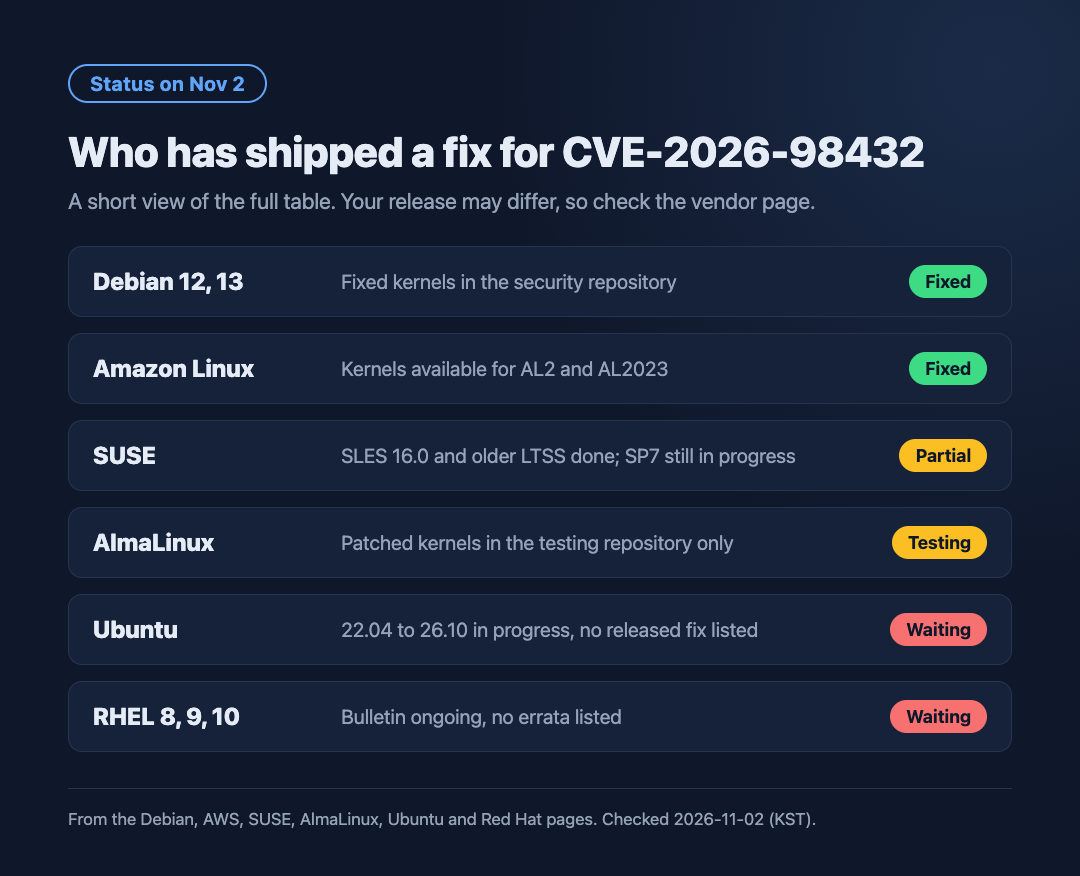
CVE-2026-98432 fix status by distribution
| Distribution | Status | Fixed build or notice |
|---|---|---|
| Debian 13 | Fixed | linux 6.12.113-1, DSA-6568-1 |
| Debian 12 | Fixed | linux 6.1.190-1, DLA-4841-1; linux-6.12 6.12.113-1~deb12u1, DLA-4850-1 |
| Ubuntu 22.04 to 26.10 | Fix in progress | None released |
| Ubuntu 16.04 to 20.04 | Vulnerable | None listed |
| RHEL 8, 9, 10, OpenShift | No errata listed | RHSB-2026-016, marked ongoing |
| AlmaLinux 8, 9, 10 | Testing repo only | See below |
| Amazon Linux 2, 2023 | Fixed | Update and reboot |
| SLES 16.0, Leap 16.0 | Fixed | kernel-default 6.12.0-160000.40.1 |
| SLES 15 SP6-LTSS | Fixed | 6.4.0-150600.23.143.1 |
| SLES 15 SP5-LTSS | Fixed | 5.14.21-150500.55.195.1 |
| SLES 15 SP4-LTSS | Fixed | 5.14.21-150400.24.246.1 |
| SLES 15 SP7 | In progress | None released |
| Leap 15.3 to 15.6 | Affected | None listed |
| Oracle Linux 7 to 10 (UEK) | Listed as fixed | ELSA-2026-500397, 500398, 500399 |
Sources: Debian tracker, Ubuntu, SUSE, Oracle Linux. Three notes on reading the table:
- Ubuntu: the tracker names builds such as 6.8.0-149.149 for 24.04 next to "work in progress". Those are builds being prepared, and the page lists no released fix.
- Red Hat: third-party trackers quoted "fix deferred" in late October, while the bulletin says Red Hat is "expediting the release of fixes". I followed the bulletin.
- Oracle Linux: the page says it is generated automatically and lists only UEK errata. Check there if you run the Red Hat compatible kernel.
I found no released fix for Rocky Linux community builds. CIQ lists patched kernels only for its paid RLC Pro LTS and FIPS variants and points community users to Rocky's errata.
Update the kernel where a fix exists
Pick your distribution, then schedule the reboot. The new kernel does nothing until the machine boots into it.
Debian:
sudo apt update && sudo apt full-upgrade
sudo reboot
Amazon Linux 2 and Amazon Linux 2023:
sudo yum update kernel && sudo reboot
sudo dnf update kernel --releasever=latest && sudo reboot
SUSE:
sudo zypper patch --cve=CVE-2026-98432
sudo reboot
Ubuntu, once a fix ships:
sudo pro fix CVE-2026-98432
sudo apt update && sudo apt full-upgrade
sudo reboot
For AlmaLinux, the fixed builds are kernel-4.18.0-553.180.2.el8_10 (8), kernel-5.14.0-687.61.2.el9_8 (9) and kernel-6.12.0-211.69.2.el10_2 (10). They were still in testing when AlmaLinux last posted, so decide whether that's acceptable for production:
sudo dnf install -y almalinux-release-testing
sudo dnf update 'kernel*' --enablerepo=almalinux-testing
sudo reboot
After the reboot, turn the testing repository off again:
sudo dnf config-manager --disable almalinux-testingConfirm the result with uname -r. If you run several exposed services, the Brotli patch checklist covers another fix from the same weeks that may need a restart window. A release upgrade won't get you ahead here, because Ubuntu 26.10 is still waiting on its own kernel fix.
AWS services
AWS's bulletin is long, so here are the common cases:
| Service | Action |
|---|---|
| EC2, Lightsail | Update the kernel and reboot |
| EKS on AL2023 | Move nodes to AMI v20261031 or later |
| ECS on EC2 | Update and reboot, or use AMI 20261031 |
| Fargate | Tasks launched after Nov 1, 9:00 AM PST are patched |
| Lambda | Not affected, no action |
| RDS, Aurora | Keep ports private; OS patch expected Nov 3 |
Block the trigger until the patch arrives
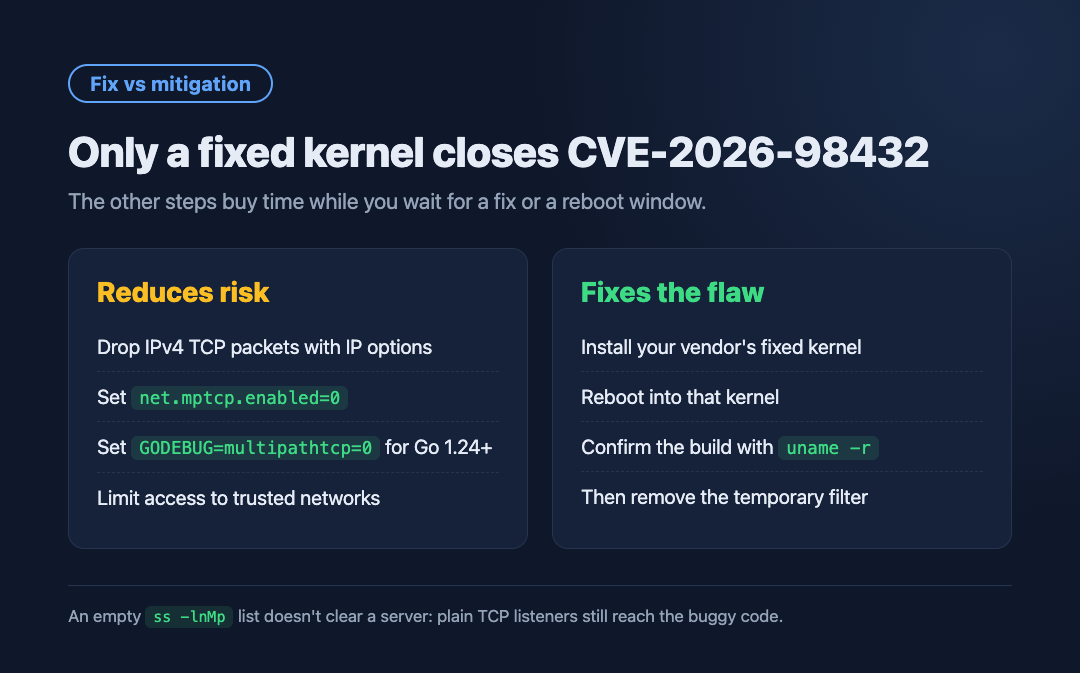
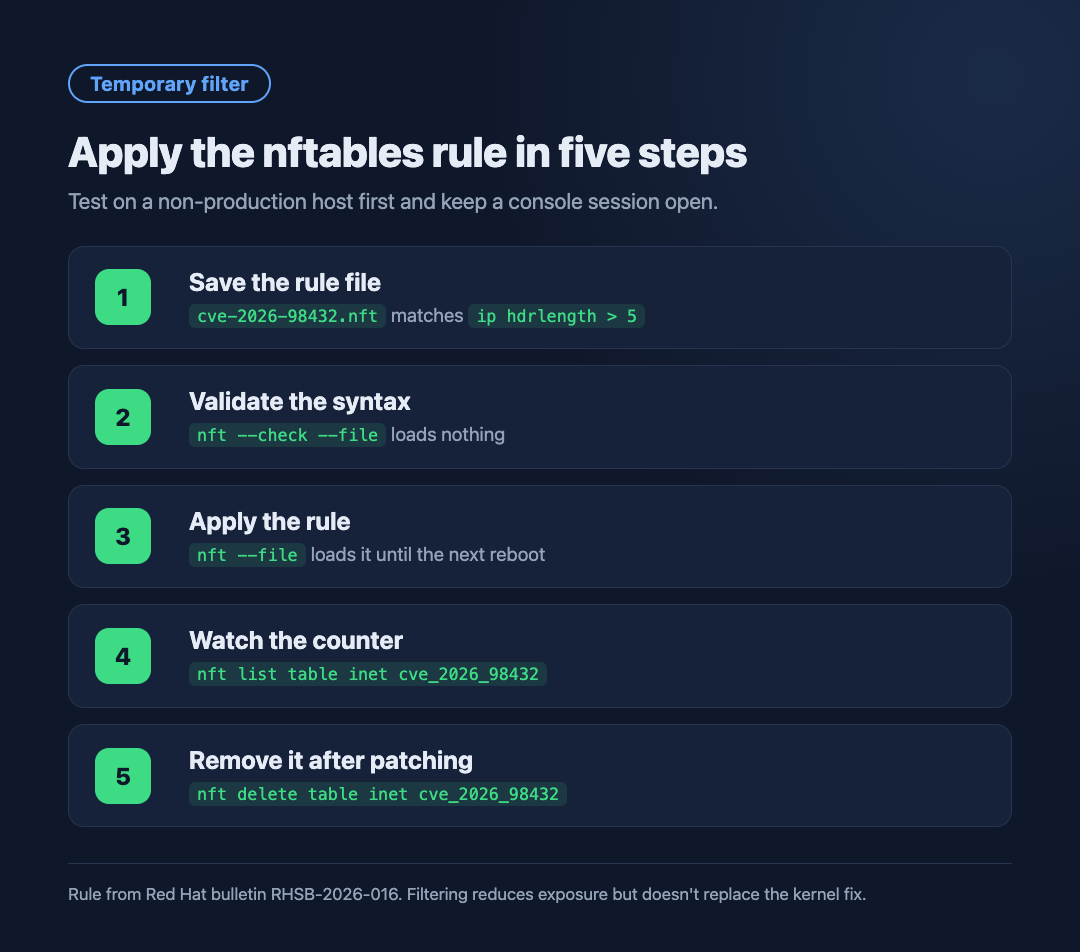
No fix yet, or no reboot window? Drop IPv4 TCP packets with IP options. A normal IPv4 header is five 32-bit words, so ip hdrlength > 5 matches packets carrying options. Red Hat's bulletin says filtering reduces exposure but doesn't replace patching, and that it may disrupt workloads. Test on a non-production host first, and keep a console session open.
Save this as cve-2026-98432.nft:
table inet cve_2026_98432 {
    chain input {
        type filter hook input priority -310; policy accept;
        ip protocol tcp ip hdrlength > 5 counter drop
    }
}
Then check, apply and confirm it:
sudo nft --check --file cve-2026-98432.nft
sudo nft --file cve-2026-98432.nft
sudo nft list table inet cve_2026_98432
The counter in the last command shows how many packets were dropped. Normal connections should keep working, because ordinary TCP traffic rarely carries IP options.
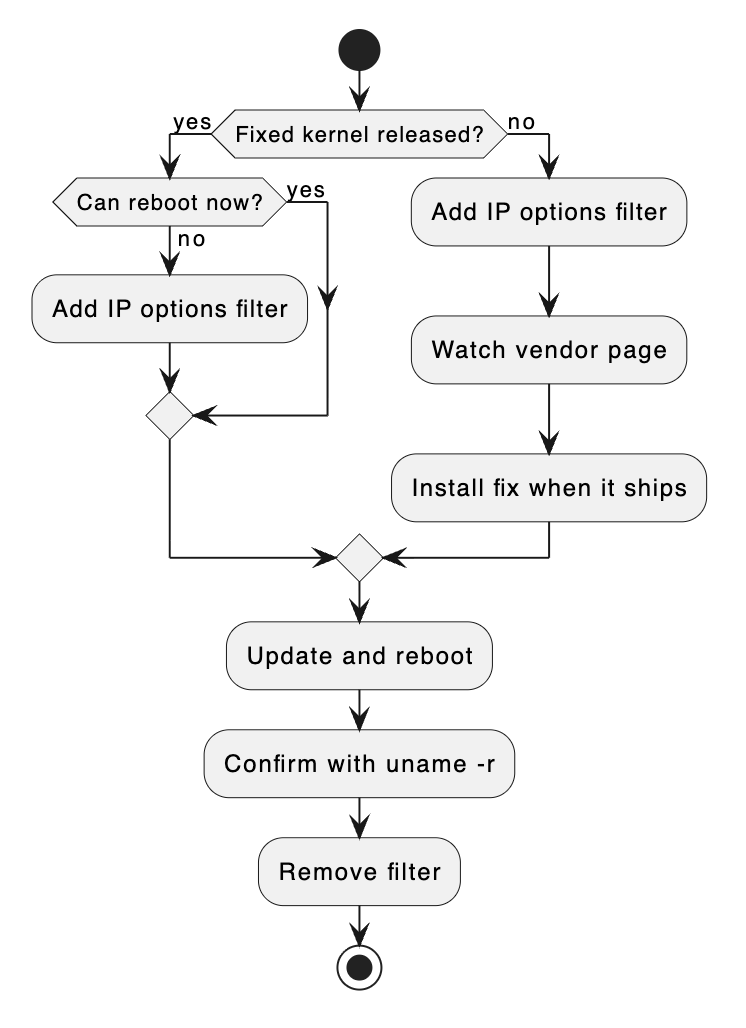
View PlantUML source
@startuml
skinparam shadowing false
start
if (Fixed kernel released?) then (yes)
  if (Can reboot now?) then (yes)
  else (no)
    :Add IP options filter;
  endif
else (no)
  :Add IP options filter;
  :Watch vendor page;
  :Install fix when it ships;
endif
:Update and reboot;
:Confirm with uname -r;
:Remove filter;
stop
@enduml
Limits of this nftables rule
- It doesn't survive a reboot. CIQ publishes a systemd unit version. It also warns that stopping
nftables.servicedeletes the table while the unit still shows active. - Forwarding and containers: Red Hat's rule hooks
input, which sees packets addressed to the host. AlmaLinux's and CIQ's versions hookpreroutingat priority -300, which also catches forwarded traffic. On a host that routes to containers I'd use thepreroutingform, though that's my reading of the hooks. AlmaLinux warns that traffic between containers on one host may bypass it, and CIQ says container behavior is untested. - CIPSO and NetLabel: don't use the rule if your network relies on those labels, which travel in IP options.
- Coverage: CIQ says IPv6, fragments and other delivery paths were not tested.
On hosts that use iptables, AWS gives this equivalent. It drops every IPv4 packet with options, TCP or not, and also needs saving to survive a reboot:
sudo iptables -I INPUT 1 -m u32 --u32 '0>>24&0x0f=6:15' -j DROPTurn off MPTCP where you don't need it
This reduces risk and fixes nothing. It closes the path Anthropic described while the TCP bug stays in place.
echo 'net.mptcp.enabled = 0' | sudo tee /etc/sysctl.d/90-disable-mptcp.conf
sudo sysctl -w net.mptcp.enabled=0
The setting only stops new MPTCP sockets, so restart any service still listed by sudo ss -lnMp. For Go 1.24+ services, set GODEBUG=multipathtcp=0, or add godebug multipathtcp=0 to go.mod and rebuild. Go's maintainers hadn't decided whether to change the default when I checked.
After patching, and if something goes wrong
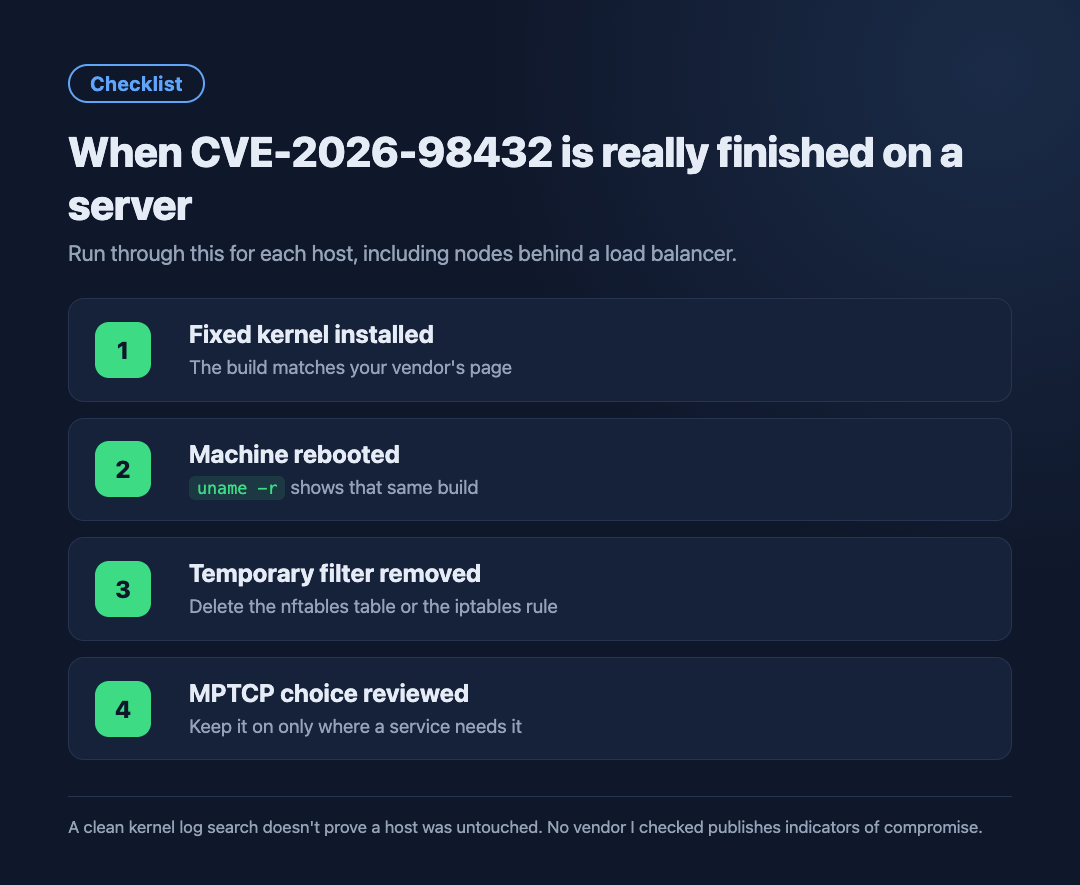
Remove the filter once uname -r shows the fixed build:
sudo nft delete table inet cve_2026_98432No vendor I checked publishes indicators of compromise. PatchMon, a third-party source, suggests searching kernel logs for crash signatures. A match points to a crash worth investigating, and no match proves nothing.
journalctl -k | grep -E 'ip_options_build|ip_build_and_send_pkt|skb_under_panic'| Problem | Likely cause | Fix |
|---|---|---|
uname -r still shows the old kernel | No reboot, or another boot entry | Reboot; check /var/run/reboot-required or needs-restarting -r |
| Debian finds no new kernel | Security repository missing | Run apt policy linux-image-amd64; check your sources |
| AL2023 finds no update | Instance locked to a release | Use --releasever=latest (2023.12.20261102 or later) |
| An app fails after the filter | It uses IP options | Remove the rule; limit access by source IP |
| Filter vanished | nftables stopped or host rebooted | Reapply it, or use a systemd unit |
net.mptcp.enabled is missing | Kernel has no MPTCP | Still patch: the TCP bug remains |
FAQ
Is my server safe if MPTCP is disabled? No. It removes the exploit path Anthropic described, but the bug is in ordinary IPv4 TCP handling. Install the fixed kernel, and use the filter until you can.
Does an IPv6-only server need this patch? IPv6 isn't affected by the main issue, according to the Ubuntu description. A related request migration problem on IPv6 only involves CALIPSO and is being handled separately. Most servers also accept IPv4, so check with ss -4 -ltnp first.
Do I need to reboot after updating the kernel? Yes, unless your live patching provider confirms a patch for this specific CVE. I couldn't confirm a live patch from any vendor, so ask yours directly.
Are containers protected if the host is patched? Containers share the host kernel, so patching and rebooting the host is what counts. A newer container image does nothing here. Managed platforms such as Fargate handle the host for you, as listed by AWS.
Is a public exploit available? I found none as of November 2. Anthropic says it built one, and third-party reports say it hasn't been released. Check your vendor's page again before you decide to wait.
References
Checked 2026-11-02 (KST).
- CVE Record: CVE-2026-98432
- Red Hat: RHSB-2026-016
- Red Hat: CVE-2026-98432
- Ubuntu: CVE-2026-98432
- Debian security tracker
- SUSE: CVE-2026-98432
- Oracle Linux: CVE-2026-98432
- AWS security bulletin 2026-160
- AlmaLinux: patched kernels in testing
- Anthropic: discovering vulnerabilities with Claude
- Go: GODEBUG settings
- Go issue 82717: disable MPTCP by default
- CISA Known Exploited Vulnerabilities catalog
- CIQ: CVE-2026-98432 mitigation
- BleepingComputer: critical Linux kernel flaw
- PatchMon: CVE-2026-98432 status
1 thought on “CVE-2026-98432 Linux Kernel Patch: Check, Block and Update”