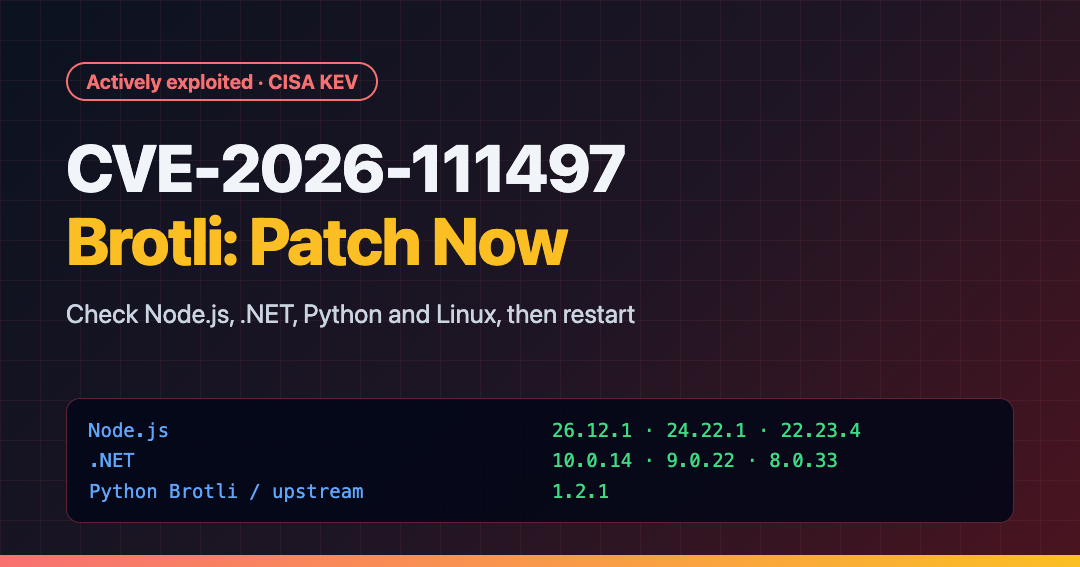
CVE-2026-111497 is an out-of-bounds write in Google's Brotli decoder, and it is being exploited. CISA added it to its Known Exploited Vulnerabilities catalog on October 27, 2026, and Singapore's Cyber Security Agency warned of active exploitation on October 30. Update to Brotli 1.2.1 (or 1.1.1 / 1.0.10), Node.js 26.12.1, 24.22.1 or 22.23.4, .NET 10.0.14, 9.0.22 or 8.0.33, or Python Brotli 1.2.1, then restart services and rebuild images, because many apps carry their own copy of the decoder.
Written 2026-10-31. Versions and dates come from the vendor advisories and distro trackers listed at the end, all checked on 2026-10-31. Items that come only from third-party write-ups are marked in the text. I did not run an exploit, and I did not test every command below on every platform listed, so try them on a staging host first.
What changed: CVE-2026-111497 in one timeline
The bug is in the streaming decoder. Per the Node.js advisory, an invalid block switch was reported as "needs more input" instead of a permanent format error, so the decoder kept appending bytes to an eight-byte internal buffer. An attacker who can feed Brotli data to your app can corrupt process memory. The result can be a crash, leaked process memory or remote code execution.
You will see the same flaw under three nicknames: Node2Shell, Broccoli2Shell and HTTP2Shell. They all refer to this one CVE.
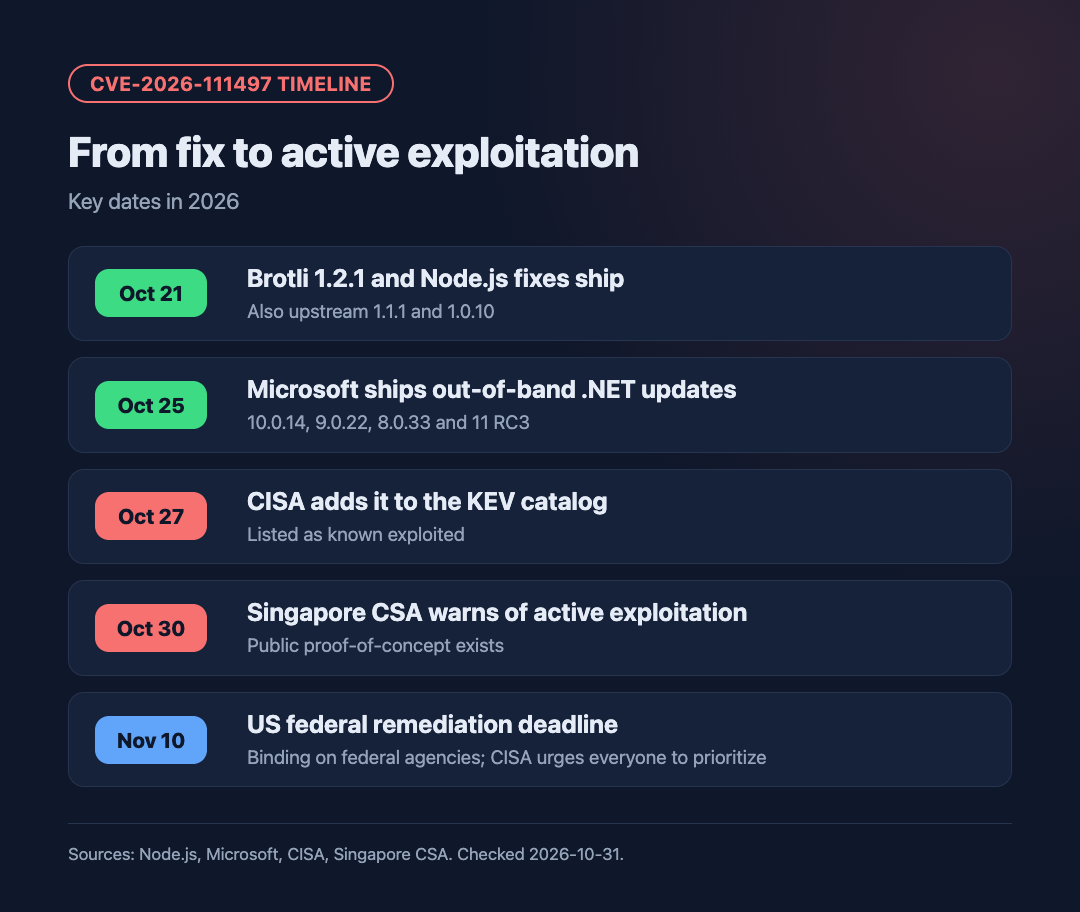
| Date (2026) | Event |
|---|---|
| Oct 21 | Brotli 1.2.1 and Node.js security releases ship |
| Oct 22 | Python Brotli 1.2.1 reaches PyPI |
| Oct 25 | Microsoft publishes out-of-band .NET updates |
| Oct 26 | Ubuntu publishes USN-8956-1; Red Hat opens bulletin RHSB-2026-015 |
| Oct 27 | CISA adds the CVE to the KEV catalog |
| Oct 30 | Singapore CSA alert: public proof-of-concept, active exploitation reported |
| Nov 10 | CISA remediation deadline for US federal agencies |
The sources I read confirm exploitation but do not describe specific victims or campaigns. Early reports that Microsoft had seen no evidence of exploitation predate the CISA listing, so do not rely on them.
Why the severity scores disagree
| Source | Rating |
|---|---|
| Google (CNA), CVSS 4.0 | 9.2 Critical |
| NVD and Singapore CSA, CVSS 3.1 | 9.8 Critical |
| Microsoft and Red Hat, CVSS 3.1 | 8.1 High / Important |
| Node.js project | High |
Red Hat scores attack complexity as high, while NVD scores it as low. That difference explains most of the gap. For prioritizing, the KEV listing matters more than the decimal: treat any internet-facing path that decodes Brotli as urgent.
Are you exposed to the Brotli vulnerability?
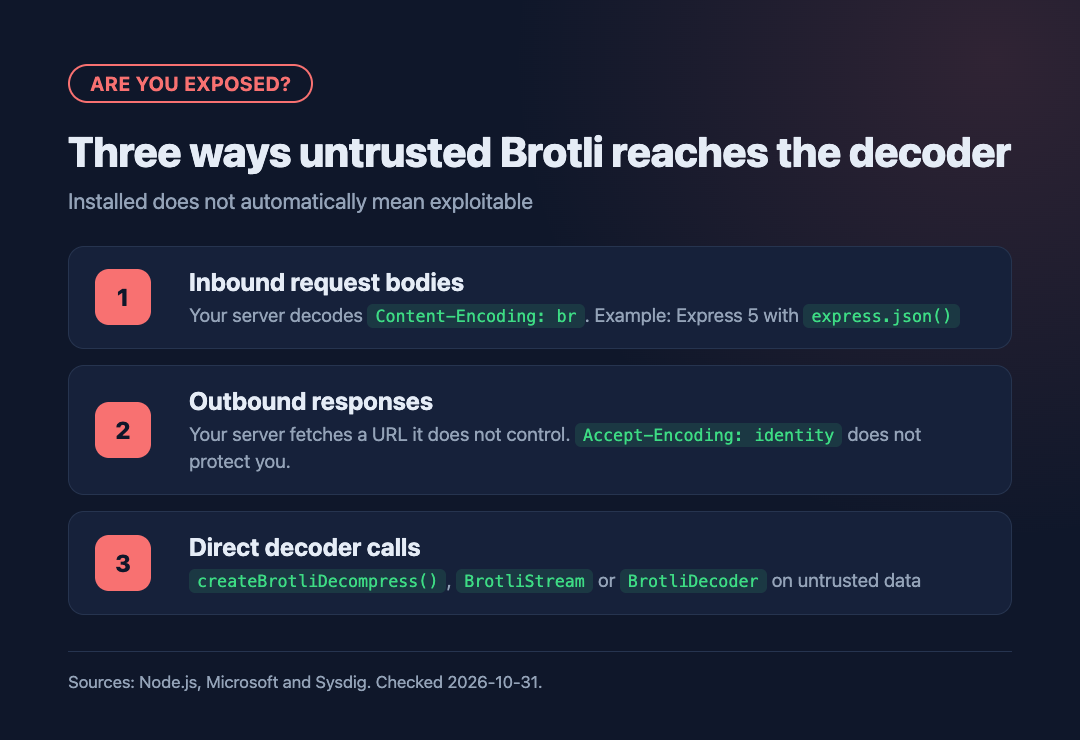
Having the library installed does not make you exploitable. Microsoft says this plainly for .NET, and Node.js does not decode Brotli on its own. You are exposed when your code, or a library it uses, decompresses Brotli data an attacker can influence. That happens in three ways:
- Inbound request bodies. A server accepts
Content-Encoding: brand decodes it. - Outbound responses. Your server fetches a URL it does not fully control, and the response comes back Brotli-encoded. Webhook and URL-preview features fit this pattern.
- Direct decoder calls. Code passes untrusted data to
createBrotliDecompress(),BrotliStreamor similar.
The second path is easy to miss. Sysdig notes that sending Accept-Encoding: identity does not protect server-side fetch(), because a malicious server can send Brotli anyway.
| Stack | Exposed when |
|---|---|
Express 5 + express.json() | By default: body-parser 2.x decodes br |
Express 4 + express.json() | Not on this path: body-parser 1.20.x returns 415 for br |
Node.js server-side fetch() | A response from an attacker-influenced server uses br |
| ASP.NET Core | br is enabled in request decompression |
.NET HttpClient | AutomaticDecompression includes Brotli or All |
Python requests, urllib3, aiohttp | Brotli or brotlicffi is installed |
Python httpx | Installed with the brotli extra |
| Envoy | Brotli decompression is enabled |
The Node.js rows come from Sysdig's analysis, the .NET rows from Microsoft and the Python rows from Aikido. The Envoy row comes from third-party summaries. .NET Framework is not affected, per Microsoft.
View PlantUML source
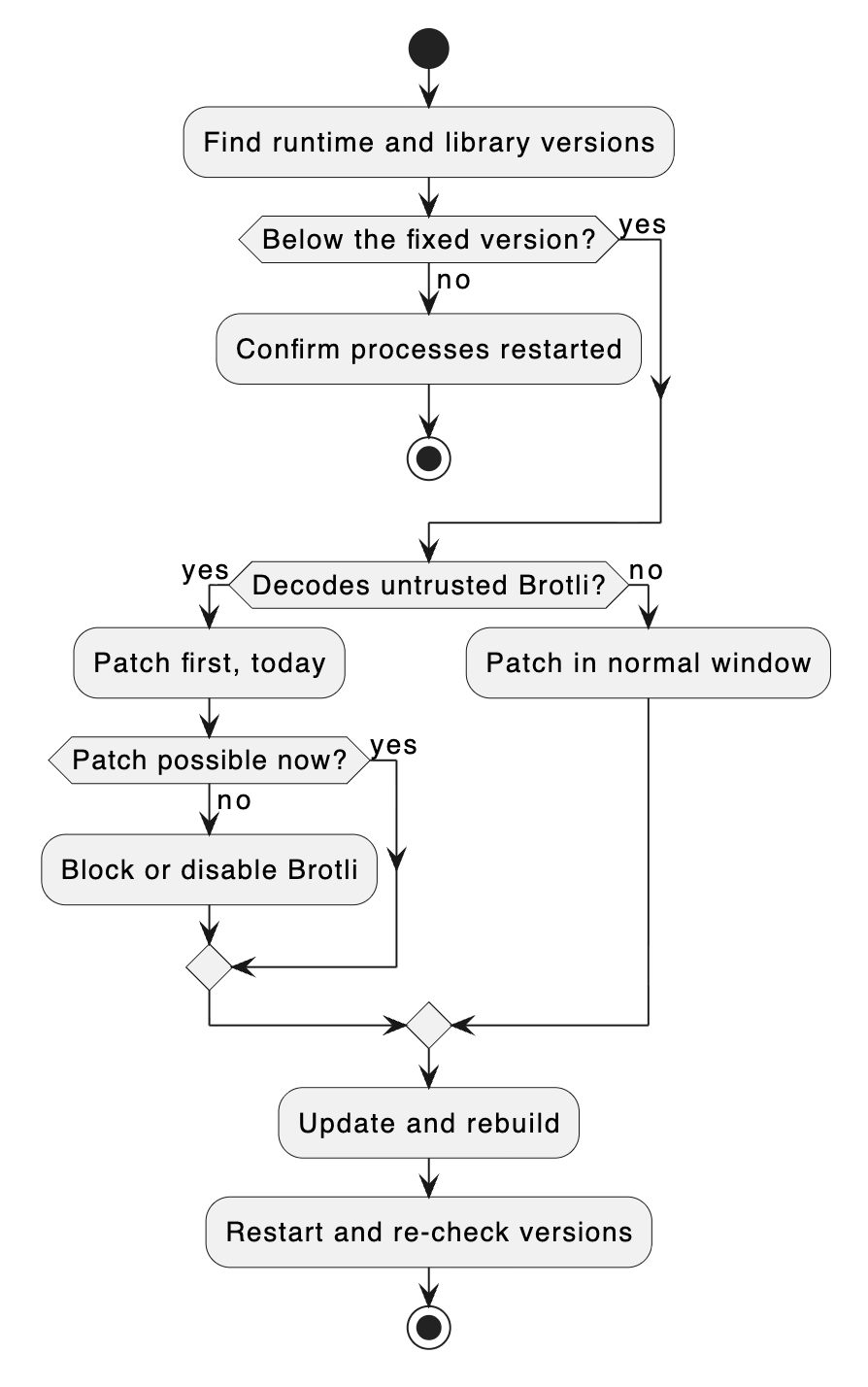
@startuml
skinparam shadowing false
skinparam defaultFontSize 14
start
:Find runtime and library versions;
if (Below the fixed version?) then (no)
  :Confirm processes restarted;
  stop
else (yes)
endif
if (Decodes untrusted Brotli?) then (yes)
  :Patch first, today;
  if (Patch possible now?) then (no)
    :Block or disable Brotli;
  else (yes)
  endif
else (no)
  :Patch in normal window;
endif
:Update and rebuild;
:Restart and re-check versions;
stop
@enduml
How to check your environment for CVE-2026-111497
Run the check where the code actually runs: inside the container, on the CI runner and on the serverless build image, not only on your laptop.
Node.js
node -v
npm ls express body-parser
grep -rnE "createBrotliDecompress|brotliDecompress" src/
docker exec <YOUR_CONTAINER> node -v
.NET
dotnet --list-runtimes
dotnet --list-sdks
grep -rnE "BrotliStream|BrotliDecoder|AutomaticDecompression|AddRequestDecompression" --include=*.cs .
Python
pip show Brotli brotlicffi
pipdeptree -r -p Brotli
grep -niE "brotli" requirements*.txt poetry.lock uv.lock
You do not need to import Brotli yourself. Aikido notes that requests and urllib3 use it automatically once it is installed.
Linux system library
Use the line for your distro: dpkg on Debian and Ubuntu, rpm on RHEL, Fedora and Amazon Linux, apk on Alpine. The find line looks for copies outside the package manager.
dpkg -l 'libbrotli*'
rpm -q brotli
apk info -v brotli-libs
sudo find / -xdev -name 'libbrotli*' 2>/dev/null
find will not reveal a decoder statically linked into a binary. Microsoft and Aikido both warn about this: updating the system library does not fix an app that bundles its own copy, including self-contained .NET apps and statically linked curl builds.
Fixed versions: the Brotli patch table by runtime
| Component | Fixed in | Note |
|---|---|---|
| Brotli (upstream) | 1.2.1, 1.1.1, 1.0.10 | Affected: 1.0.3 through 1.2.0 |
| Node.js | 26.12.1, 24.22.1, 22.23.4 | 20 and 25 are EOL: no fix |
| .NET | 10.0.14, 9.0.22, 8.0.33, 11.0.0-rc.3.26522.148 | SDKs: 10.0.114 / 10.0.403, 9.0.123 / 9.0.320, 8.0.133 / 8.0.427 |
Python Brotli | 1.2.1 | PYSEC-2026-4322 |
Python brotlicffi | 1.2.1.0 | PYSEC-2026-4323 |
| Bun | 1.4.4 | Rebuild compiled executables |
Java brotli4j | 1.24.0 | Per Aikido |
| Envoy | 1.40.0, 1.39.3, 1.38.6, 1.37.8 | Third-party summaries; confirm upstream |
| Istio | 1.31.2, 1.30.6, 1.29.9 | Third-party summaries; confirm upstream |
Bun's own 1.4.4 notes list security fixes without naming this CVE, so the Bun row relies on Sysdig and Aikido. Network appliances have separate advisories, such as Palo Alto's PAN-OS notice. Check your vendor if you run one.
The same Node.js release also fixes nine other issues, including TLS hostname bypasses, and updates the CA bundle after the eMudhra intermediate compromise. See our eMudhra trust store guide if you manage CA stores separately.
Linux distro packages
| Distro | Package | Fixed version |
|---|---|---|
| Ubuntu 26.10 | brotli | 1.2.0-4ubuntu0.1 |
| Ubuntu 26.04 LTS | brotli | 1.2.0-3ubuntu0.1 |
| Ubuntu 24.04 LTS | brotli | 1.1.0-2ubuntu0.1 |
| Ubuntu 22.04 LTS | brotli | 1.0.9-2ubuntu0.1 |
| Ubuntu 20.04 (ESM, Pro) | brotli | 1.0.7-6ubuntu0.1+esm1 |
| Debian 13 trixie | brotli | 1.1.0-2+deb13u1 |
| Debian 12 bookworm | brotli | 1.0.9-2+deb12u1 |
These versions look older than 1.0.10 or 1.1.1 because distros backport the fix. A scanner that compares only the upstream number may keep flagging them, so check the distro tracker before you panic.
RHEL: The status needs a manual check. Red Hat's bulletin RHSB-2026-015 lists RHEL 7 through 10 as affected, was still marked ongoing and listed no errata when I read it on October 31 (its last update was October 27). Third-party reports disagree on whether standard repositories now have fixes. Trust the Red Hat Customer Portal and dnf output over any blog, including this one.
Node.js from a distro package is a special case. On Ubuntu 22.04 and later, and on Debian, Node.js links to the system Brotli library. There, node -v does not tell you whether you are patched; libbrotli1 does. Ubuntu 20.04's Node.js uses its own vendored copy and is listed as vulnerable with no fixed version. On RHEL 8 and 9, the nodejs:24 module bundles Brotli while nodejs:22 uses the system library, and .NET 8 bundles it on RHEL 8 through 10.
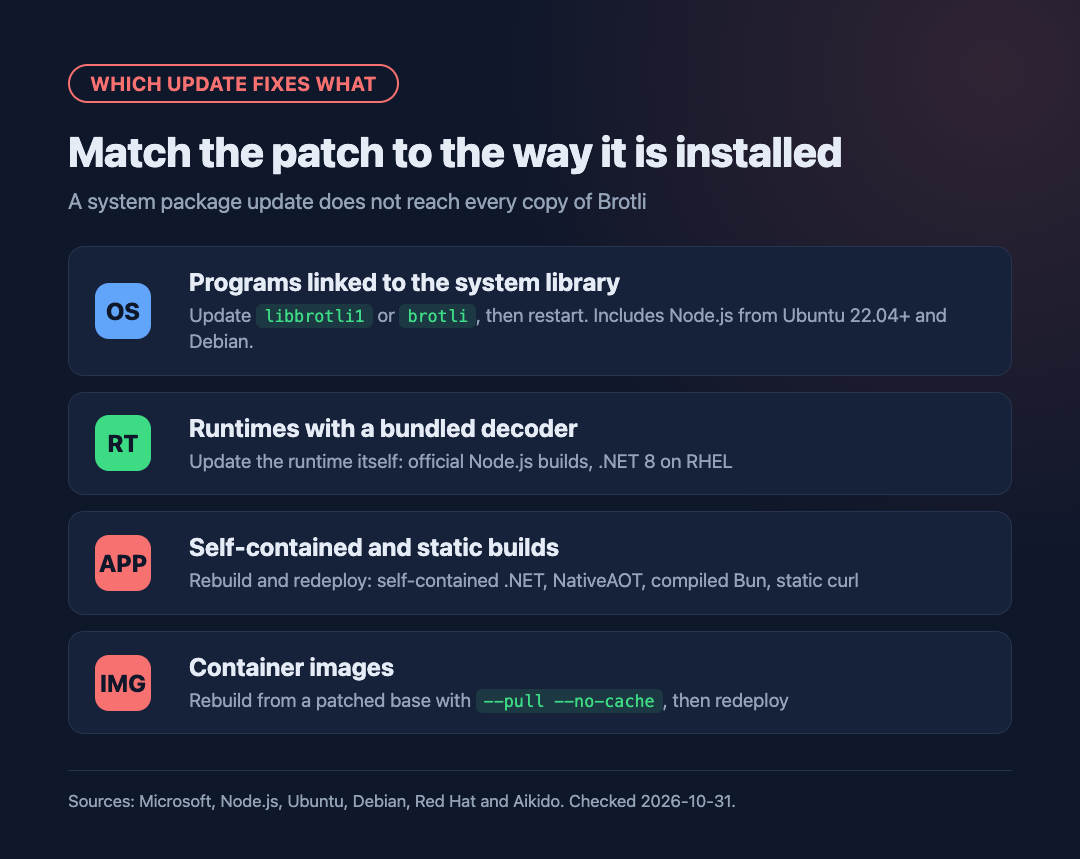
Update and restart commands
Node.js
With nvm:
nvm install 24.22.1
nvm alias default 24.22.1
With Docker, pin FROM node:24.22.1-slim in your Dockerfile, then force a fresh base image:
docker build --pull --no-cache -t <YOUR_IMAGE> .Then restart the service and confirm with node -v inside the running process's environment. If you are still on Node.js 20 or 25, move to a supported line. Our Node.js 26 upgrade checklist covers the jump, and Vercel's bulletin says projects on Node.js 22 or 24 need only a redeploy for its runtime protections. Projects on 20 must change version.
.NET
Install the updated runtime or SDK from your usual channel, then:
sudo systemctl restart <YOUR_SERVICE>Self-contained and NativeAOT apps must be republished:
dotnet publish -c Release -r linux-x64 --self-containedA machine-wide runtime update does not reach self-contained apps or a decoder already linked into a NativeAOT executable. Microsoft requires a rebuild and redeploy for both.
Python
Upgrade the package you have. Run the second line only if you already use brotlicffi:
pip install -U "Brotli>=1.2.1"
pip install -U "brotlicffi>=1.2.1.0"
For lockfile projects, use the command for your tool:
uv lock --upgrade-package brotli
poetry update brotli
Pin the floor in your constraints file and restart long-running workers such as Celery or Gunicorn.
Debian and Ubuntu
sudo apt update
sudo apt install --only-upgrade libbrotli1 brotli python3-brotli
Then find processes still holding the old library in memory:
sudo lsof -nP 2>/dev/null | grep -i libbrotli | grep -iE 'DEL|deleted'Restart anything that appears. A package upgrade does not change code already loaded into a running process. If you plan to move releases at the same time, our Ubuntu 26.10 upgrade guide has the steps.
RHEL family
sudo dnf check-update brotli
sudo dnf upgrade --refresh brotli
If dnf offers nothing, use the stopgaps below and watch the Red Hat bulletin.
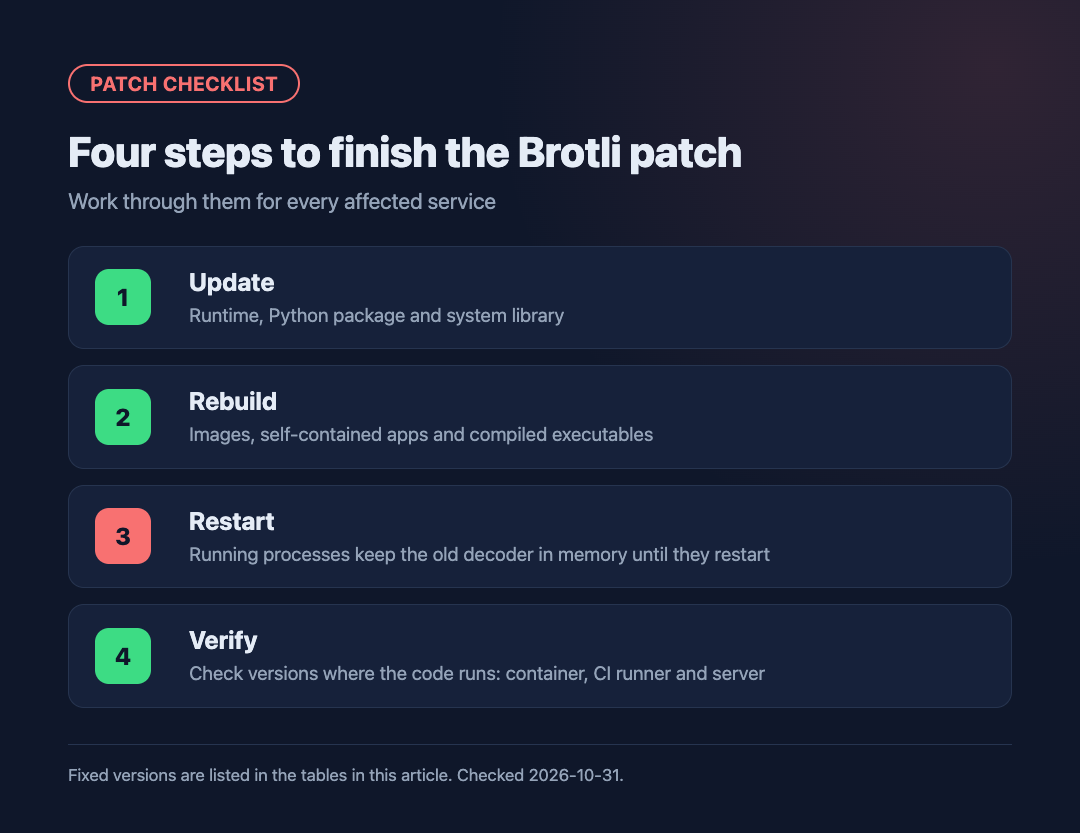
Stopgaps if you cannot patch CVE-2026-111497 today
These reduce exposure. They do not fix the bug.
Reject br at the edge. Red Hat and Microsoft both suggest this. For nginx, add to the server block and test with nginx -t:
if ($http_content_encoding ~* "(^|,\s*)br(\s*,|$)") {
    return 415;
}
This covers inbound requests only. It does nothing for responses your services fetch.
Express. express.json({ inflate: false }) rejects compressed bodies. It also rejects gzip, so test your clients first.
Node.js code. Avoid zlib.brotliDecompress() and zlib.createBrotliDecompress() on untrusted data.
ASP.NET Core and HttpClient. Remove the br provider from your existing AddRequestDecompression setup, and exclude Brotli from AutomaticDecompression. Microsoft also warns against adding decompression features you do not already use, since that can create new denial-of-service risk.
Python. Uninstall Brotli and brotlicffi, and drop extras such as httpx[brotli]. Expect errors if a server sends Brotli anyway.
Containment. Restrict outbound network access for services that fetch third-party URLs, run them as an unprivileged user and keep secrets out of the process environment where you can.
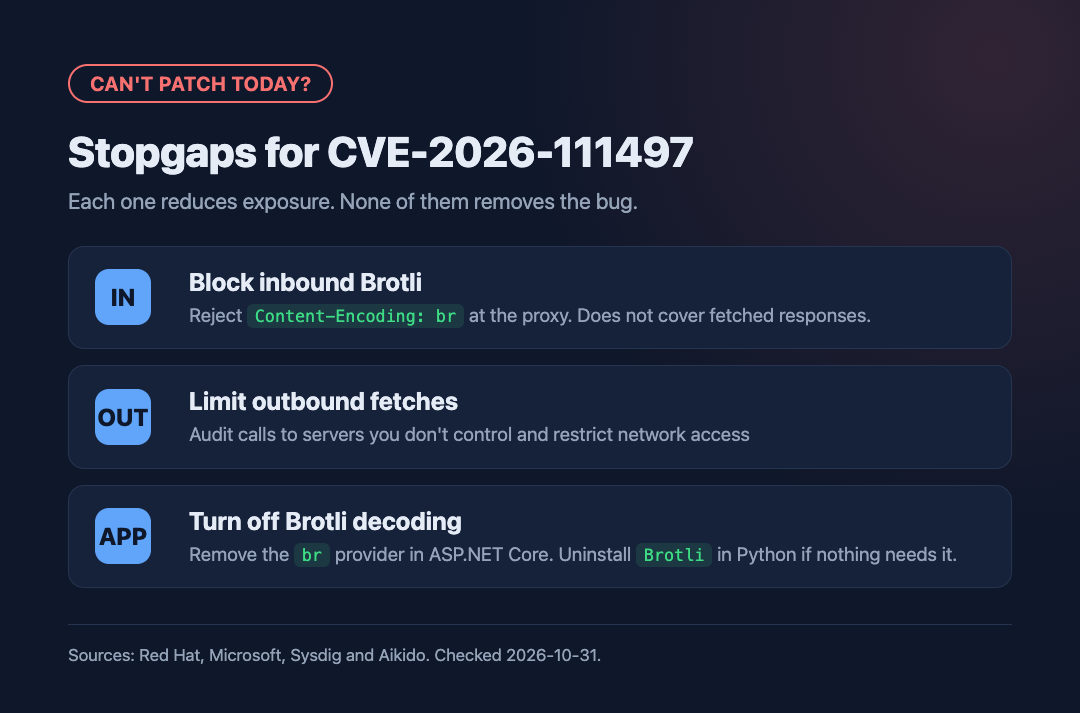
If something goes wrong after the patch
| Symptom | Likely cause | Fix |
|---|---|---|
| Container still shows the old Node.js | Cached floating tag | docker pull, pin the tag, rebuild |
node -v unchanged after apt upgrade | Distro Node.js uses system Brotli | Normal; check libbrotli1, restart |
| Scanner still flags a patched distro | Backported version number | Compare with the distro tracker |
| .NET app still vulnerable after update | Self-contained or NativeAOT build | Republish and redeploy |
| Clients get 415 errors | Your stopgap blocks compressed bodies | Allow gzip, or ask clients to send plain bodies |
| Crashes continue after the patch | Possible exploit attempts or an unpatched copy | Check every process's runtime, then the logs below |
Signs of exploitation to look for
Sysdig reports that failed attempts usually crash the Node.js process, so unexplained crashes in web-facing services deserve a look. Other signals include shell processes spawned by the runtime, unexpected outbound connections, malware downloads and cryptominers.
Patching does not undo a compromise. Because the bug can leak process memory even when code execution fails, rotate the secrets and cloud tokens that a process could reach if you find evidence of an attack.
FAQ
Is CVE-2026-111497 only a Node.js problem? No. The flaw is in Google's Brotli library. Canada's Cyber Centre names Node.js, .NET, PowerShell, Bun, Envoy, Istio and the Python Brotli and brotlicffi packages among the affected software, and says the list is not limited to those.
Do web servers that only compress responses need the fix? The flaw is in the decoder, so a server that only compresses output is not on the attack path described in these advisories. Still update, since the same host may decode Brotli elsewhere, such as in an HTTP client or a proxy filter.
I'm behind Vercel's WAF. Am I safe? Not completely. Vercel says its WAF covers inbound traffic through its network, but not responses your functions fetch from other servers. Self-hosted Next.js, external backends, CI runners and your own images still need the Node.js upgrade.
Does updating libbrotli fix everything on the server? No. It fixes programs that link the system library, after they restart. Official Node.js builds, self-contained .NET apps and statically linked tools carry their own decoder and need their own updates.
Which fix should come first? Start with internet-facing services that accept br bodies or fetch URLs you don't control. Then cover internal services, CI runners and developer tools.
Once this is done, keep your runtime on a supported line so the next fix reaches you quickly. Node.js users can continue with the Node.js 26 upgrade checklist.
References
All checked 2026-10-31.
Official advisories
- Node.js: October 2026 security releases
- Microsoft Security Advisory CVE-2026-111497 (.NET)
- Google Brotli v1.2.1 release
- CISA Known Exploited Vulnerabilities catalog
- Singapore CSA alert AL-2026-154
- Canadian Centre for Cyber Security alert AL26-027
- Ubuntu CVE page
- Debian security tracker
- Red Hat CVE page and bulletin RHSB-2026-015
- Vercel: Node.js security advisory
- Palo Alto Networks: CVE-2026-111497 portfolio status
- Brotli on PyPI
Analysis and news
3 thoughts on “CVE-2026-111497 Brotli Patch: Check Node, .NET, Python, Linux”