The eMudhra certificate compromise means anyone with the leaked keys can forge a TLS certificate for any domain, and browsers already block it but your servers, containers and runtimes may not. The fix is to update the trust store each program actually uses: the OS ca-certificates package, Python certifi, Node.js, Go, Rust webpki-roots and Java, then rebuild images and test against a known-bad host. This guide gives the fixed versions, the check commands and a test that proves the fix worked.
Written 2026-10-29. Versions and dates were checked against the Cloudflare blog, Go, Node.js, PyPI and Ubuntu security notices on that date. The situation is still moving, so re-check the linked sources before you rely on a version number.
What happened in the eMudhra certificate compromise
Private keys for eight intermediate certificate authorities run by eMudhra (the emSign brand) were reported compromised. Cloudflare says it learned about it at about 17:00 UTC on October 19, 2026, and its write-up states the risk plainly: "an attacker can create a forged certificate for any domain." Cloudflare also says its review found no active exploitation on its own services.
The intermediates chain up to two roots that many trust stores ship:
- emSign ECC Root CA – G3 (eMudhra)
- AAA Certificate Services (Comodo/Sectigo, through Sectigo cross-signs)
Removing or blocking these is the job of whoever maintains your trust store. That is why the fix is spread across many packages instead of one patch.
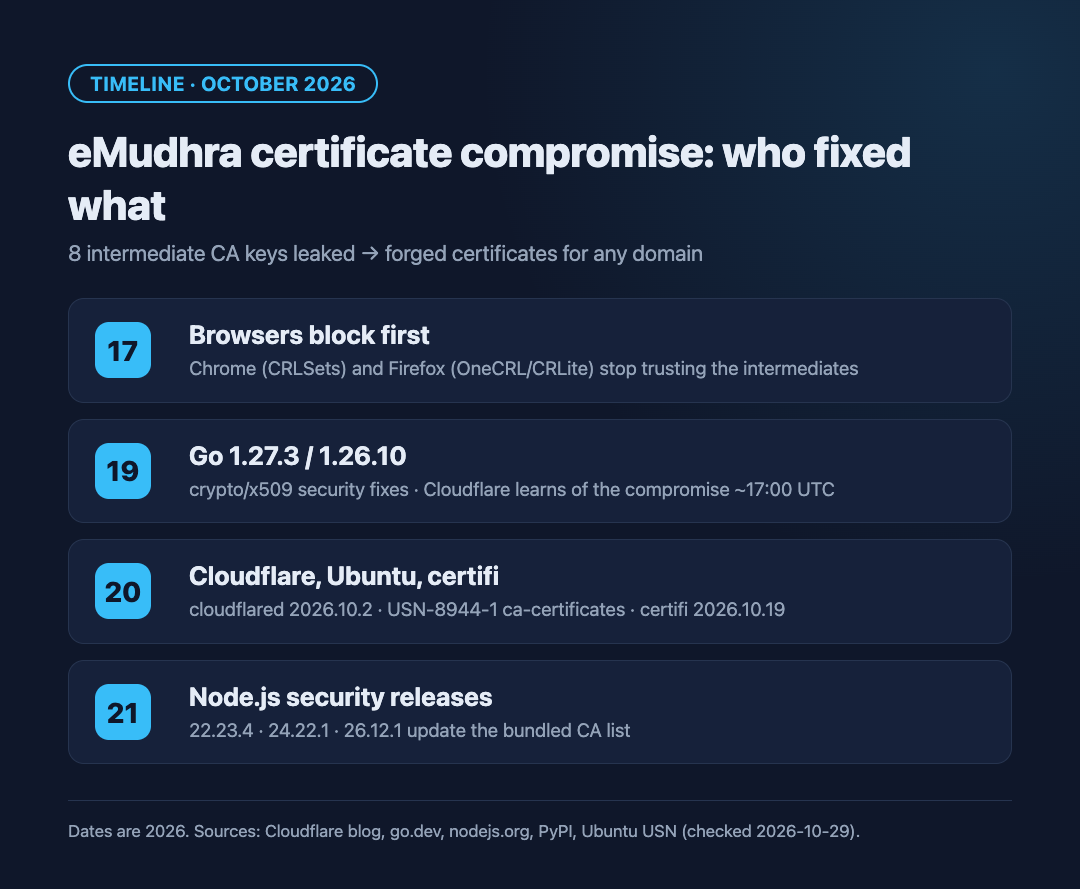
| Date (2026) | What shipped |
|---|---|
| Oct 17 | Chrome (CRLSets) and Firefox (OneCRL/CRLite) block the intermediates |
| Oct 19 | Go 1.27.3 and 1.26.10 with crypto/x509 security fixes |
| Oct 20 | Cloudflare advisory, cloudflared update, Ubuntu USN-8944-1, certifi 2026.10.19 |
| Oct 21 | Node.js 26.12.1, 24.22.1 and 22.23.4 security releases; Ubuntu USN-8944-2 for older releases |
Who is already protected and who is not
Browsers were fixed first because they can push revocation lists without a full release. Everything that carries its own copy of the root list is a separate problem. Cloudflare's advice for developers is to "look beneath the SDK": updating an HTTP library may not change the CA bundle it reads.
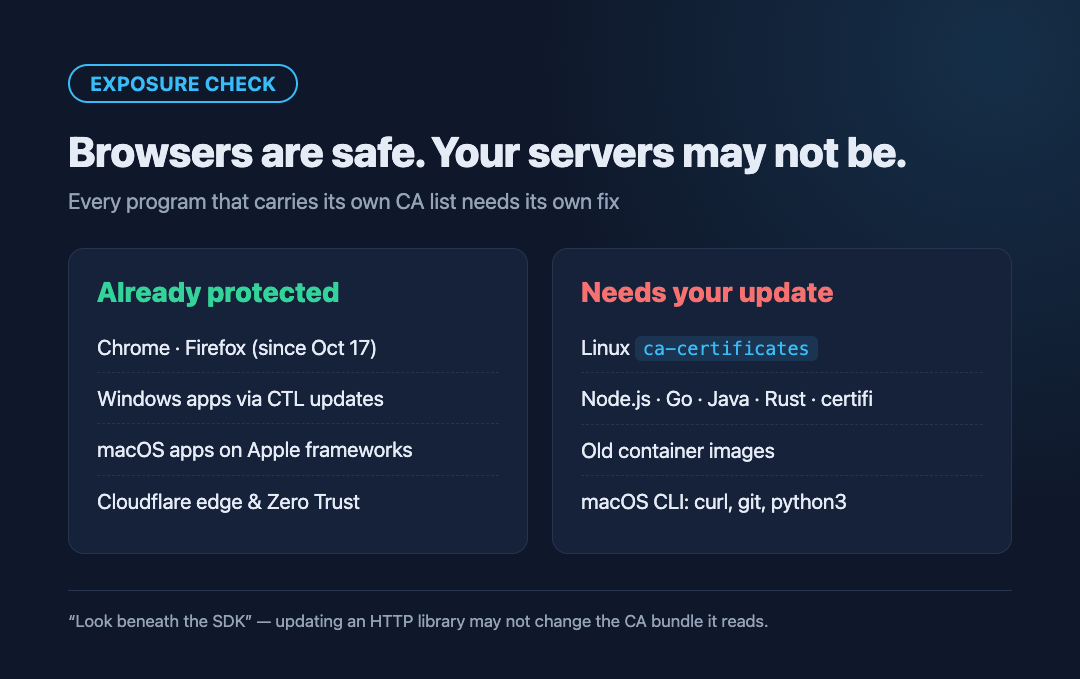
| Client | Status on 2026-10-29 | What to do |
|---|---|---|
| Chrome, Firefox | Blocked since Oct 17 | Nothing |
| Windows apps using the system store | Blocked via automatic CTL updates from Oct 20 | Make sure CTL updates are not disabled |
| macOS apps using Apple frameworks | Blocked from Oct 22 | Command-line tools (curl, git, python3) may still trust the roots, so test them |
| Linux servers, containers, language runtimes | Depends on package versions | Update and rebuild (below) |
If you run Docker hosts with long-lived containers, remember that a container keeps the trust store it was built with. A host update does nothing for an image built last month.
Fixed versions for each trust store
These are the minimum versions published after the compromise. Newer versions in the same line are fine.
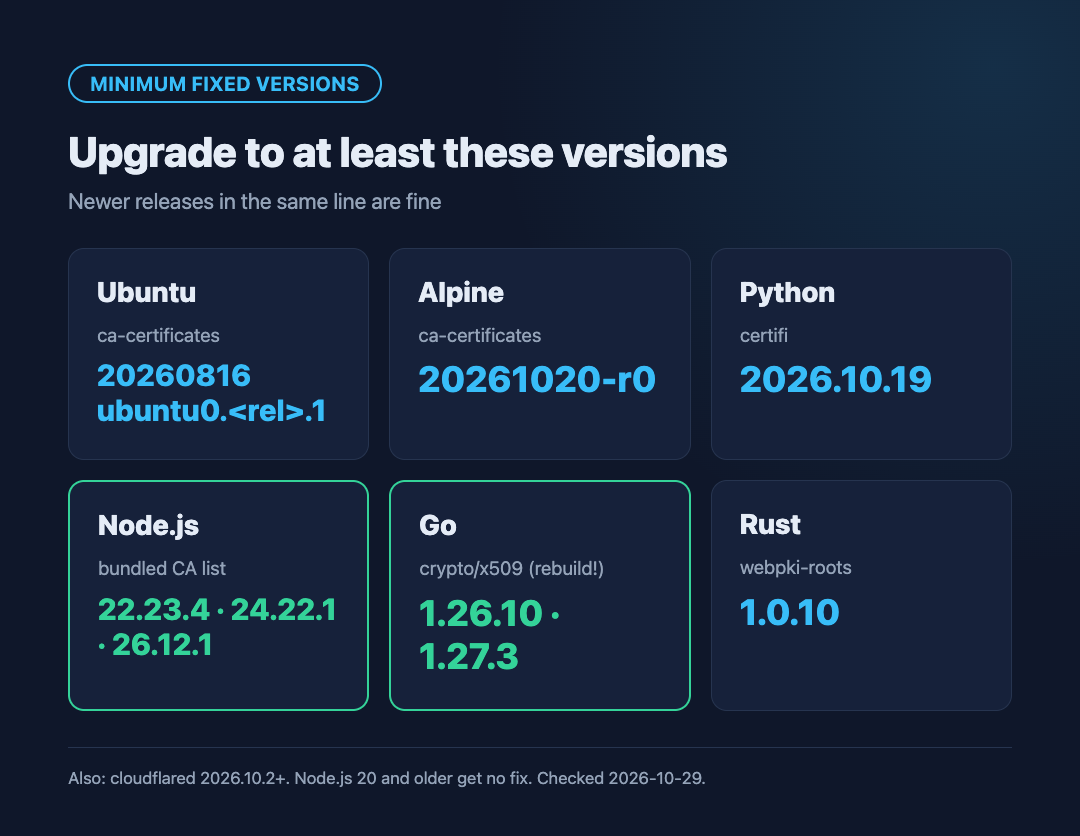
| Trust store | Minimum fixed version | Source |
|---|---|---|
Ubuntu ca-certificates | 20260816ubuntu0.<release>.1 (22.04, 24.04, 26.04, 26.10) | USN-8944-1 |
Alpine ca-certificates | 20261020-r0 | Test-site package list |
Python certifi | 2026.10.19 | PyPI |
| Node.js | 22.23.4, 24.22.1, 26.12.1 | Node.js security release |
| Go | 1.26.10, 1.27.3 | Go release history |
Rust webpki-roots | 1.0.10 (rustls-webpki 0.103.16) | Test-site list, Render advisory |
| cloudflared | 2026.10.2 | Cloudflare blog |
Ubuntu 14.04 through 20.04 are covered by USN-8944-2 through Ubuntu Pro. Node.js 20 and older are end-of-life and get no fix. For Java, the community package list showed Oracle JDK updates (for example 21.0.13.0.3 and 17.0.21.0.3) while OpenJDK builds were still pending on October 28.
Check and update each layer
Work from the bottom up: OS first, then runtimes, then your app's lockfile, then images.
Linux ca-certificates (Debian, Ubuntu, Alpine, RHEL)
Check the installed version:
dpkg -s ca-certificates | grep '^Version'   # Debian / Ubuntu
apk info -v ca-certificates                 # Alpine
rpm -q ca-certificates                      # RHEL / Fedora / Rocky
Update it:
sudo apt update && sudo apt install --only-upgrade ca-certificates   # Debian / Ubuntu
apk upgrade --no-cache ca-certificates                               # Alpine
sudo dnf upgrade ca-certificates                                     # RHEL / Fedora / Rocky
Long-running services load the CA bundle at startup. Restart them (nginx as a proxy client, app servers, workers) after the update.
Python certifi
requests, httpx, pip and many SDKs use certifi, not the OS store.
python3 -c "import certifi; print(certifi.__version__, certifi.where())"

pip install --upgrade "certifi>=2026.10.19"   # pip
uv lock --upgrade-package certifi             # uv
poetry update certifi                         # Poetry
Commit the updated lockfile so the next deploy picks it up.
Node.js
Node.js ships its own CA list compiled into the binary, so a system update does not fix it.
node -v # need v22.23.4+, v24.22.1+ or v26.12.1+The same October 21 release also fixed TLS hostname checks and a Brotli decoder bug (CVE-2026-111497), so this is worth doing even apart from eMudhra. If you are still on Node 22 and planning a jump, see how to upgrade to Node.js 26 LTS. Render's advisory lists NODE_OPTIONS=--use-openssl-ca as a temporary workaround, which makes Node read the (updated) OS store instead of its bundled list.
Go
The Go fix lives in crypto/x509, so it is compiled into your binary.
go version # need go1.26.10+ or go1.27.3+Rebuild and redeploy every Go binary with the patched toolchain. Updating Go on your laptop does not change binaries already running in production.
Rust, Java and others
cargo update -p webpki-roots -p rustls-webpki
grep -A1 'name = "webpki-roots"' Cargo.lock
For Java, update the JDK, or on Debian/Ubuntu regenerate the Java keystore from the updated system store after the ca-certificates upgrade:
sudo rm -f /etc/ssl/certs/java/cacerts && sudo update-ca-certificates --freshRebuild container images
Images are where most stale trust stores hide. Pull a fresh base image and skip the build cache so the package update actually runs:
docker build --pull --no-cache -t <YOUR_IMAGE>:<NEW_TAG> .
docker run --rm <YOUR_IMAGE>:<NEW_TAG> sh -c 'dpkg -s ca-certificates | grep Version'
If your Dockerfile does not upgrade packages, add a line such as RUN apt-get update && apt-get install -y --only-upgrade ca-certificates. Then push the new tag and point your deployment at it. If you run Cloudflare Tunnel in a container, Cloudflare's guidance is the same: update to cloudflared 2026.10.2 or later and redeploy the fixed image.
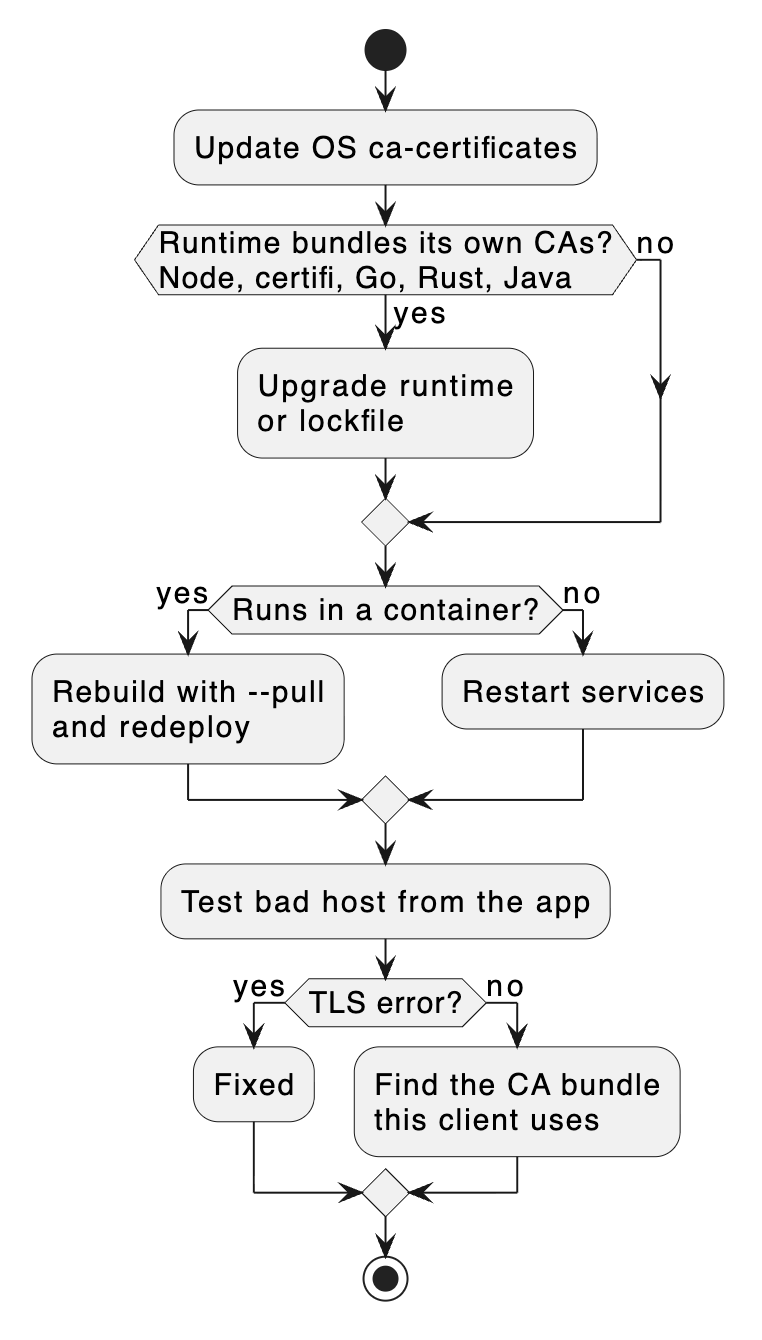
View PlantUML source
@startuml
skinparam defaultFontSize 15
start
:Update OS ca-certificates;
if (Runtime bundles its own CAs?\nNode, certifi, Go, Rust, Java) then (yes)
  :Upgrade runtime\nor lockfile;
else (no)
endif
if (Runs in a container?) then (yes)
  :Rebuild with --pull\nand redeploy;
else (no)
  :Restart services;
endif
:Test bad host from the app;
if (TLS error?) then (yes)
  :Fixed;
else (no)
  :Find the CA bundle\nthis client uses;
endif
stop
@enduml
Test the fix against a known-bad host
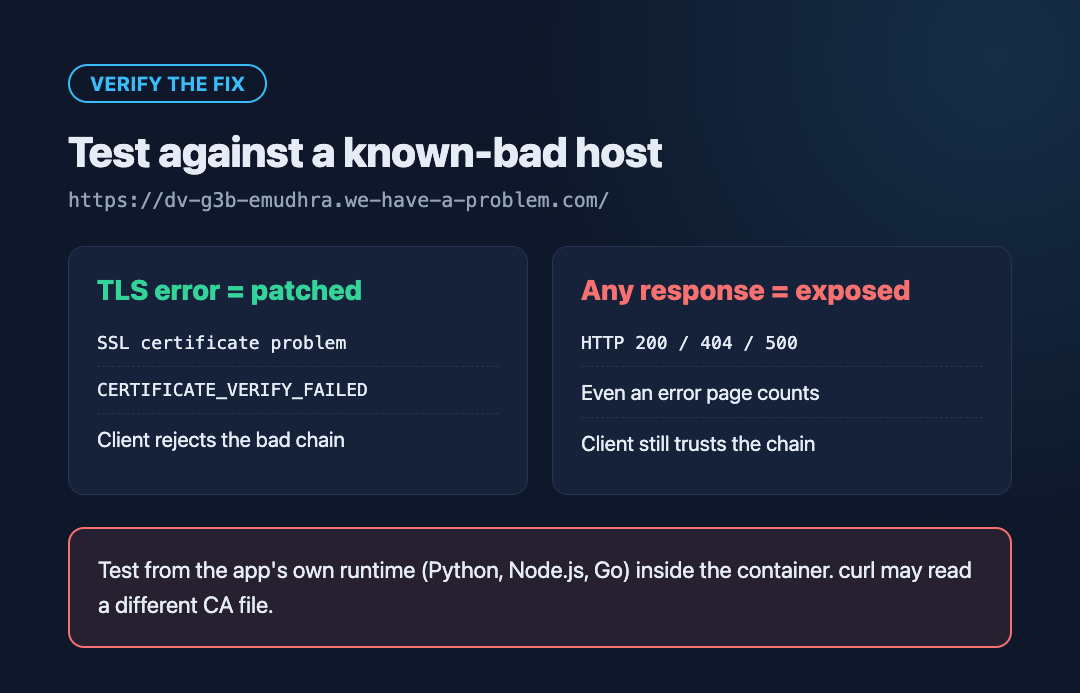
The community test site (by Dennis Jackson, linked from Cloudflare's post) serves certificates that chain through the compromised intermediates. A patched client must fail to connect.
curl -sS -o /dev/null https://dv-g3b-emudhra.we-have-a-problem.com/ && echo "STILL TRUSTED" || echo "rejected"
curl -sS -o /dev/null https://dv-g3b-aaa-emudhra.we-have-a-problem.com/ && echo "STILL TRUSTED" || echo "rejected"
Run the same test from the runtime your service uses, because curl may read a different CA file. The first line uses Python requests (certifi), the second uses Node.js fetch:
python3 -c "import requests; requests.get('https://dv-g3b-emudhra.we-have-a-problem.com/'); print('STILL TRUSTED')"

node -e "fetch('https://dv-g3b-emudhra.we-have-a-problem.com/').then(()=>console.log('STILL TRUSTED')).catch(e=>console.log('rejected:', e.cause?.code))"
A certificate verification error (for example CERTIFICATE_VERIFY_FAILED in Python) is the good result. Any HTTP response, even a 404, means the client still trusts the chain. The site notes that a "rejected" result can also come from a plain network failure, so read the error text. Never "fix" these errors in your real apps by turning off verification; Cloudflare explicitly warns against it.
eMudhra certificate compromise checklist
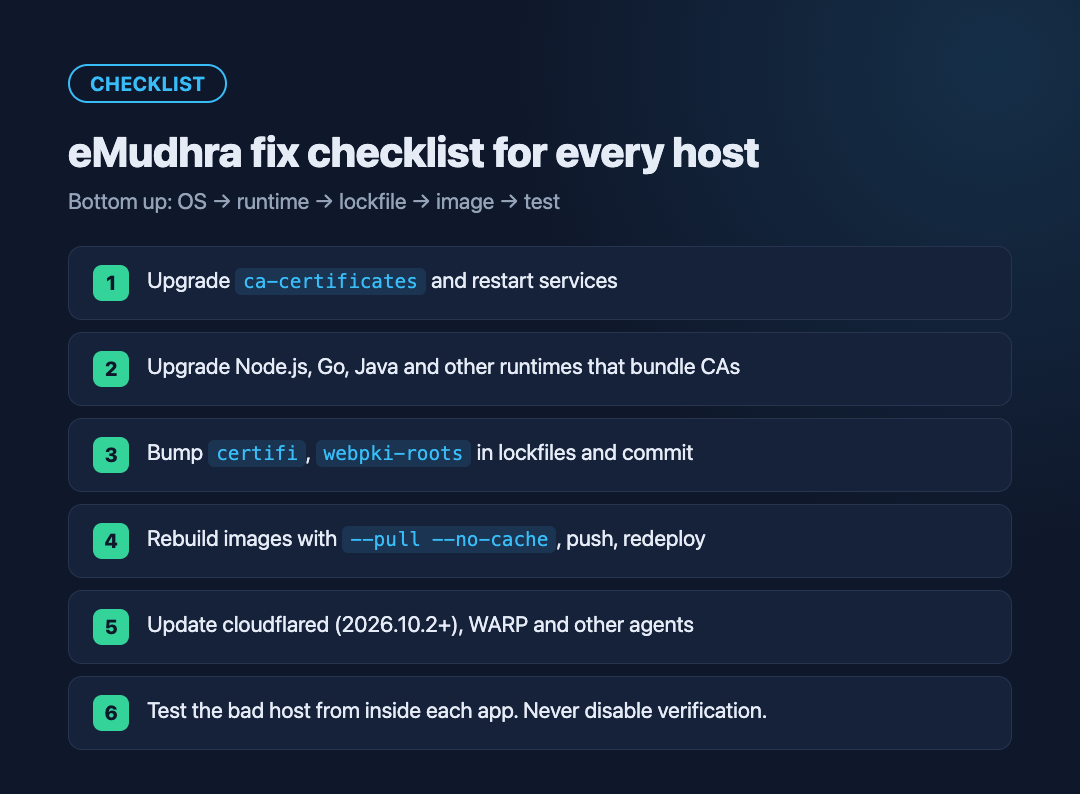
- Upgrade
ca-certificateson every host and restart services. - Upgrade Node.js, Go, Java and other runtimes that bundle CAs.
- Bump
certifi,webpki-rootsand similar packages in lockfiles. - Rebuild images with
--pull --no-cache, push, redeploy. - Update cloudflared, WARP and other agents to their fixed versions.
- Test the bad host from inside each app and container.
The same "patch, rebuild, verify" routine applies to other urgent fixes, such as the PHP security release on October 21.
FAQ
Is my website's own certificate affected? Only if it was issued by one of the compromised eMudhra intermediates. Most sites use other CAs. Cloudflare asks customers using Full (strict) mode with custom origin certificates to review them, and eMudhra is moving affected subscribers to new certificates.
I updated the OS. Why does my Node.js app still connect to the test host? Node.js uses its own bundled CA list by default. Upgrade to 22.23.4, 24.22.1 or 26.12.1 or later, or temporarily start it with --use-openssl-ca so it reads the updated OS store.
Do I need to rotate my own keys or certificates? Not because of this incident alone, unless your certificates came from an affected eMudhra intermediate. The risk is that an attacker could impersonate other servers to your clients, so the fix is on the client trust side.
Does this break TLS encryption? No. Cloudflare says it is a certificate authentication problem, not a weakness in TLS encryption algorithms. The danger is a convincing fake certificate, which enables man-in-the-middle attacks.
Is it safe to remove the AAA Certificate Services root myself? The community site documents manual removal as a workaround, but that root also anchors legitimate Sectigo chains. Prefer vendor package updates, and test important services before removing roots by hand.
References
- 8 eMudhra certificates are compromised. Here's what you need to know — Cloudflare Blog — checked 2026-10-29
- Go release history (go1.27.3, go1.26.10) — checked 2026-10-29
- Node.js October 21, 2026 security releases — checked 2026-10-29
- certifi release history — PyPI — checked 2026-10-29
- USN-8944-1: ca-certificates update — OSV — checked 2026-10-29
- Cloudflare Tunnel (cloudflared) releases — GitHub — checked 2026-10-29
- eMudhra compromise package list and test site (Dennis Jackson) — checked 2026-10-29
- Advisory: eMudhra Certificate Compromise — Render Docs — checked 2026-10-29
4 thoughts on “eMudhra Certificate Compromise: How to Patch Trust Stores”