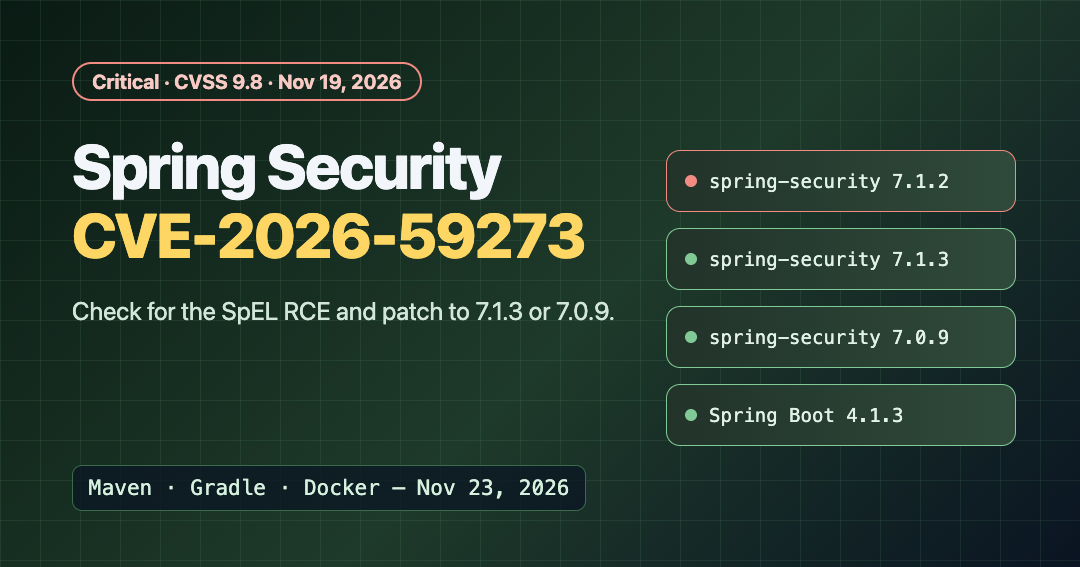
Spring Security CVE-2026-59273 is a critical (CVSS 9.8) remote code execution flaw in ELRequestMatcher, fixed on November 19, 2026 in open-source releases Spring Security 7.1.3 and 7.0.9. If you're on Spring Boot 4.1 or 4.0, move to Boot 4.1.3 or 4.0.10 and confirm the resolved spring-security-web version. If you're still on Boot 3.5 or Spring Security 6.x, there is no free patch: the 6.x fixes are Enterprise Support only, so you need to check your code for the vulnerable pattern today and plan a Boot 4 move.
Written November 23, 2026. The Spring security advisories (published November 19, 2026), the Spring Boot 4.1.3 and 4.0.10 release posts (November 20) and the third-party write-ups linked below were checked on November 23, 2026 (KST). I haven't reproduced the exploit. Where a fact comes from a third party rather than Spring, I say so.
What changed in the Spring November 2026 security release
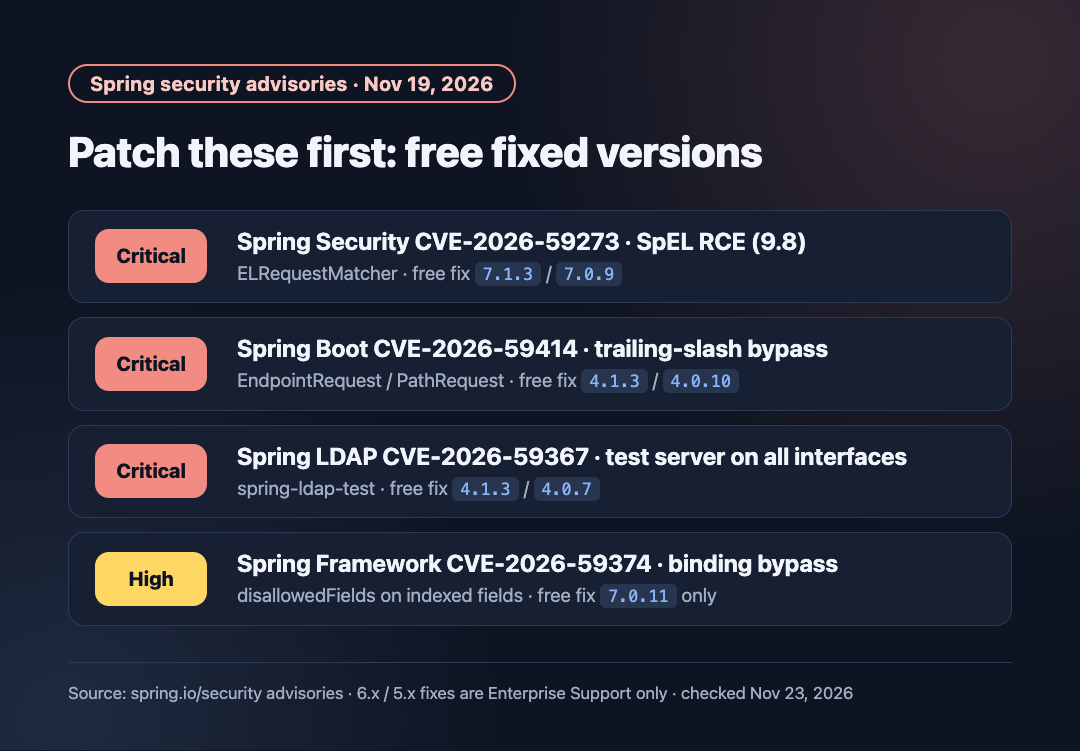
On November 19, 2026, the Spring team published a large batch of advisories across Spring Security, Spring Boot, Spring Framework, Spring AI, Spring LDAP, Spring Integration, Spring Web Services and more. Three are rated Critical. The one that matters most for web apps is CVE-2026-59273.
| Advisory | Project | Severity | Free (OSS) fix |
|---|---|---|---|
CVE-2026-59273 SpEL RCE in ELRequestMatcher | Spring Security | Critical 9.8 | 7.1.3, 7.0.9 |
| CVE-2026-59414 trailing-slash auth bypass | Spring Boot | Critical | 4.1.3, 4.0.10 |
| CVE-2026-59367 embedded test LDAP on all interfaces | Spring LDAP | Critical | 4.1.3, 4.0.7 |
| CVE-2026-59374 data binding bypass on indexed fields | Spring Framework | High | 7.0.11 |
What CVE-2026-59273 does, in one paragraph: Spring Security ships a property editor that turns a string into an ELRequestMatcher. Spring Framework's data binding finds that editor automatically by naming convention. So if your app binds request data to a bean property of type RequestMatcher, the attacker's string is evaluated as a Spring Expression Language (SpEL) expression with a full evaluation context. According to Ostorlab's analysis, the fix (commit 5d28474a5cef) switches that evaluation to the restricted SimpleEvaluationContext.
Exploitation status as of November 22, 2026, per Ostorlab: two public proof-of-concept repositories appeared on November 20 and 21. They show type access, not command execution. No in-the-wild exploitation is known, and the CVE isn't in the CISA KEV catalog.
Affected versions and fixed versions for CVE-2026-59273
Spring's advisory lists these ranges. "Enterprise" means the fixed build is only available through Spring's commercial support, not Maven Central.
| Spring Security line | Affected | Free fix | Enterprise-only fix |
|---|---|---|---|
| 7.1.x | 7.1.0–7.1.2 | 7.1.3 | 7.1.2.1 |
| 7.0.x | 7.0.0–7.0.8 | 7.0.9 | 7.0.8.1 |
| 6.5.x | 6.5.0–6.5.12 | none | 6.5.13 |
| 6.4.x | 6.4.0–6.4.19 | none | 6.4.20 |
| 5.8.x / 5.7.x | 5.8.0–5.8.28, ≤5.7.26 | none | 5.8.29, 5.7.27 |
Ostorlab also reports that Spring Security 7.2.0 (published to Maven Central on November 19 alongside 7.1.3 and 7.0.9) contains the fix. Spring's project page lists Spring Boot 4.2.0 as the current version.
Is your app exposed? Find the vulnerable pattern
Having a vulnerable version is not the same as being exploitable. The advisory ties the risk to one pattern: an app "that binds external input to a bean property of this matcher type." A RequestMatcher you build from a fixed string in your own code is not attacker-controlled.
Search your source for RequestMatcher used as a field or setter type on objects that receive request data (form-backing objects, @ModelAttribute classes, controller command objects, @ConfigurationProperties fed by user input):
The three searches below find, in order: fields typed as RequestMatcher (Java and Kotlin), setters that accept one, and direct use of the EL matcher.
grep -rnE "(private|protected|public|val|var)[^;=(]*\bRequestMatcher\b" --include=*.java --include=*.kt src/
grep -rnE "void set[A-Za-z]+\(\s*RequestMatcher\b" --include=*.java src/
grep -rn "ELRequestMatcher" --include=*.java --include=*.kt --include=*.xml src/
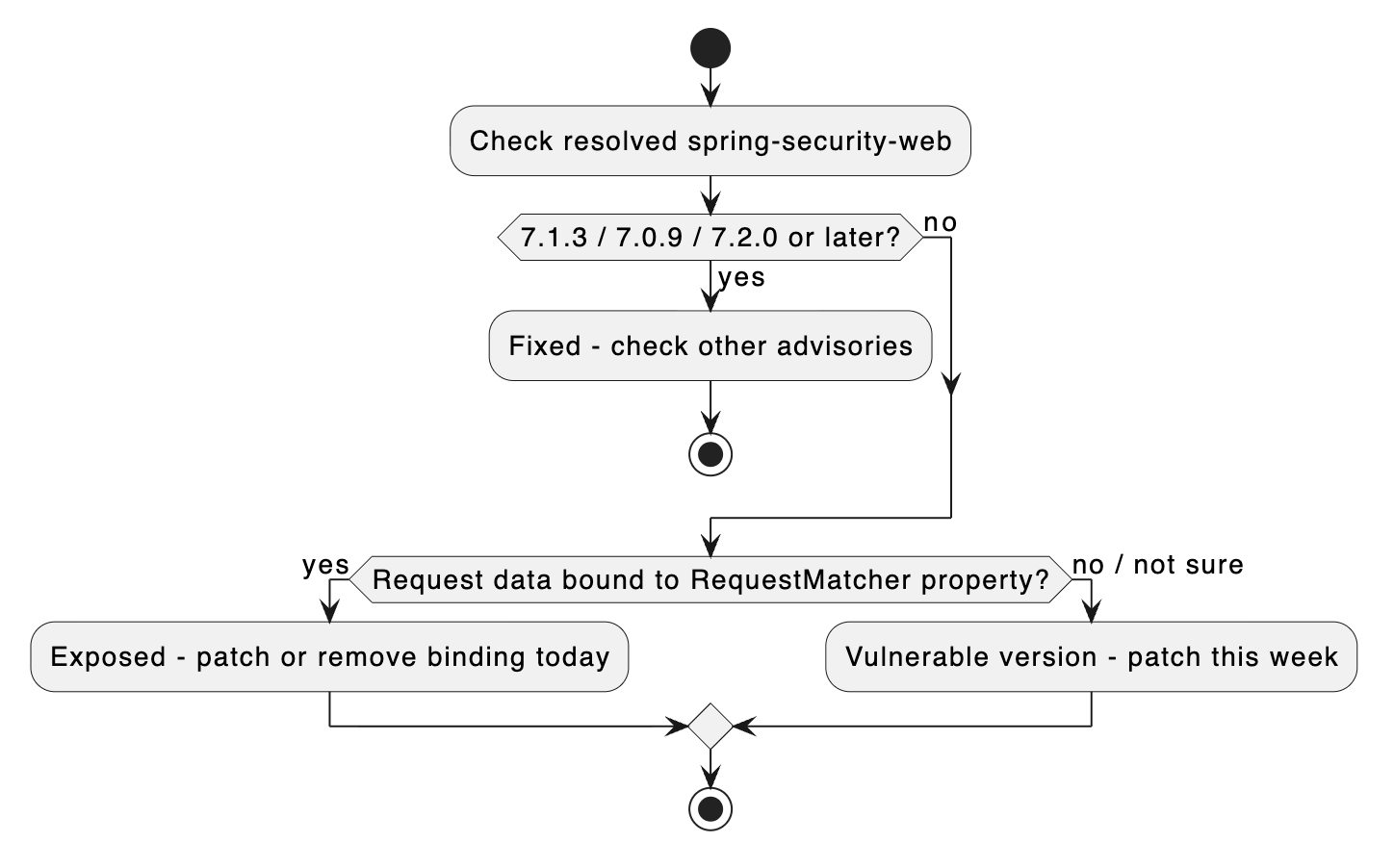
Then look at each hit and ask one question: can any part of an HTTP request reach that property through data binding? If the class is only built in a SecurityFilterChain bean or similar configuration code, it isn't the exposed pattern. If the class is a controller argument, a @ModelAttribute, or it's populated with WebDataBinder, treat it as exposed.
View PlantUML source
@startuml
skinparam monochrome false
skinparam defaultFontSize 14
start
:Check resolved spring-security-web;
if (7.1.3 / 7.0.9 / 7.2.0 or later?) then (yes)
  :Fixed - check other advisories;
  stop
else (no)
endif
if (Request data bound to RequestMatcher property?) then (yes)
  :Exposed - patch or remove binding today;
else (no / not sure)
  :Vulnerable version - patch this week;
endif
stop
@enduml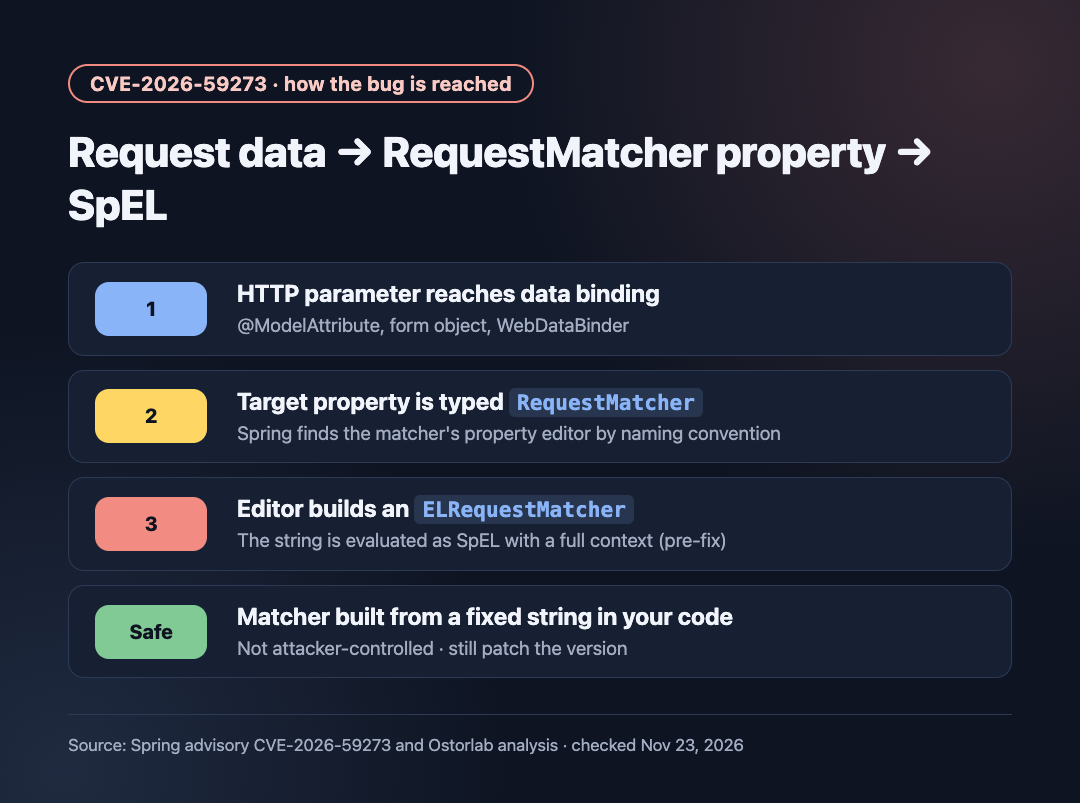
How to check your Spring Security version
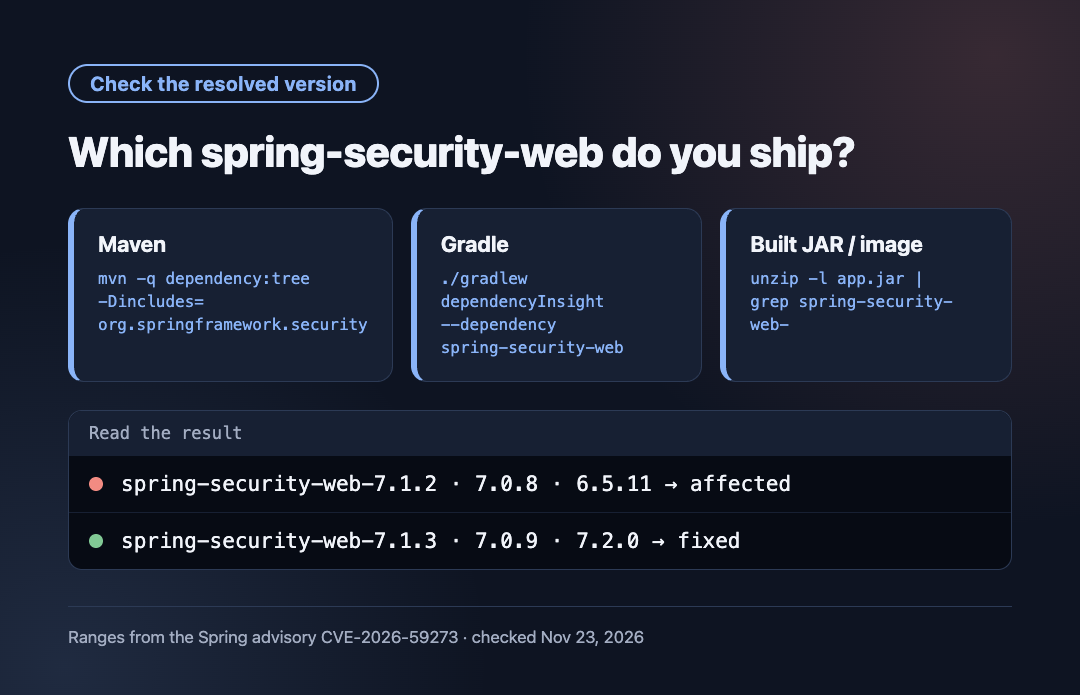
Don't trust the version in your build file alone. Spring Boot's dependency management chooses the Spring Security version unless you override it, so check what actually resolves.
Maven
mvn -q dependency:tree -Dincludes=org.springframework.securityExample output:
com.example:shop:jar:1.0.0
\- org.springframework.boot:spring-boot-starter-security:jar:4.1.2:compile
   +- org.springframework.security:spring-security-config:jar:7.1.2:compile
   \- org.springframework.security:spring-security-web:jar:7.1.2:compile
Here spring-security-web is 7.1.2, which falls in the affected range. You need 7.1.3 or later.
Gradle
./gradlew dependencyInsight --dependency spring-security-web --configuration runtimeClasspathThe first line of each block shows the selected version, for example org.springframework.security:spring-security-web:7.0.8. Anything from 7.0.0 to 7.0.8 is affected.
A built JAR or a running container
If you only have the artifact, list the bundled libraries. A Spring Boot fat JAR keeps them under BOOT-INF/lib/:
For a fat JAR on disk:
unzip -l app.jar | grep -E "spring-security-(web|core)-"For a container image, copy the JAR out first (replace the image name and the JAR path):
docker create --name s59273 <YOUR_IMAGE>:<TAG>
docker cp s59273:/app/app.jar ./app-from-image.jar
docker rm s59273
unzip -l app-from-image.jar | grep -E "spring-security-(web|core)-"
A result like BOOT-INF/lib/spring-security-web-6.5.11.jar means the 6.5 line, which has no free fix. If you use layered or exploded images, the JARs may sit in a directory such as /app/BOOT-INF/lib instead.
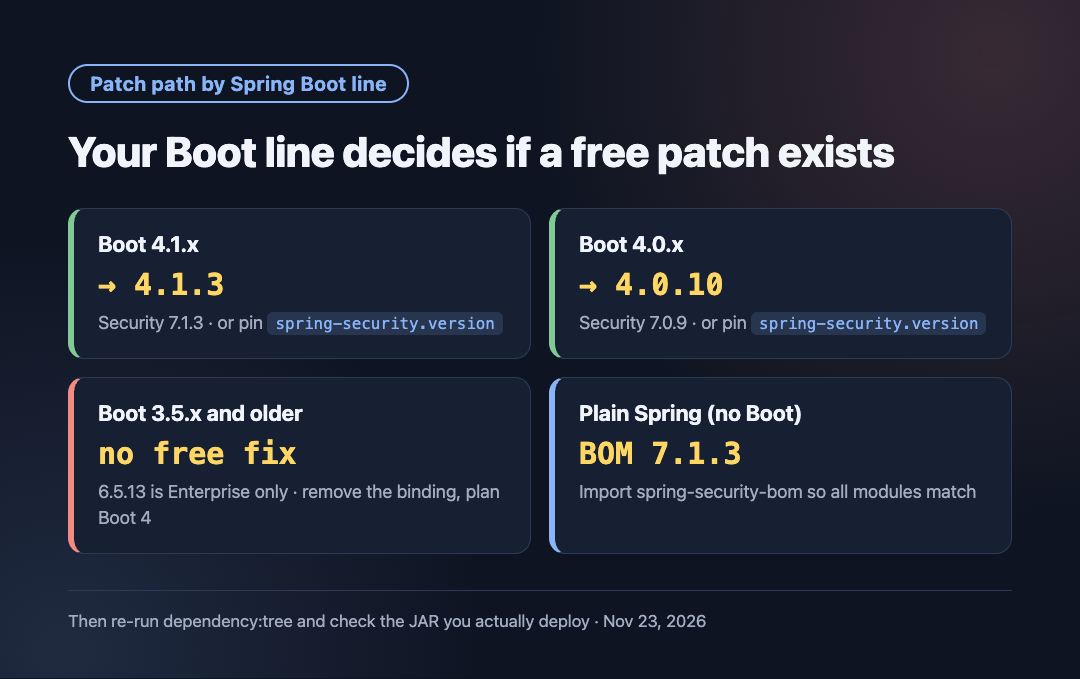
Patch Spring Security CVE-2026-59273 by Spring Boot line
Pick the path that matches the Boot line you run today.
Spring Boot 4.1.x or 4.0.x: bump the Boot version
Maven:
<parent>
  <groupId>org.springframework.boot</groupId>
  <artifactId>spring-boot-starter-parent</artifactId>
  <version>4.1.3</version> <!-- or 4.0.10 on the 4.0 line -->
</parent>
Gradle (Kotlin DSL):
plugins {
    id("org.springframework.boot") version "4.1.3" // or "4.0.10"
}
Spring's November 20 release posts for Boot 4.1.3 and 4.0.10 don't list the bundled Spring Security version. Ostorlab reports that Boot 4.1.3 pulls Security 7.1.3 and Boot 4.0.10 pulls 7.0.9. Confirm it yourself by running the dependency:tree or dependencyInsight command again after the bump. These Boot releases also carry the free fixes for the two Boot advisories, CVE-2026-59414 and CVE-2026-59378.
Can't move Boot yet? Override only Spring Security
Spring Boot lets you override a managed version with a property. On Boot 4.0 or 4.1 you can pin the patched Security release while the full Boot bump goes through testing:
<properties>
  <spring-security.version>7.1.3</spring-security.version> <!-- 7.0.9 on Boot 4.0 -->
</properties>
// build.gradle.kts with the io.spring.dependency-management plugin
extra["spring-security.version"] = "7.1.3"Remove the override once you're on Boot 4.1.3 or 4.0.10, so it doesn't pin you to an old release later.
Plain Spring (no Boot): use the Spring Security BOM
<dependencyManagement>
  <dependencies>
    <dependency>
      <groupId>org.springframework.security</groupId>
      <artifactId>spring-security-bom</artifactId>
      <version>7.1.3</version>
      <type>pom</type>
      <scope>import</scope>
    </dependency>
  </dependencies>
</dependencyManagement>
Spring Boot 3.5 or older: no free patch
Ostorlab notes that the newest public Boot 3.5 release pulls Spring Security 6.5.11, which is in the affected range, and Spring's advisory lists the 6.5.13 fix as Enterprise Support only. You can't just pin Security 7.x onto Boot 3.x, because Security 7 is built for Spring Framework 7 and Boot 4. Your realistic choices:
- Commercial support: if you already have Spring Enterprise Support, take Security 6.5.13 (or Boot 3.5.18) from the enterprise repository.
- Remove the exposed pattern now (next section), then plan the Boot 4 migration with Spring's official migration guide.
- Commercial long-term support from another vendor, if your organization already uses one for end-of-life Java libraries.
Verify after the upgrade
Expect spring-security-web:jar:7.1.3 (or 7.0.9 / 7.2.0) in the output:
mvn -q dependency:tree -Dincludes=org.springframework.security:spring-security-web
./gradlew dependencyInsight --dependency spring-security-web --configuration runtimeClasspath
Then rebuild the image and repeat the unzip -l check on the JAR you actually deploy. A patched pom.xml doesn't help if CI pushed an image from a cached build.
Can't upgrade today? Remove the exposed binding
Spring's advisory gives no workaround. Its mitigation text is only: "Users of affected versions should upgrade to the corresponding fixed version." Anything below is an application-level change, not a vendor-supported setting, and it doesn't remove the other advisories.
- Stop binding request data to
RequestMatcherproperties. Change the field type toString, then map the string to a matcher yourself from a fixed allowlist:
// Before: request data could reach a RequestMatcher-typed property
// private RequestMatcher target;

// After: accept a plain key and map it in code
private String target;

private static final Map<String, RequestMatcher> ALLOWED = Map.of(
    "admin", PathPatternRequestMatcher.withDefaults().matcher("/admin/**"),
    "api",   PathPatternRequestMatcher.withDefaults().matcher("/api/**")
);

RequestMatcher resolve() {
    RequestMatcher m = ALLOWED.get(target);
    if (m == null) throw new IllegalArgumentException("unknown target");
    return m;
}- Don't rely on
setDisallowedFieldsas your fix. The same release includes CVE-2026-59374, where exactdisallowedFieldspatterns on nested, map-keyed or list-indexed properties can be bypassed in affected Spring Framework versions. - WAF rules that block
#{orT(in parameters can catch crude attempts, but SpEL has many encodings. Treat a rule like that as noise reduction, not a fix.
Side effect to expect: any client that really sent matcher expressions as parameters will now get an error. That's the point, but check your logs for legitimate callers first.
Other Spring advisories to patch in the same pass
While you're touching the build, cover the rest of the November 19 batch. All free fixes below come from the individual Spring advisories.
| Project | CVE | When you're affected | Free fix |
|---|---|---|---|
| Spring Boot | 59414 (Critical) | EndpointRequest/PathRequest matchers, paths with a trailing slash | 4.1.3, 4.0.10 |
| Spring Boot | 59378 (High) | Jersey + Actuator health path shared with a JAX-RS resource | 4.1.3, 4.0.10 |
| Spring Framework | 59374 (High) | Exact disallowedFields on nested or indexed properties | 7.0.11 |
| Spring LDAP | 59367 (Critical) | spring-ldap-test EmbeddedLdapServer reachable from the network | 4.1.3, 4.0.7 |
| Spring Data Elasticsearch | 123886 (High) | String @Query with user input | 6.1.3, 6.0.9 |
| Spring AI | 59338, 59339, 59344, 59345, 59361, 59369 | Untrusted documents or filter expressions | 2.0.3 |
| Spring Web Services | 59349 (High) | Default behavior, no size limit | 5.0.4 |
Check the resolved spring-core version the same way you checked Security: mvn -q dependency:tree -Dincludes=org.springframework:spring-core. If it shows 7.0.0 to 7.0.10, you're in the CVE-2026-59374 range, and 7.0.11 is the free fix (spring-framework.version property on Boot). The 6.2.x fix (6.2.21) is Enterprise only.
For Spring Data Elasticsearch, the advisory's workaround is to "reject input containing #{ before passing it to @Query methods", or switch to CriteriaQuery/NativeQuery. For Spring Web Services, cap request size at your reverse proxy or servlet container until you can upgrade.
If you run dependency bots across many repositories, check that they're still active first. GitHub is pausing Dependabot alerts for inactive repos, which I covered in Dependabot Alerts Pause Dec 8: Find and Fix Inactive Repos.
Troubleshooting after the Spring Security update
The old version still resolves after the Boot bump. Something pins it. Look for an explicit <version> on a spring-security-* dependency, a leftover spring-security.version property, or a BOM imported before Boot's own BOM that wins the conflict. In Gradle, dependencyInsight prints the reason (for example "By constraint" or "Forced") under the selected version.
NoSuchMethodError or ClassNotFoundException at startup. That's usually a mixed set of Spring Security modules, for example spring-security-web 7.1.3 with spring-security-config 7.1.2. Run the dependency tree for the whole org.springframework.security group and make every module match. Importing spring-security-bom keeps them aligned.
Tests fail with 401 or 403 on Actuator paths after Boot 4.1.3/4.0.10. The Boot fix for CVE-2026-59414 changes how EndpointRequest and PathRequest matchers handle trailing slashes. If a test or a health probe called /actuator/health/ and used to pass, it may now hit a different rule. Fix the caller's path rather than loosening the security rule.
Roll back. Revert the version change in pom.xml or build.gradle(.kts), rebuild, and redeploy the previous image tag (for example docker run <YOUR_IMAGE>:<PREVIOUS_TAG> or roll back your Kubernetes deployment with kubectl rollout undo deployment/<YOUR_APP>). Rolling back puts you back in the vulnerable range, so pair it with the binding change above.
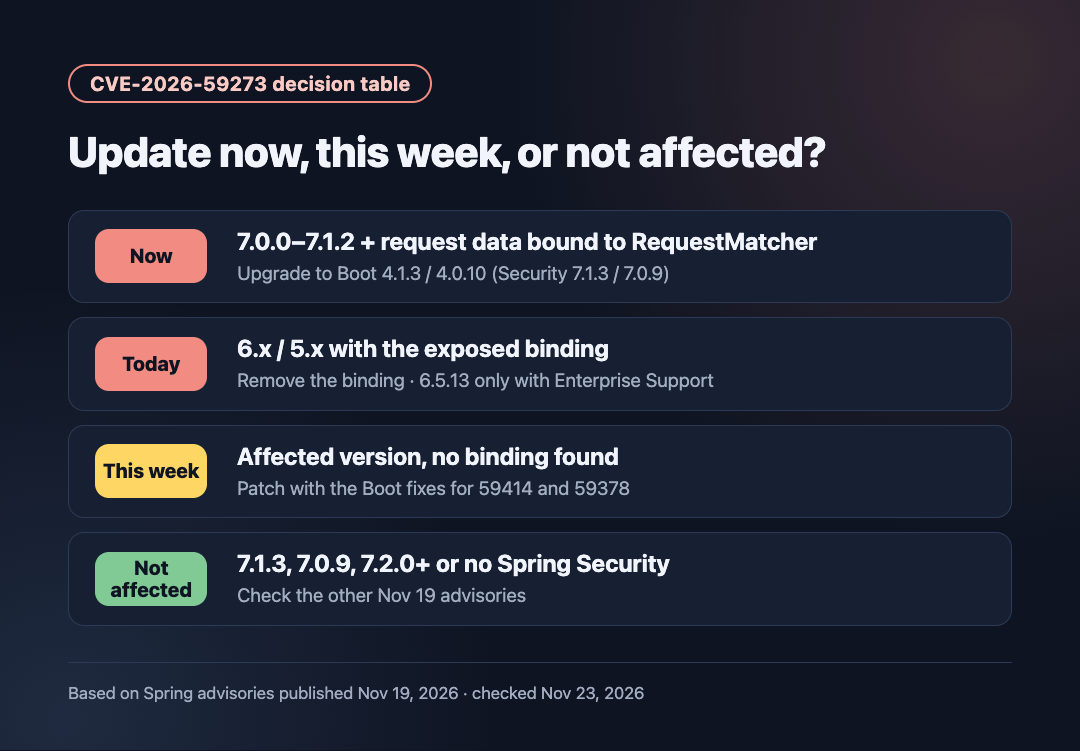
Decision table: update now, this week, or not affected
| Your setup | Action |
|---|---|
Security 7.0.0–7.1.2 and request data bound to a RequestMatcher property | Update now to 7.1.3/7.0.9 (Boot 4.1.3/4.0.10) |
| Security 7.0.0–7.1.2, no such binding found | This week, together with the Boot fixes |
| Security 6.x or 5.x (Boot 3.x/2.x) with the exposed binding | Today: remove the binding; take 6.5.13 if you have enterprise support |
| Security 6.x or 5.x, no exposed binding | This week: document the finding and plan Boot 4 migration |
| Security 7.1.3, 7.0.9, 7.2.0 or later | Not affected by CVE-2026-59273; check the other advisories |
| No Spring Security on the classpath | Not affected by this CVE |
If your stack also runs on a JDK that hasn't been patched for the Base64 decoder flaw, fix that in the same deployment window: see Java4Shell Fix: Patch CVE-2026-114938 in Docker and Linux.
FAQ
Is every app on Spring Security 7.1.2 exploitable through CVE-2026-59273? No. The advisory ties exploitation to apps that bind external input to a RequestMatcher-typed bean property. The version is still vulnerable, so patch anyway, but apps without that binding are lower urgency.
Is there a free fix for Spring Boot 3.5? Not as of November 23, 2026. The advisory lists Spring Security 6.5.13 and the Boot 3.5.18 fixes as Enterprise Support only. The free fixed lines are Spring Security 7.1.x and 7.0.x, which go with Boot 4.1 and 4.0.
Is CVE-2026-59273 being exploited? Ostorlab reported no known in-the-wild exploitation as of November 22, 2026, and the CVE was not in CISA's KEV catalog. Two public proof-of-concept repositories exist, but they show type access rather than command execution.
Does Spring Boot 4.2.0 fix it? Spring Boot 4.2.0 isn't in the affected ranges of the Boot advisories, and Ostorlab reports it pulls Spring Security 7.2.0, which contains the fix. Run the dependency check above to confirm on your build.
Is a WAF rule enough until I can upgrade? No. The official guidance is to upgrade. Blocking #{ patterns reduces noise, but removing the RequestMatcher binding is the only change that takes the exposed path away.
Next step: once Security is patched, review your @ConfigurationProperties and form objects for other types with automatic property editors. That class of bug outlives any one CVE.
References
- Spring Security advisory CVE-2026-59273 — Spring, published Nov 19, 2026, checked Nov 23, 2026
- Spring Boot advisory CVE-2026-59414 — Spring, checked Nov 23, 2026
- Spring Boot advisory CVE-2026-59378 — Spring, checked Nov 23, 2026
- Spring Framework advisory CVE-2026-59374 — Spring, checked Nov 23, 2026
- Spring security advisories list — Spring, checked Nov 23, 2026
- Spring Boot 4.1.3 available now — Spring blog, Nov 20, 2026, checked Nov 23, 2026
- Spring Boot 4.0.10 available now — Spring blog, Nov 20, 2026, checked Nov 23, 2026
- Spring Security SpEL Injection RCE, Fixed in 7.1.3 (CVE-2026-59273) — Ostorlab (third party), checked Nov 23, 2026
- Spring November 2026 Update Fixes 50 Flaws — SecurityOnline (third party), checked Nov 23, 2026