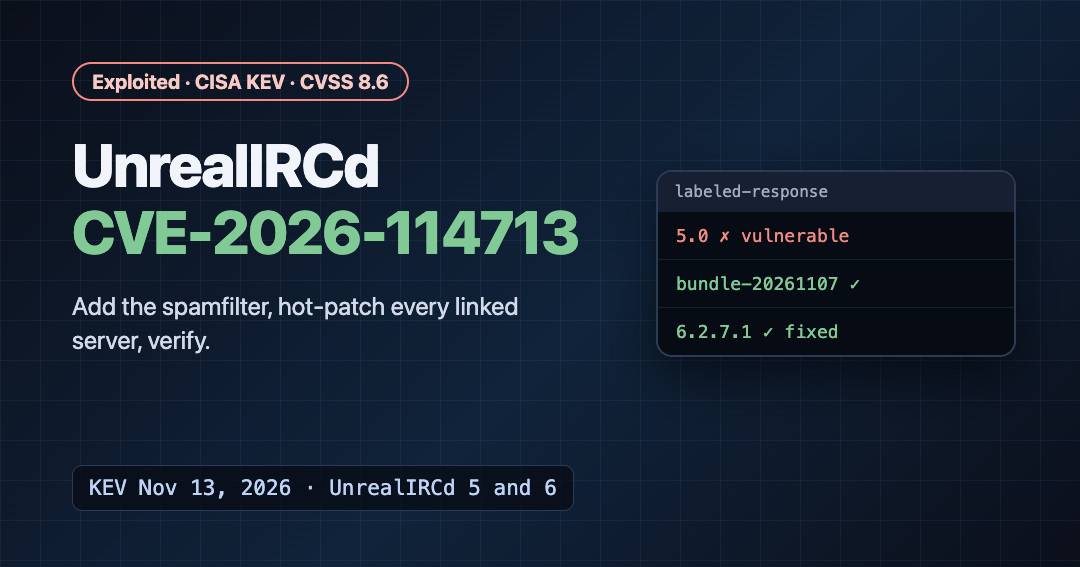
UnrealIRCd CVE-2026-114713 lets any ordinary user on a linked IRC network inject server-to-server commands and run them with server authority. It is exploited in the wild, and CISA added it to the Known Exploited Vulnerabilities catalog on November 13, 2026. Add the vendor's Invalid_label spamfilter now, then run ./unrealircd hot-patch bundle-20261107 on every 6.x server (no restart) or upgrade to UnrealIRCd 6.2.7.1. UnrealIRCd 5 gets no fix: blacklist the labeled-response module and move to 6.
Written November 16, 2026, 13:30 KST (04:30 UTC). Facts checked on November 16, 2026 against the UnrealIRCd advisory posted to oss-security on November 8, the CVE record, the CISA KEV alert of November 13, and the UnrealIRCd FAQ and upgrade docs. I have not run these commands on a live IRC network for this post. They are the commands the UnrealIRCd maintainer publishes, plus standard Linux and Windows commands for finding versions.
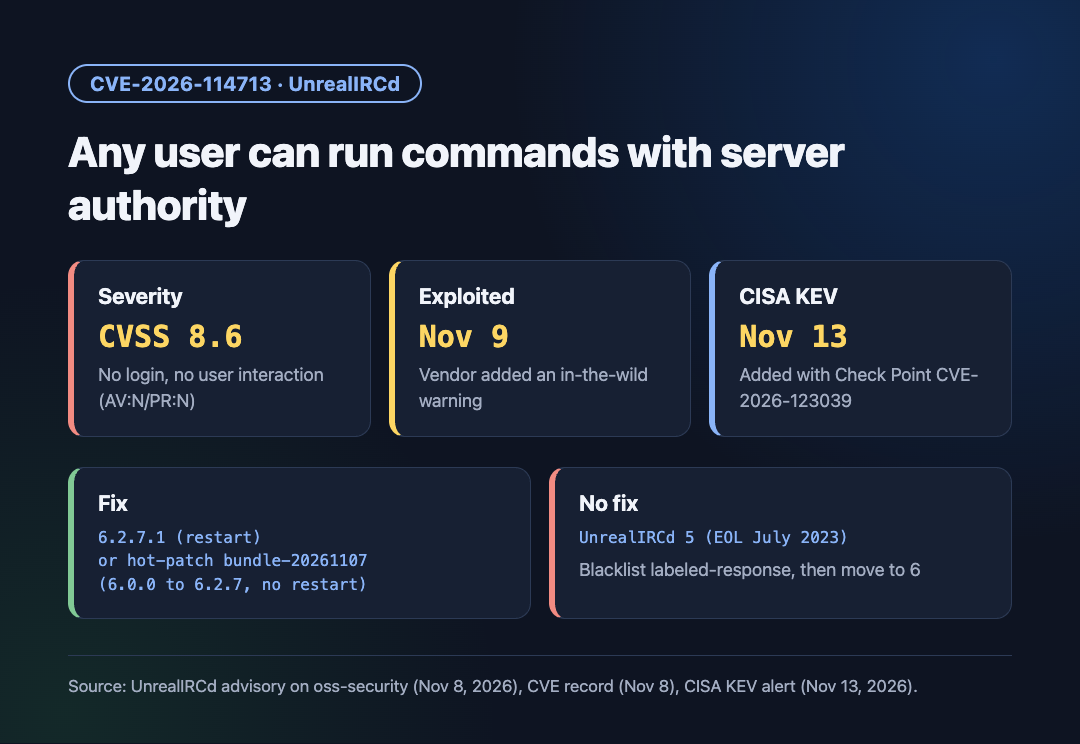
What CVE-2026-114713 changes
The bug sits in the labeled-response module, which handles the IRCv3 label message tag. When the server echoes that tag back into replies, it does not escape it. A user can slip newlines into the label, and on a network with linked servers the extra lines are read as server-to-server traffic. The maintainer calls it the most critical UnrealIRCd issue in 15 years.
| Item | Detail |
|---|---|
| CVE | CVE-2026-114713 (CWE-140) |
| Severity | CVSS 3.1 8.6, High |
| Who can attack | Any connected user, no login |
| Affected | 6.0.0 to 6.2.7, plus EOL 5.x |
| Fixed | 6.2.7.1 or hot-patch bundle-20261107 |
Timeline: the security release and hot-patch came out on November 7, the advisory and CVE on November 8, the "exploited in the wild" warning on November 9, and the KEV listing on November 13. The same patch also fixes eight other bugs, including two IP address leaks (one lets a user "decloak" others), a CHGIDENT crash, a whowasdb crash and a TLS renegotiation flood.
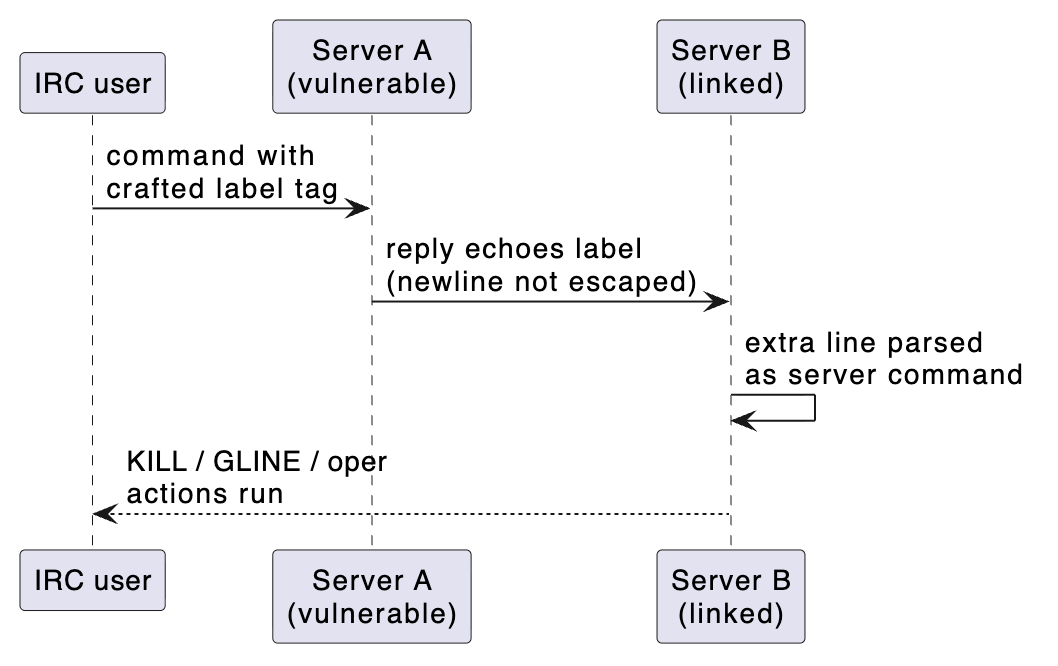
View PlantUML source
@startuml
skinparam shadowing false
skinparam defaultFontSize 14
participant "IRC user" as U
participant "Server A\n(vulnerable)" as A
participant "Server B\n(linked)" as B
U -> A : command with\ncrafted label tag
A -> B : reply echoes label\n(newline not escaped)
B -> B : extra line parsed\nas server command
B --> U : KILL / GLINE / oper\nactions run
@enduml
The CVE text says the attack needs two or more linked servers. The maintainer's advisory tells everyone on 6.0.0 to 6.2.7 to patch, so patch a single standalone server too. The hot-patch fixes the other eight bugs as well.
Check if your UnrealIRCd server is vulnerable
Run these on every server in the network, as the user that runs UnrealIRCd, from the install directory (usually ~/unrealircd).
Linux and BSD source installs
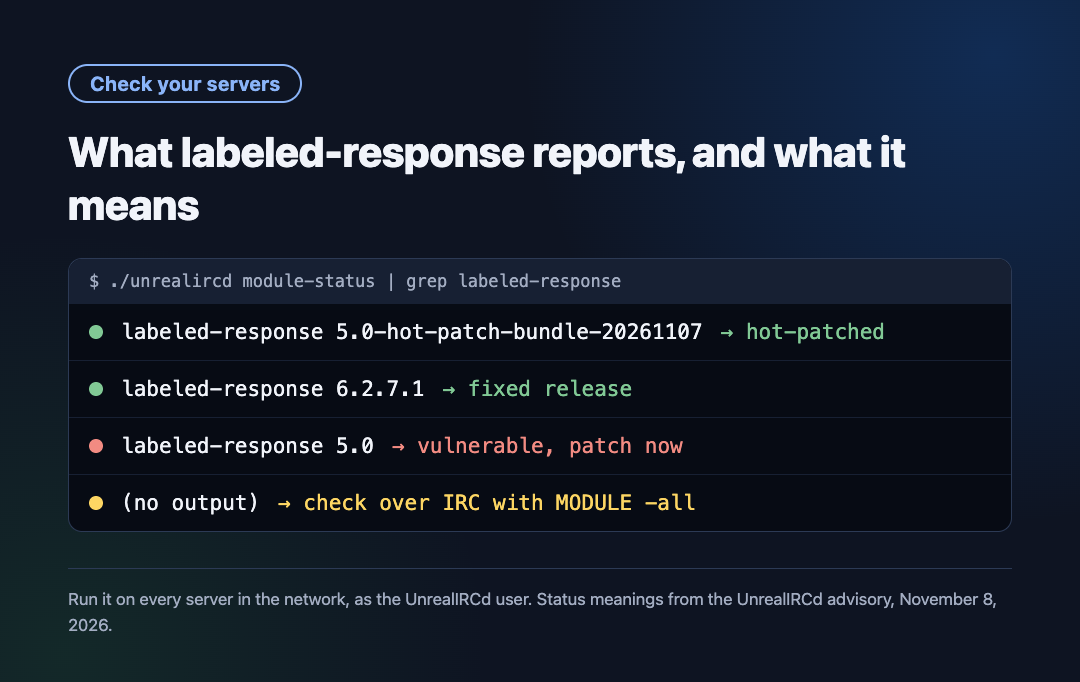
The maintainer's own check reads the version of the patched module:
cd ~/unrealircd
./unrealircd module-status | grep labeled-response| Output | Meaning |
|---|---|
labeled-response 5.0-hot-patch-bundle-20261107 | Hot-patched, safe |
labeled-response 6.2.7.1 | Fixed release, safe |
labeled-response 5.0 (no bundle) | Vulnerable, patch now |
| No output | Use the IRC check below |
The hot-patch needs the original source folder (for example ~/unrealircd-6.2.7). Check that it still exists before you pick a fix path:
ls -d ~/unrealircd-6.*/Over IRC, for the whole network
As an IRCOp, you can check remote servers without logging in to each host. These are standard IRC and UnrealIRCd commands:
/LINKS
/VERSION remote.server.name
/MODULE -all remote.server.name
/LINKS lists every server you need to cover. In the MODULE -all output, look for the labeled-response line and read it with the table above.
Windows and Alpine packages
On Windows, UnrealIRCd installs as a normal program. This PowerShell line reads the installed version from the uninstall registry keys:
Get-ItemProperty HKLM:\Software\Microsoft\Windows\CurrentVersion\Uninstall\*, HKLM:\Software\WOW6432Node\Microsoft\Windows\CurrentVersion\Uninstall\* |
  Where-Object DisplayName -like '*UnrealIRCd*' |
  Select-Object DisplayName, DisplayVersion
Anything below 6.2.7.1 needs the upgrade. Windows does not get the hot-patch path.
Alpine Linux ships its own unrealircd package. OSV lists the fix in 6.1.10-r1 on Alpine v3.24, a distro backport with a lower version number than upstream:
apk info -v unrealircdOn Alpine, trust the package release (-r1 or later on that branch), not the upstream 6.2.7.1 number. If you run a community Docker image, check its tag. A hot-patch made inside a running container is lost when the container is recreated, so rebuild or pull a fixed image.
Fix CVE-2026-114713: workaround, hot-patch or upgrade
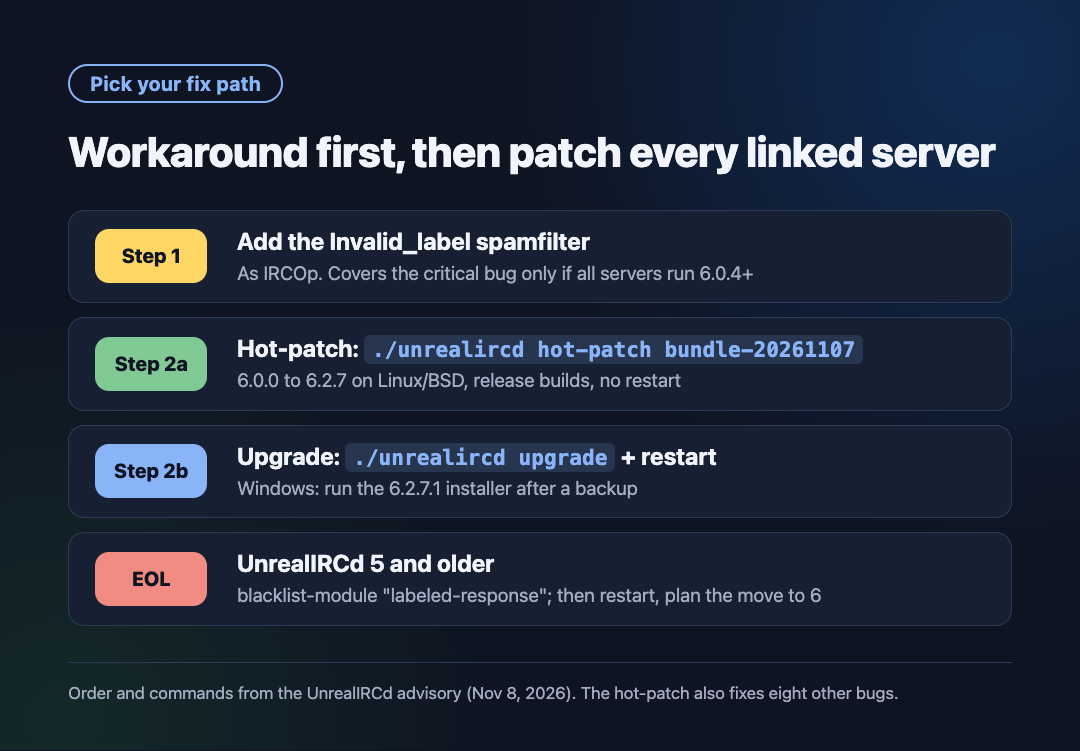
Step 1: add the spamfilter workaround now
The maintainer asks you to do this first, as an IRCOp, before patching:
SPAMFILTER add -regex T block - Invalid_label ^label=(?![^\r\n;\x20]*\z)It blocks message tags whose label contains a carriage return, newline, semicolon or space. Normal clients do not send those, so side effects should be small. The catch: it only protects against the critical bug if all linked servers run 6.0.4 or newer. It is a stopgap, not a fix.
Step 2a: hot-patch without a restart (6.0.0 to 6.2.7)
This works on Linux and BSD release builds. Users stay connected:
cd ~/unrealircd
./unrealircd hot-patch bundle-20261107
Success ends with Patch installed and server rehashed correctly. All should be good now! Older versions print Done! All should be good now. Then confirm:
./unrealircd module-status | grep labeled-responseYou should see labeled-response 5.0-hot-patch-bundle-20261107.
Step 2b: upgrade to 6.2.7.1 (restart required)
On Linux and BSD, the built-in upgrader handles 6.x to 6.y. Take a copy of the install first, because the docs do not describe a rollback:
cp -Rav ~/unrealircd ~/unrealircd.bak-20261116
cd ~/unrealircd
./unrealircd upgrade
echo "exit code: $?"| Exit code | Meaning | Next step |
|---|---|---|
| 0 | Upgrade and configtest OK | ./unrealircd restart |
| 5 | Upgrade OK, config needs edits | Fix config, then restart |
| 1 | Error | Read output, or upgrade by hand |
| 10 | No newer version | Check with module-status |
After the restart, run ./unrealircd module-status | grep labeled-response again and expect 6.2.7.1.
On Windows: stop UnrealIRCd, back up C:\Program Files\UnrealIRCd 6, run the 6.2.7.1 installer from unrealircd.org, then start the server again.
UnrealIRCd 5 and older: no patch
UnrealIRCd 5 reached end of life on July 1, 2023, and is vulnerable. Add this to the config on every server:
blacklist-module "labeled-response";Then restart. A rehash is not enough. Clients lose the IRCv3 labeled-response feature, which most users will not notice. The maintainer did not check 3.2.x or 4, and expects many of the other fixed bugs to go back to 3.2.x. Treat this as a bridge to UnrealIRCd 6, not a fix.
Should you patch now? Decision table
| Your setup | Action |
|---|---|
| 6.0.0 to 6.2.7, linked network | Now: spamfilter + hot-patch |
| 6.0.0 to 6.2.7, single server | Now: hot-patch (fixes 8 other bugs too) |
| Windows 6.x below 6.2.7.1 | Now: installer upgrade |
| 5.x or older | Now: blacklist module, plan move to 6 |
| Alpine package below 6.1.10-r1 | Today: apk upgrade unrealircd |
| 6.2.7.1 or bundle shown | No action, verify all servers |
The table is my reading of the advisory. "Now" means today: the bug is exploited, needs no login, and a single linked server left unpatched keeps the whole network exposed.
If the hot-patch or upgrade fails
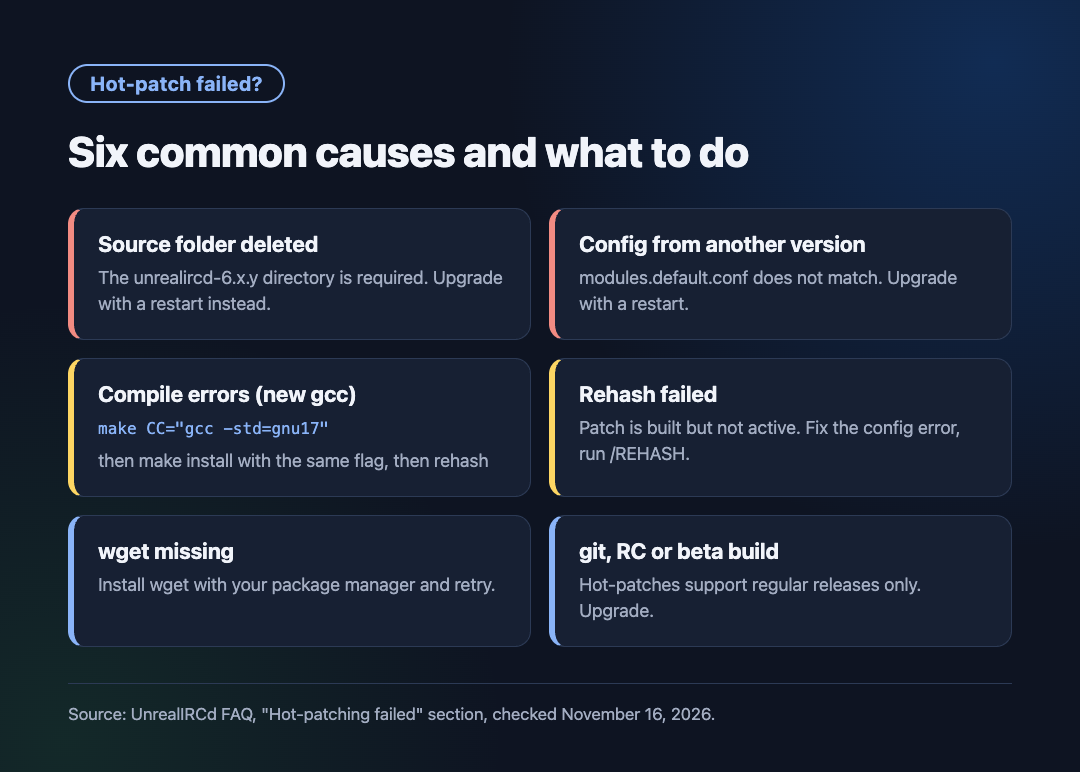
"Patch already applied. Nothing to do." but module-status still shows 5.0. The FAQ warns that this message does not prove the patch is active. On new compilers (for example gcc 15), rebuild with the older C standard, then rehash:
cd ~/unrealircd-6.2.7
make CC="gcc -std=gnu17"
make install CC="gcc -std=gnu17"
cd ~/unrealircd && ./unrealircd rehash
If that still fails, use the full upgrade.
The hot-patch compiles but the rehash fails. The patch is built but not active until a rehash works. A config error that was already there is the usual cause. Run ./unrealircd configtest, fix what it reports, then run /REHASH.
Source folder deleted, config from another version, or a git/RC/beta build. Hot-patching needs the original source folder and a matching modules.default.conf, and supports regular releases only. Use ./unrealircd upgrade and restart.
./unrealircd upgrade ends with "ERROR: Upgrade failed". Read the lines above the error. If you cannot fix them, upgrade by hand: build 6.2.7.1 from source up to make install, run ./unrealircd configtest until it prints "Configuration test passed OK", then ./unrealircd restart. Install gpgv if the script warns it cannot verify the download.
Roll back an upgrade. The docs only describe the backup step, so here is the plain approach with the copy you made: ./unrealircd stop, move ~/unrealircd aside, rename ~/unrealircd.bak-20261116 back to ~/unrealircd, then ./unrealircd start. Rolling back puts you on the vulnerable build. Keep the spamfilter in place and retry the fix soon. The docs do not cover undoing a hot-patch.
After patching: check for abuse
The advisory publishes no indicators of compromise. Exploitation gives a user operator-level actions such as KILL and GLINE, so these checks are general incident hygiene, not vendor instructions:
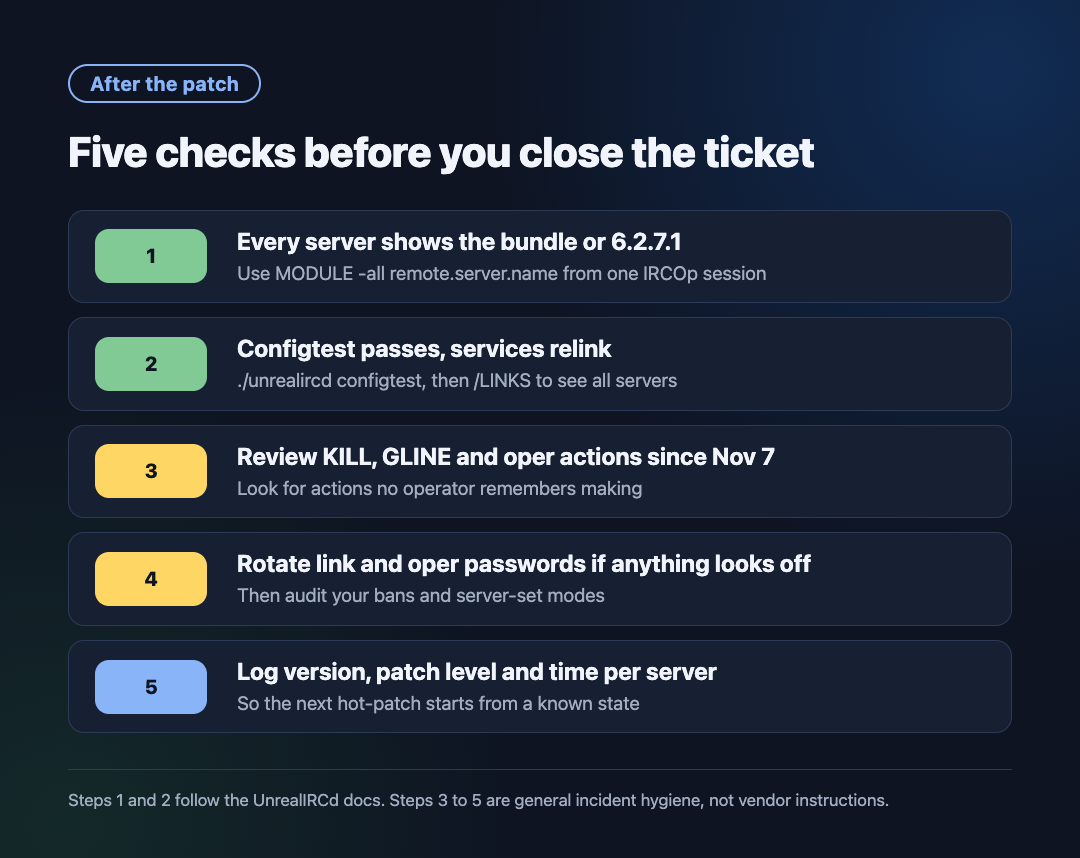
- Confirm every server from
/LINKSshows the bundle or 6.2.7.1. - Review your logs (by default under
~/unrealircd/logs/) since November 7 for KILL, GLINE or other oper actions no operator remembers making. - List active bans and remove ones nobody set on purpose.
- If anything looks wrong, rotate link passwords and oper credentials.
If you also run Check Point gateways, the other flaw in the same November 13 KEV batch is covered in CVE-2026-123039 Check Point Patch: Install the Jumbo Hotfix. For another recent exploited server-side bug with a short patch window, see OpenSSH 10.6p2: Fix the Alpine Linux Password Bypass Now.
FAQ
Is a single UnrealIRCd server with no links vulnerable to CVE-2026-114713? The CVE description needs two or more linked servers for command injection. The maintainer's advisory still tells every 6.0.0 to 6.2.7 user to patch, and the same patch fixes eight other bugs, including IP leaks and crashes. Patch anyway.
Does the hot-patch disconnect users? No. The hot-patch is built to apply without a restart. It compiles the fix and rehashes the server. The full upgrade to 6.2.7.1 does need a restart.
Can I skip patching if I add the spamfilter? No. The spamfilter only covers the critical bug, and only if all linked servers run 6.0.4 or newer. It does not fix the other eight issues.
Is there a hot-patch for Windows? The advisory lists hot-patching for *NIX only. On Windows, back up the install folder and run the 6.2.7.1 installer.
What is the CISA deadline? The CISA alert of November 13 adds CVE-2026-114713 to the KEV catalog. The due date applies to US federal agencies and is listed in the catalog entry. For everyone else, the practical deadline is now, since attacks have been reported since November 9.
References
- UnrealIRCd advisory, "UnrealIRCd 6.2.7.1 released & hot-patch (CVE-2026-114713)", oss-security, November 8, 2026: seclists.org/oss-sec/2026/q4/576 (checked November 16, 2026)
- UnrealIRCd forum advisory and updates: forums.unrealircd.org/viewtopic.php?t=9487 (listed in the CVE record, checked November 16, 2026)
- UnrealIRCd FAQ, hot-patching failed: unrealircd.org/docs/FAQ (checked November 16, 2026)
- UnrealIRCd docs, Upgrading: unrealircd.org/docs/Upgrading (checked November 16, 2026)
- CVE record CVE-2026-114713: cve.org (checked November 16, 2026)
- CISA, "CISA Adds Two Known Exploited Vulnerabilities to Catalog", November 13, 2026: cisa.gov (checked November 16, 2026)
- OSV, ALPINE-CVE-2026-114713: osv.dev (checked November 16, 2026)
- SecurityOnline, exploitation report: securityonline.info (checked November 16, 2026)